Headline
Trump pledges stronger defense ties with Philippines, eyes nuclear energy cooperation

ASM, Philippine Canadian Inquirer
November 19, 2026
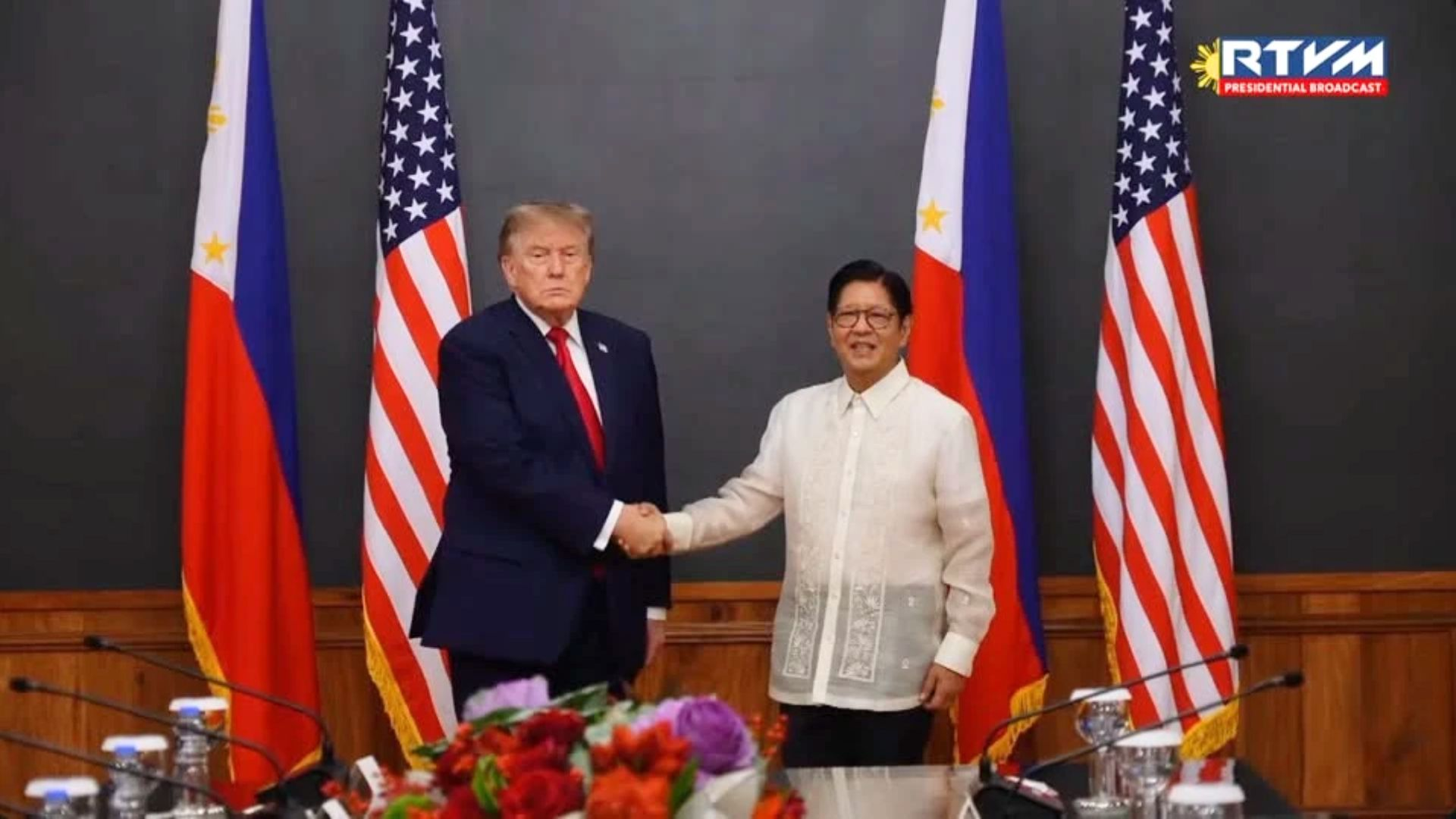
Photo courtesy: Philippine News Agency
United States President Donald Trump has pledged to expand defense cooperation with the Philippines, announcing new military financing plans and exploring a potential civilian nuclear energy partnership during talks with President Ferdinand Marcos Jr. in Manila.
The two leaders reaffirmed their countries’ longstanding alliance during their November 18 meeting at Malacañang Palace, where they discussed security, energy, technology and economic cooperation.
Trump said Washington was strengthening its military support for Manila, citing more than $5 billion in arms sales approved since he took office.
He described defense cooperation as an important part of maintaining security in the region.
US announces new defense financing plans
The White House outlined several defense initiatives following Trump’s visit, including a proposed Foreign Military Financing loan package worth more than $2 billion.
The financing is intended to help the Philippines acquire defense and security equipment from American suppliers.
Washington also announced plans to use $400 million in military financing to improve Philippine defense capabilities in the South China Sea.
The funding will support long-range weapons systems, command and control capabilities, critical infrastructure and drones, according to a White House statement released on November 18.
The announcements come as the Philippines continues efforts to modernize its armed forces and strengthen its ability to protect its maritime interests.
The White House also disclosed a $37 million Philippine Department of National Defense contract with a U.S. company for technology-based military support.
Another $63 million initiative is planned to modernize the department’s defense cloud infrastructure.
These projects are intended to improve military coordination, secure information systems and cooperation between the two countries’ armed forces.
Trump downplays concerns over West Philippine Sea tensions
Despite the expanded defense commitments, Trump said he was not worried about tensions in the West Philippine Sea.
Asked about China’s activities in disputed waters and the United States’ readiness to respond under its defense treaty with the Philippines, Trump expressed confidence that the situation would be addressed.
“I’m not concerned about that at all. That’ll be taken care of,” he told reporters.
He did not explain what specific measures Washington would take if tensions escalated.
The Philippines and China have repeatedly confronted each other in parts of the South China Sea, including waters near Scarborough Shoal.
China claims sovereignty over most of the South China Sea, overlapping with maritime areas where the Philippines asserts sovereign rights under international law.
The two countries have been involved in encounters involving coast guard vessels and other ships, raising concerns about maritime security.
The Philippines and the United States are bound by the 1951 Mutual Defense Treaty, which commits both countries to act against common dangers following an armed attack in the Pacific, subject to their constitutional processes.
Marcos emphasized the significance of that relationship, describing the United States as the Philippines’ only treaty ally.
Philippines and US explore nuclear energy project
Beyond defense, Trump raised the possibility of American involvement in a major civilian nuclear energy project in the Philippines.
He said U.S. nuclear technology could help the country expand its energy supply while strengthening economic ties between the two allies.
The White House subsequently confirmed that both governments had agreed to explore an intergovernmental agreement on civilian nuclear technology.
Such an arrangement could create opportunities for American nuclear companies and support future power generation in the Philippines.
However, the announcement does not mean that construction of a nuclear power plant has been approved or that a final project agreement has been signed.
The two countries are still exploring the proposed partnership.
Trump also identified the Philippines as a potential buyer of American natural gas from a planned export project in Alaska.
He said the country could become an important partner as Washington seeks to expand energy exports to markets across the Pacific.
Alliance expands beyond military cooperation
Marcos and Trump also discussed investments and infrastructure projects aimed at strengthening economic ties.
The White House announced plans to modernize Basco Airport in Batanes to improve operational access, disaster response and commercial supply chains.
It also identified a planned $40 million fuel storage facility at Subic Bay that would support military and commercial operations.
Both projects form part of broader efforts to improve transportation, logistics and security cooperation between the countries.
During their meeting, Marcos highlighted the Philippines’ long history of cooperation with the United States, noting that the two countries are marking 80 years of diplomatic relations and 75 years of their defense alliance in 2026.
Trump concluded his two-day visit to Manila on November 18 before traveling to Shenzhen, China, for the Asia-Pacific Economic Cooperation summit.
Among the commitments announced during his Philippine visit were the proposed defense financing package, the $400 million allocation for military capabilities and exploratory talks on civilian nuclear technology, with implementation depending on the terms and progress of each initiative.