Headline
South Korea tightens college entrance exam security after AI cheating scandal, warns of 10-year ban

ASM, Philippine Canadian Inquirer
November 18, 2026
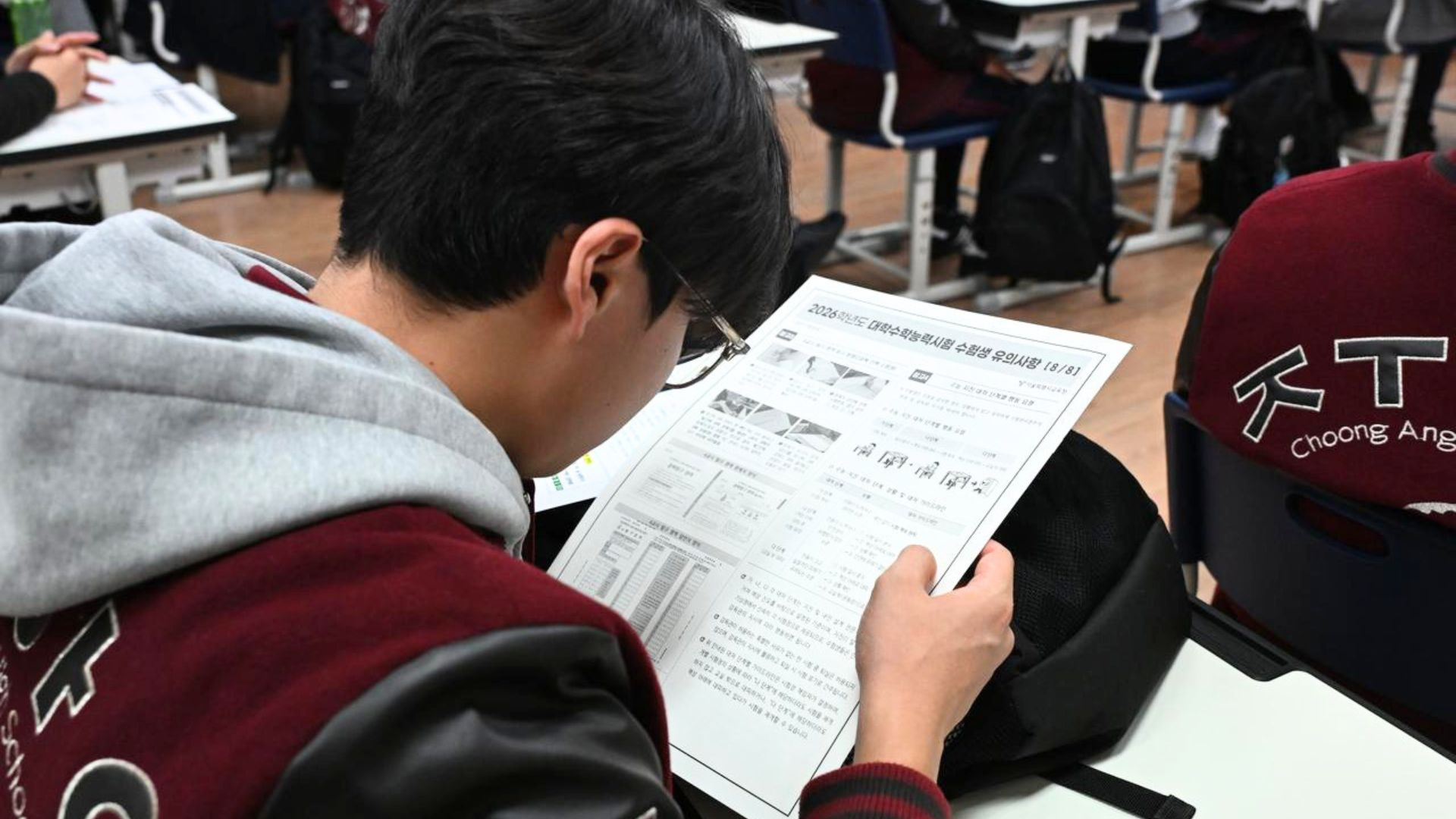
Photo courtesy: The Korea Herald
South Korea is tightening security for its nationwide college entrance examination after a high-profile cheating scandal involving artificial intelligence (AI), with authorities deploying thousands of additional personnel, inspecting students for concealed electronic devices and pursuing tougher penalties for violations.
More than 550,000 students are expected to take the College Scholastic Ability Test (CSAT), known locally as the Suneung, on November 19, 2026. The annual examination plays a major role in determining university admission opportunities in one of Asia’s most competitive education systems.
Prime Minister Han Seong-sook announced the emergency security measures on November 17, following a confession by the top scorer of a national tax accountant examination that he had used AI and concealed electronic devices to obtain answers.
The incident triggered widespread concerns about whether increasingly sophisticated technology could undermine the fairness of one of South Korea’s most important examinations.
Thousands of additional personnel deployed
The government is assigning approximately 8,400 additional personnel to reinforce security at 1,312 testing centres nationwide.
They will join around 75,000 existing examination supervisors, bringing the total number of personnel involved in monitoring the examination to approximately 83,400.
The additional deployment includes about 1,800 personnel responsible for detecting prohibited smart devices and 6,600 supervisors assigned to hallways and other areas outside examination rooms.
Authorities are particularly concerned about miniature cameras, smart glasses, smartphones and other devices capable of capturing examination questions and transmitting them to AI systems for answers.
Students will be required to surrender prohibited electronic devices before the examination begins. Possessing an unauthorized device during the test may be treated as cheating even if the student does not use it.
Supervisors will also inspect eyeglasses to determine whether they contain cameras or other smart technology.
Students may be instructed to roll up their sleeves, while clothing collars and buttons will be examined for concealed devices. Officials will cover buttons with stickers as an additional precaution against hidden cameras.
An emergency phone alert will be issued before the examination to help identify mobile phones that students may have failed to surrender.
Authorities are also implementing measures to restrict unauthorized Wi-Fi communication near examination sites, reducing opportunities for students to receive outside assistance.
AI cheating confession sparks nationwide concern
The heightened security follows a confession made on November 15 by the highest-scoring candidate in South Korea’s certified tax accountant examination.
The individual admitted using a miniature camera to photograph test questions, a smartphone to access the images and generative AI technology to obtain answers.
According to the admission, the same method was used during both stages of the examination.
The candidate reportedly answered 159 out of 160 questions correctly in the first stage and subsequently achieved another unusually high score.
He also admitted using similar methods during a certified public accountant examination.
The case, which is under police investigation, raised concerns that technology-assisted cheating may have gone undetected in other professional and national qualification examinations.
South Korean authorities have since initiated broader efforts to examine suspected AI-related misconduct in government-administered tests.
Government seeks tougher penalties for cheating
The government is pursuing a substantial increase in penalties for students caught cheating during the Suneung.
Under the announced measures, offenders could face a 10-year prohibition on retaking the examination, compared with the existing one-year restriction.
Serious violations involving smart devices could also result in criminal complaints or police investigations.
Authorities intend to continue examining suspected misconduct after the examination has ended, rather than limiting investigations to incidents detected inside testing centres.
Students found to have secured university admission through cheating could have their admission revoked. Those already enrolled could also face expulsion if their admission was obtained fraudulently.
The proposed penalties represent a significant escalation in South Korea’s efforts to discourage technology-assisted examination fraud.
President Lee demands strict enforcement
South Korean President Lee Jae Myung has called for a zero-tolerance response to examination cheating, emphasizing the importance of maintaining public confidence in the education system.
Lee chaired an emergency meeting on November 17 through a video conference from Manila, Philippines, where he was attending ASEAN-related diplomatic engagements.
During the meeting, the president directed officials to strengthen preventive measures and thoroughly investigate suspected cheating, including cases discovered after the examination.
He warned that cheating threatens the principle of fair competition and the credibility of the national testing system.
Lee also instructed authorities to make the consequences of cheating widely known before students enter examination centres.
Student challenges decision to proceed with exam
The government’s preparations have also faced a legal challenge.
An 18-year-old high school student, identified as Ahn Min-jun, filed a constitutional complaint on November 17, arguing that proceeding with the examination without sufficient safeguards against advanced cheating methods could undermine students’ right to fair competition.
The student also sought an injunction that would suspend the scheduled examination date while the Constitutional Court considers the complaint.
Education authorities have maintained that the test should proceed on November 19 despite calls for postponement.
Officials have cited practical concerns, including the distribution of examination papers and the logistical complications that could arise from rescheduling the nationwide test at short notice.
No ruling suspending the examination had been confirmed in the reports reviewed as of November 18.
Why the Suneung matters in South Korea
The Suneung is among South Korea’s most consequential academic examinations, influencing admission to leading universities and, for many students, their future employment opportunities.
The examination is held once a year, and the country traditionally makes extensive adjustments to reduce disruptions while students take the test.
Businesses, public transportation services and other institutions may adjust their schedules to help students reach examination centres and complete their assessments without unnecessary distractions.
The pressure surrounding the test has made examination fairness a particularly sensitive issue, as students and families often spend years preparing for the results.
This year’s examination will proceed with additional security personnel, tighter inspections and enhanced monitoring of electronic devices.
The government’s announced 10-year ban and other severe penalties remain part of its strengthened enforcement plans, while the examination itself is scheduled to begin on November 19 at 1,312 centres nationwide.