
Canada News
Ottawa is counting on copper to be a nation builder — and Canada has to play catch-up

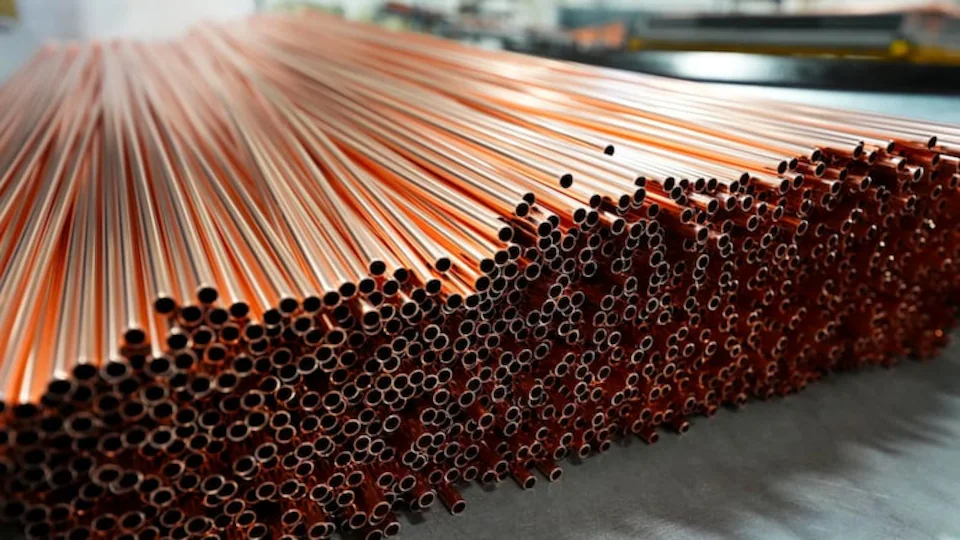
Copper tubing is stacked at Cancoil, a manufacturer of commercial refrigeration products, during a news conference in Kingston, Ont., on April 3. Ottawa’s list of fast-tracked ‘nation-building’ projects includes the development of two Canadian copper mines. (Sean Kilpatrick/The Canadian Press)
PHOTO: (SEAN KILPATRICK/THE CANADIAN PRESS)
By RCI, CBC News
One of world’s most important metals faces supply challenges amid high demand.
Ottawa’s list of fast-tracked nation-building
projects includes (new window) the development of two copper mines — to source one of the world’s most important natural resources as global demand soars and supply challenges persist.
Such projects must strengthen Canada’s autonomy, our resilience and our security. It must have clear benefits for Canadians,
said Prime Minister Mark Carney during the Thursday announcement.
Enter copper, the world’s third-most widely used metal and a conduit for all things electrical. The federal government is recommending regulatory approval for the McIlvenna Bay Foran Copper Mine Project (new window) in Saskatchewan, and an expansion (new window) of the Red Chris Mine in northwestern B.C.
The critical mineral is used to build electric vehicles and other green energy products. But demand is skyrocketing (new window) amid the global boom of data centres, which house the hardware (new window) that powers artificial intelligence.
Canada is a major mining power, and copper is one of the most important natural resources of this century,
said Vince Beiser, the Vancouver-based author of Power Metal: The Race for the Resources That Will Shape the Future.
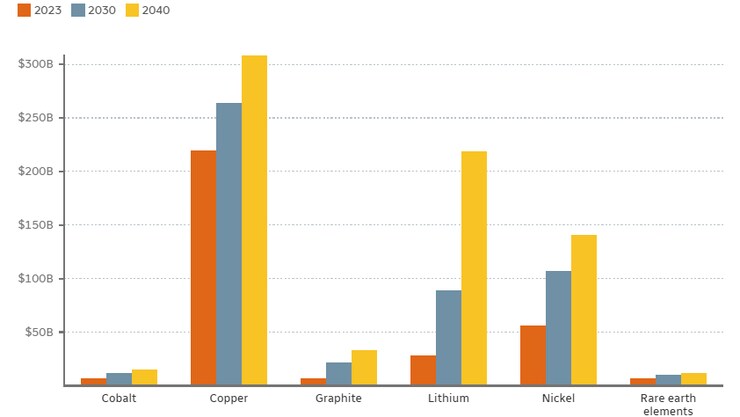
Expected market value of key energy transition minerals, in U.S. dollars.
PHOTO: GOVERNMENT OF CANADA (CBC)
All of our digital gadgets need electricity. How does electricity travel? How does it get from the dam or the solar power farm to your home? It travels on copper,
he said.
Canada is home to copper mines, refineries and a smelter. But the country has fallen behind on producing and exporting copper over the last decade, and even the accelerated projects might be too little too late, according to experts who spoke with CBC News.
A small piece of the pie
The metal is one of the chess pieces caught in the crossfire of the U.S.-China trade war. While copper prices have been rising over the last several years, they spiked and stayed elevated earlier this summer (new window) when the Trump administration threatened a tariff on raw copper.
Eventually, it instead imposed a 50 per cent levy (new window) on semi-finished copper products — sparing countries like Canada from the worst of the damage, but hitting Chinese refiners that account for roughly half (new window) of the world’s copper-smelting capacity.
At least one federal official has pointed to Chinese dominance of the copper market as reason why Ottawa is trying to accelerate its metal production.
Natural Resources Minister Tim Hodgson says Canada has a role to play in copper production as a democratic country,
and accuses Beijing of manipulating copper prices.
We have an opportunity to take the cards out of autocrats’ hands and put those cards in Canada’s hand,
Hodgson said Thursday on CBC Radio, arguing that others
are using copper as a tool of coercion.
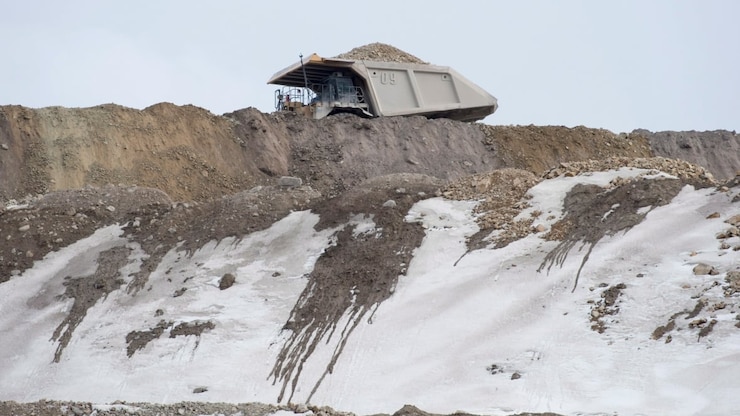
Teck’s Highland Valley copper mine is pictured in the B.C. Interior on March 26, 2017. (Jonathan Hayward/The Canadian Press)
PHOTO: (JONATHAN HAYWARD/THE CANADIAN PRESS)
Though China has a stranglehold
on rare-earth minerals, it doesn’t have quite as commanding a position
with copper, despite its strength in processing and refining, according to Beiser.
This is another reason why I think it does make sense for Canada to try to strengthen their hand in this particular realm because, hey, we’ve got copper, we’ve got copper mines. We also have copper refineries,
he said.
Supply challenges
However, Canada is a relatively small piece of the global copper puzzle, making up just two per cent of global production, according to Dennis da Silva, a senior portfolio manager at Middlefield who analyzes the metals and mining sectors.
Globally speaking, most of the growth that could come in the copper space, in fact, is outside of Canada,
said da Silva, adding that the federal government has targeted perhaps the only relevant projects for Canada that could be built.
Recently, several Canadian mining companies have prioritized copper over other commodities. Barrick Mining, formerly known as Barrick Gold, recently sold its last gold mine in Canada for $1.1 billion as it shifts its focus to its copper portfolio.
That push was led by Barrick CEO Mark Bristow, who projected earlier this year (new window) that about 30 per cent of the company’s production will be copper — roughly equivalent to the increase it expects for its gold portfolio.
Meanwhile, the news that the U.K. mining multinational Anglo American plans to acquire (new window) the Canadian mining company Teck Resources for its copper operations rippled through the industry earlier this week.
The deal, subject to shareholder and regulatory approval, would be one of the biggest mining mergers in the sector’s history, and according to da Silva, highlights the dearth of shovel-ready projects
in the supply-challenged copper sector.
Production has declined ‘significantly’
Copper production in Canada has declined quite significantly
over the last few decades, according to Photinie Koutsavlis, vice-president of economic affairs and climate change at the Mining Association of Canada.
Between 2014 and 2023, it dropped by more than 22 per cent (new window), according to data from Natural Resources Canada. Over the same period, copper exports declined by roughly 24 per cent, says Statistics Canada.
We’ve definitely lost our footing in our global rankings on copper,
Koutsavlis said. Hopefully these projects are a good start at reversing that trend.
The U.S. makes up about five per cent of global copper production, while Chile is the world’s biggest producer at 30 per cent. Canada could potentially make up seven to eight per cent of production over the next 20 years, according to da Silva.
But Canada would have needed to kind of start putting these things on the drawing board probably five years ago in order to properly match the expectations for demand,
he said.
You can imagine how long it takes to find it, prove it out, justify the economics, and then ultimately build it, turn on the switch and bring it into production.
Jenna Benchetrit (new window) · CBC News
This article is republished from RCI.




















