Business and Economy
Can a non-corporate grocery chain work across Canada?

By Frances Willick, CBC News, RCI
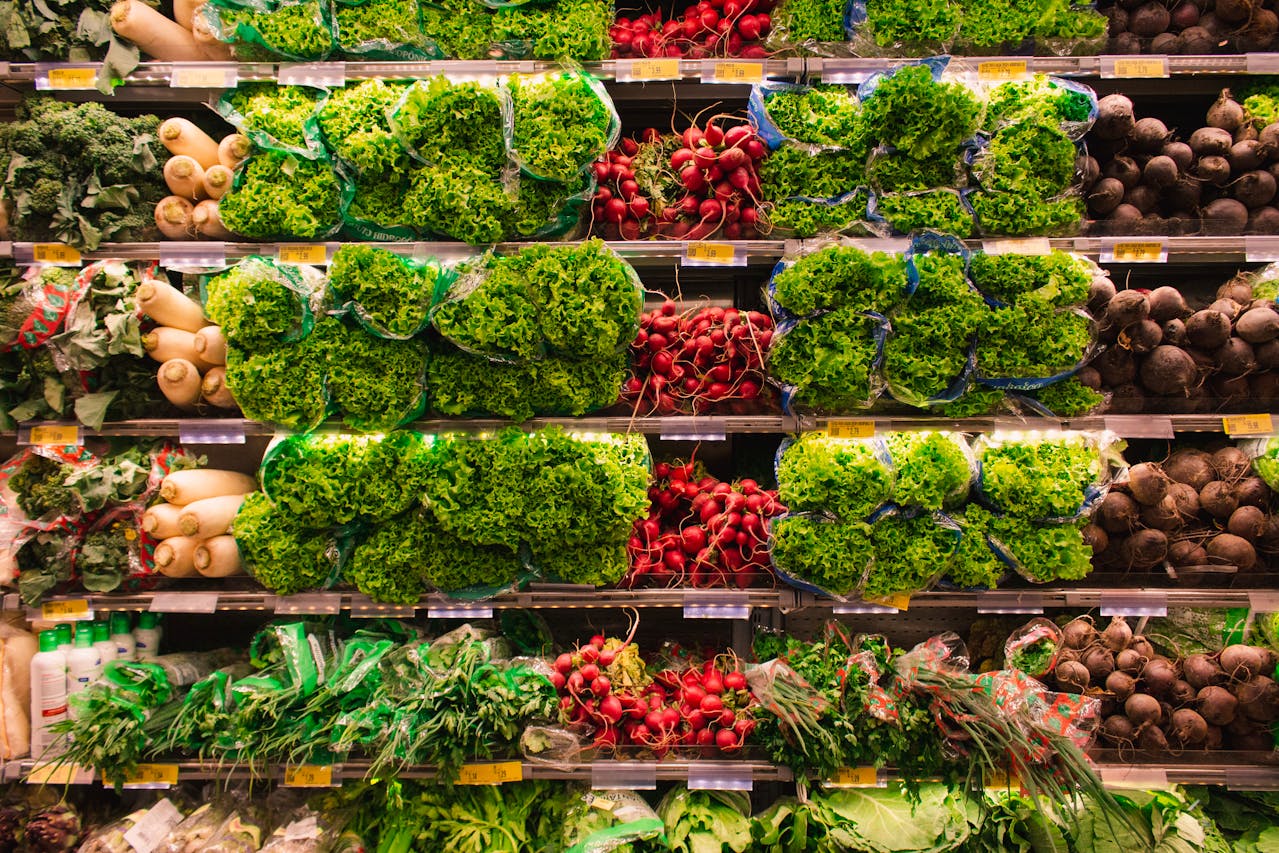
Just five companies control 76 per cent of the Canadian grocery market share: Loblaw, Sobeys, Metro, Costco and Walmart. (Pexels Photo)
Building nationwide chain of non-corporate grocers would be ‘difficult and painful process’.
As food prices continue to rise and Canadians raise concerns about practices at large retailers, some shoppers may be wondering if there’s an alternative to Big Grocery.
The cost of food has skyrocketed in the last few years, with Statistics Canada reporting that as of July 2025, Canadians were paying 27.1 per cent more than they were in July 2020.
Meanwhile, Canada’s top three grocers continue to make profits — $3.6 billion in 2022 on more than $100 billion in sales.
In many parts of the country, alternatives are scarce, and the big players dominate the market. Just five companies control 76 per cent of the Canadian grocery market share: Loblaw, Sobeys, Metro, Costco and Walmart.
Consumer concerns go beyond price tags, with questions raised about labelling, weighing practices, price discrimination, anti-competitive conduct and security at some of the country’s biggest chains.
But is another world possible? Some say yes.
There are already examples in Canada of other food retailing models, including co-ops, non-profits, sliding-scale stores and farmers’ markets. In the U.S., New York mayoral candidate Zohran Mamdami has even mused about opening city-owned grocery stores to provide cheaper options to those living in food deserts.
‘A different feeling’
Spencer Osberg has already largely shunned large grocers and found his food Shangri-La.
The Grainery is a small co-op in Halifax that offers bulk, package-free, locally sourced, mostly organic food to its members and customers and is run by volunteers like Osberg.
Osberg says before he started shopping at The Grainery, he thought the high prices in regular grocery stores were just a factor of life that I had to live with.
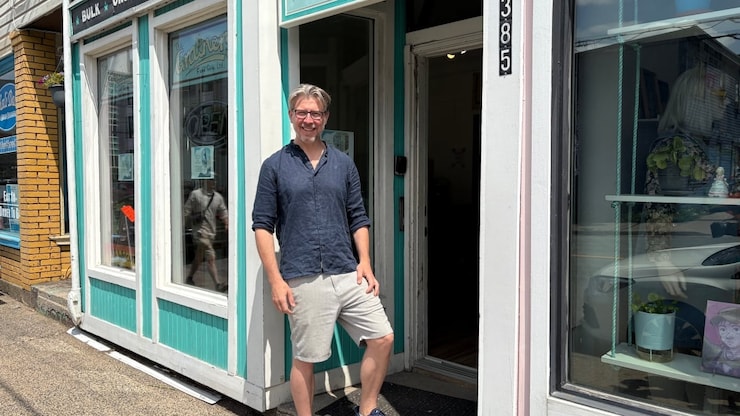
Spencer Osberg is a volunteer with The Grainery, a food co-op in Halifax that just celebrated its 25th anniversary. (Frances Willick/CBC) Photo: (Frances Willick/CBC)
Since working at The Grainery, it’s become clear that those prices are excessive and unnecessary, and it’s actually infuriating to go into the grocery store to see how much more the stores are charging than they need to,
he says.
Osberg says at The Grainery, organic quinoa, for instance, costs about half of what’s charged in the large stores, and steel-cut oats are about a third of the price.
And for Osberg, membership has other benefits, too.
It’s a different feeling when you come into the store than when you go to Sobeys or Superstore and there’s security guards watching you, there’s cameras everywhere, there’s bad music playing, there’s terrible lighting,
he says. Everyone’s just kind of pushing their way through to get to the line and has other things on their mind.
He says at The Grainery, there’s a nicer vibe, people get to know each other, and the money spent stays in the community.
You don’t have to be supporting the Westons buying another Rolex or another BMW,
he says, referring to the multibillionaire family behind Loblaw.
Breaking into sector an uphill battle
Breaking into Canada’s food retailing sector is tough, according to a 2023 Competition Bureau of Canada report called Canada Needs More Grocery Competition. The ongoing concentration of ownership in the industry makes it hard for new businesses to compete effectively, and the big players are already entrenched in the shopping habits of Canadians.
Although there are about 6,900 independent grocery stores in Canada, even the biggest independents face challenges trying to compete against the grocery giants,
the report says.
Smaller, independent grocery stores and co-ops can find success through specialization or location, says Mike von Massow, a professor of food, agricultural and resource economics at the University of Guelph.
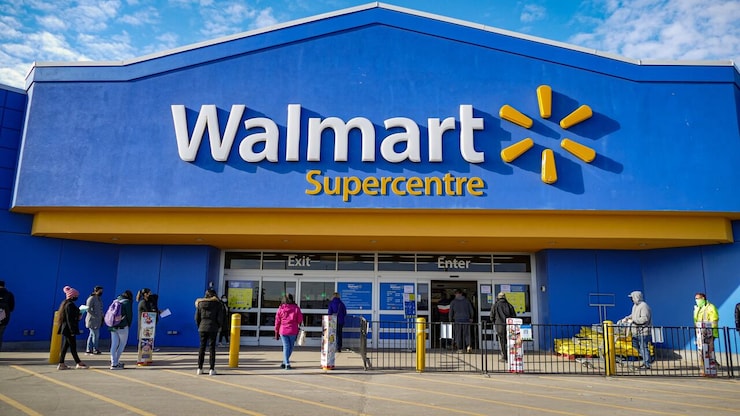
Five companies — Loblaw, Sobeys, Metro, Costco and Walmart — control about 76 per cent of the grocery market in Canada. Photo: CBC / Lyzaville Sale
For instance, a focus on local or organic food, or having a downtown location where people shop for convenience, can help a store carve out a niche clientele.
But can alternative models work on a broader scale, such as a national chain of non-corporate stores?
Von Massow says that’s possible, but difficult.
“Large grocery stores are very much like an iceberg. The retail portion of it is what we see above the water, and it’s that huge infrastructure underneath that really differentiates those big stores.“
Von Massow says the bricks and mortar of building a grocery store are the easy parts. It’s sourcing the products, buying them and distributing them cost-effectively that are the challenge for new or smaller enterprises.
It becomes a profoundly difficult thing to scale that infrastructure in a way that allows you to scale growth in the retail sector,
he says. So can it work? I think it could, but it would be a very difficult and painful process to get established and to grow.
Co-ops have small share of Canadian market
Co-ops had just four per cent of the market share in Canada in 2020.
A chain of co-operative stores does exist in Western Canada — Federated Co-operatives Limited, which are owned by their members, and where profits are returned to the community. However, with one exception, the co-op stops abruptly at the Ontario border.
Von Massow says once again, it’s that pesky distribution issue that would be the challenge to expansion.
That jump across Lake Superior and then down into southwestern Ontario would be more difficult because not only would you have to build stores, you would then have to expand your distribution infrastructure.
Other individual Co-op-branded stores do exist elsewhere in Canada, but are not part of Federated Co-operatives Ltd., and some of them rely on larger retail chains’ wholesale networks.
Arctic Co-operatives Ltd. is another co-op that is owned by more than 30 independent community co-op stores across the North, and the company’s shareholders are its customers.
While some consumers may seek alternatives to grocery corporations for ideological reasons or because it’s the only game in town, Von Massow — whose independent grocer called during an interview with CBC News to say his custom-made sausage was ready for pickup — says ultimately, many people just want low prices and will shop wherever they get the best deals.
So is there an appetite for looking elsewhere? Yes, but only if elsewhere can give them the cheap groceries that they’re looking for.
People are looking for alternatives
Jon Steinman is the owner of a grocery store in Nelson, B.C. — well, one of about 18,000 members who effectively own the co-operative store there.
The author of Grocery Story: the Promise of Food Co-ops in the Age of Grocery Giants is a member of the Kootenay Co-op, where the profits are recirculated into the business, and any profits beyond that are redistributed to members through credits.
In a way, it’s as if the grocery store is saying to its customers, ‘Hey, we looked at our financials at the end of the year and it appears we charged you a little too much and we’d like to apologize and return some of those profits back to you,’
he says.
Steinman says some co-ops are price competitive with mainstream grocers, but that’s not necessarily the case, or the point.
People are more and more looking for those alternatives,
he says, pointing to boycotts on products and stores in recent years.
I think this might be an opportunity for Canadians to say, OK, you know, we want to have more power in our grocery shopping experience. Does it have to stop at what we choose to buy?
Steinman says it’s possible that co-ops can bring general food prices down in the long term, just as the organic food co-ops of the ’70s helped organics go mainstream and reduce prices over time.
Surviving ‘against all odds’
Back in Halifax, Osberg says The Grainery isn’t without its inconveniences and challenges.
The store is open odd hours and sometimes runs out of products. Sometimes it’s difficult to fill volunteer shifts, and the store doesn’t have a huge bank of savings in case something catastrophic happens.
But for naysayers who doubt the potential longevity of an enterprise like The Grainery, Osberg points to the store’s recent 25th anniversary celebration.
The fact that we’ve been here for 25 years against all odds, I think is proof in the pudding that it is possible and that an expansion of this model across Halifax, Nova Scotia, Canada, would benefit everyone and provide that alternative that everyone now is looking for to the corporate-controlled grocery system.
This article is republished from RCI.