

By Ian Hall, Griffith University, The Conversation
Just months into President Donald Trump’s second term in office, one of the United States’ most important strategic partnerships is in crisis.
Relations between the US and India are at their lowest ebb in a quarter of a century. Things are so bad that Indian Prime Minister Narendra Modi has reportedly refused to accept calls from Trump for more than two months.
In recent days, Trump labelled trade ties with India a “totally one-sided disaster” and a report emerged that he is no longer planning to visit India later this year for a summit of the Quad partners (India, the US, Australia and Japan).
So bad, so quickly
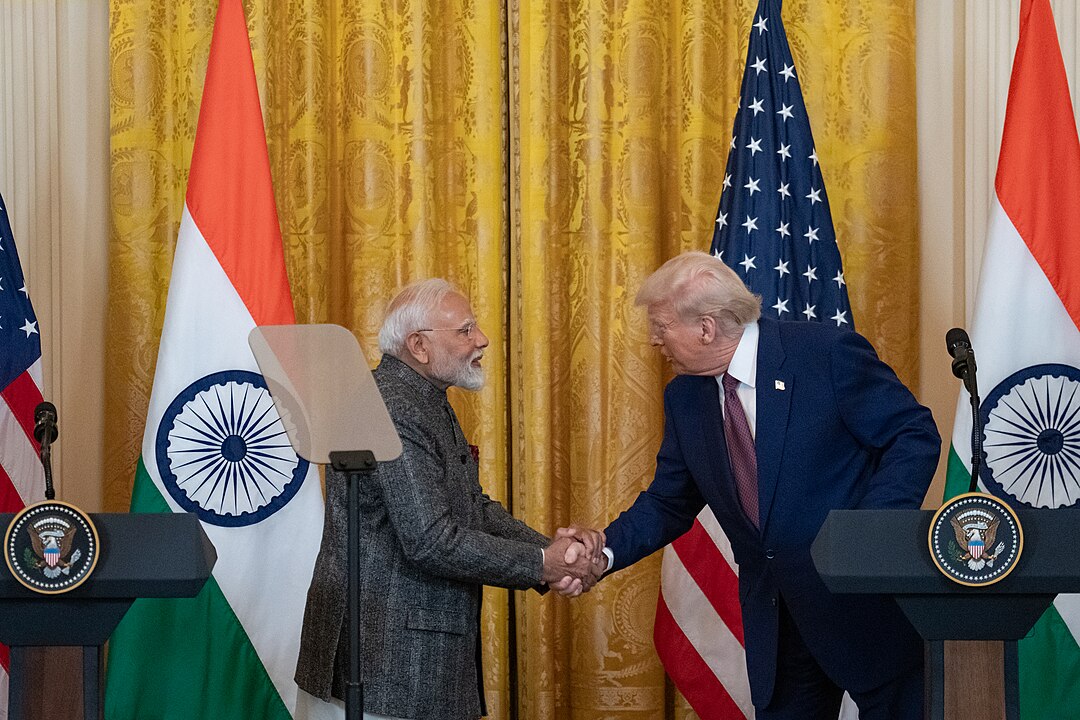
Things were not meant to happen this way. Many in New Delhi were delighted when Trump won the election last year. Modi congratulated his “friend” on X, along with pictures of the two embracing and holding hands.
India’s foreign minister, S. Jaishankar, told journalists that while other countries might be “nervous” about Trump’s return, India was not.
Feeling confident, Modi went to Washington to meet Trump days after his return to office. The encounter did not go well.
On the eve of the meeting, Modi was embarrassed by distressing images of Indian nationals, handcuffed and shackled, being deported from the US on a military aircraft.
In the Oval Office, he promised to buy more US arms, oil and gas, and asked that Trump not impose punitive tariffs on India. Modi failed to get that commitment.
A few weeks later, Trump announced India would be hit with a 27% tariff – far higher than the 10% imposed on China – unless it could negotiate something better.
Crisis in Kashmir
Begrudgingly, New Delhi began to talk trade. US Vice President JD Vance visited India in late April and both sides made positive noises about a deal. But while Vance was in town, India was engulfed in a new crisis.
On April 22, terrorists killed 26 people – mostly Hindu tourists – in Kashmir, long the site of simmering conflict between India and Pakistan. The Modi government pledged to respond with force, as it had done in the past after similar incidents.
On May 7, India bombed what it claimed were militant camps in Pakistan and Pakistan-administered Kashmir. A rapidly escalating, unpredictable conflict followed, as both sides used drones and missiles to attack one another.
Alarmed, governments around the world urged the two nuclear-armed states to end hostilities before matters got out of control. Early in the morning on May 10, they did, and agreed to a ceasefire.
Trump anoints himself peacemaker
Before either the Indian or Pakistani governments had a chance to say anything, Trump stepped in to take credit.
On social media, he announced both sides had agreed a deal. The next day he claimed they would soon sit down with him as mediator and find a solution to the Kashmir conflict.
Islamabad was jubilant at this outcome. New Delhi, meanwhile, was furious.
India’s longstanding view is that the Kashmir dispute must be settled bilaterally, without third-party involvement. The US has accepted this position for more than 20 years. Now it appeared Trump was taking a different view.
This put Modi in a bind. Keen to maintain a mutually beneficial partnership and avoid punitive tariffs, he did not wish to upset Trump.
But he could not acknowledge Trump’s claims without setting aside a fundamental principle of Indian policy. So, Modi called Washington and explained he would not accept mediation over Kashmir.
The final straw
Meanwhile, Pakistan saw an opportunity to win favour in Washington and drive a wedge between the US and India.
Recognising that Trump covets a Nobel Peace Prize, Islamabad nominated him for his supposed role in ending the conflict.
Enthused, Trump called Modi on June 17 and asked him to do the same. Worse still, Trump requested Modi stop in Washington on the way back from the G7 summit in Canada, and meet with Pakistan’s military chief, Asim Munir.
According to a recent report, that was the final straw for Modi. He flatly refused both requests. The two men reportedly haven’t spoken since.
Piqued, Trump responded by punishing India for continuing to buy Russian oil by lifting its tariff rate to 50% and postponing trade talks.
New Delhi’s dilemma
Trump’s actions have ordinary Indians seething and demanding action, but the Modi government does not have good options.
Giving in to coercion would make Modi – dubbed by political opponents “Narender Surrender” – look weak. Yet, no other major power can offer India what it needs in terms of markets, investment, technology, weapons and diplomatic support.
With US-India relations strained, New Delhi has been working hard to stabilise its relationship with China, which has been tense since bloody border clashes between the two in 2020.
Modi went to China for the first time in seven years on August 31 to further that aim, shaking hands with President Xi Jinping. But although Xi emphasised the need for amicable ties – he said the “elephant and dragon should dance together” – there is little trust between India and China at present.
Modi has more faith in Russia. In China, Modi and Russian President Vladimir Putin reportedly spoke for nearly an hour in Putin’s limousine. And Modi will host the Russian leader for more talks in India later this year. However, Russia remains a pariah in Europe, with limited means to help.
Other countries, like Japan, where Modi stopped off on his way to China, could also help India navigate the current crisis. But they do not have the clout to resolve it.
Unless Modi can find a way to win Trump back, India’s next few years could be very difficult.
Ian Hall, Professor of International Relations, Griffith University
This article is republished from The Conversation under a Creative Commons license. Read the original article.




















