
Immigration
More than half of healthcare workers have been getting Canadian PR

By Asheesh Moosapeta, CIC News

The majority of healthcare workers (between 68-78% depending on the cohort) within the study period obtained PR through economic immigration streams; however, the representation of streams changed throughout the years. (Pexels Photo)
Over half (58%) of temporary foreign workers (TFWs) in the healthcare sector from 2000 to 2022 have obtained permanent residence (PR) in Canada, according to a new study by Statistics Canada.
This included 57% of Indian healthcare workers and 77% of Filipino healthcare workers throughout this period.
More than 25% of these temporary workers had obtained PR within two years of their first employment in Canada’s healthcare sector, a finding that has held consistent throughout the study period.
This article will cover several key findings from the new government study, including
- Characteristics of foreign healthcare workers who transitioned to PR;
- The growing importance of foreign workers to Canada’s healthcare system; and
- Special immigration measures for healthcare workers.
Which healthcare workers transition to PR?
Between 2000 and 2022, 105,000 healthcare workers transitioned from temporary to permanent residence in Canada.
The absolute numbers of healthcare workers who transitioned to PR in each year range of the study period are given below:
| Landing cohort | 2005–2009 | 2010–2014 | 2015–2019 | 2020–2021 | 2022–2023 |
|---|---|---|---|---|---|
| Person count | 10,800 | 19,100 | 27,800 | 19,700 | 27,300 |
The majority of healthcare workers (between 68-78% depending on the cohort) within the study period obtained PR through economic immigration streams; however, the representation of streams changed throughout the years.
Between 2005 and 2019, roughly one-quarter of these workers became PRs through the Live-in Caregiver Program, although the program’s significance declined in later years (this is likely due to the sunsetting and replacement of these programs with the Home Care Worker Pilot).
Of the TFWs who obtained PR in 2022 and 2023, 27% did so via the Temporary Resident to Permanent Resident Pathway, a limited-time policy that was in effect from May to November 2021.
Over the entire study period, the Provincial Nominee Program (PNP) and the Canadian Experience Class (CEC) remained two important economic streams through which foreign workers in the health care sector obtained permanent residency, with fluctuating levels of transition.
A spike in admissions through the CEC can be seen for the landing cohort between 2020 and 2021, likely due to a one-time measure that Immigration, Refugees and Citizenship Canada (IRCC) took in the wake of the COVID-19 pandemic, to invite the entire Express Entry pool to apply for PR.
The relative proportion of programs used by these new healthcare workers to transition to PR is given in the graph below:

Of the 105,000 healthcare workers who transitioned to PR throughout the study period, roughly three-quarters were women.
The average age among healthcare workers who transitioned also decreased slightly throughout the study period, from 36.9 years between 2005–2009, to 33.9 years between 2022–2023.
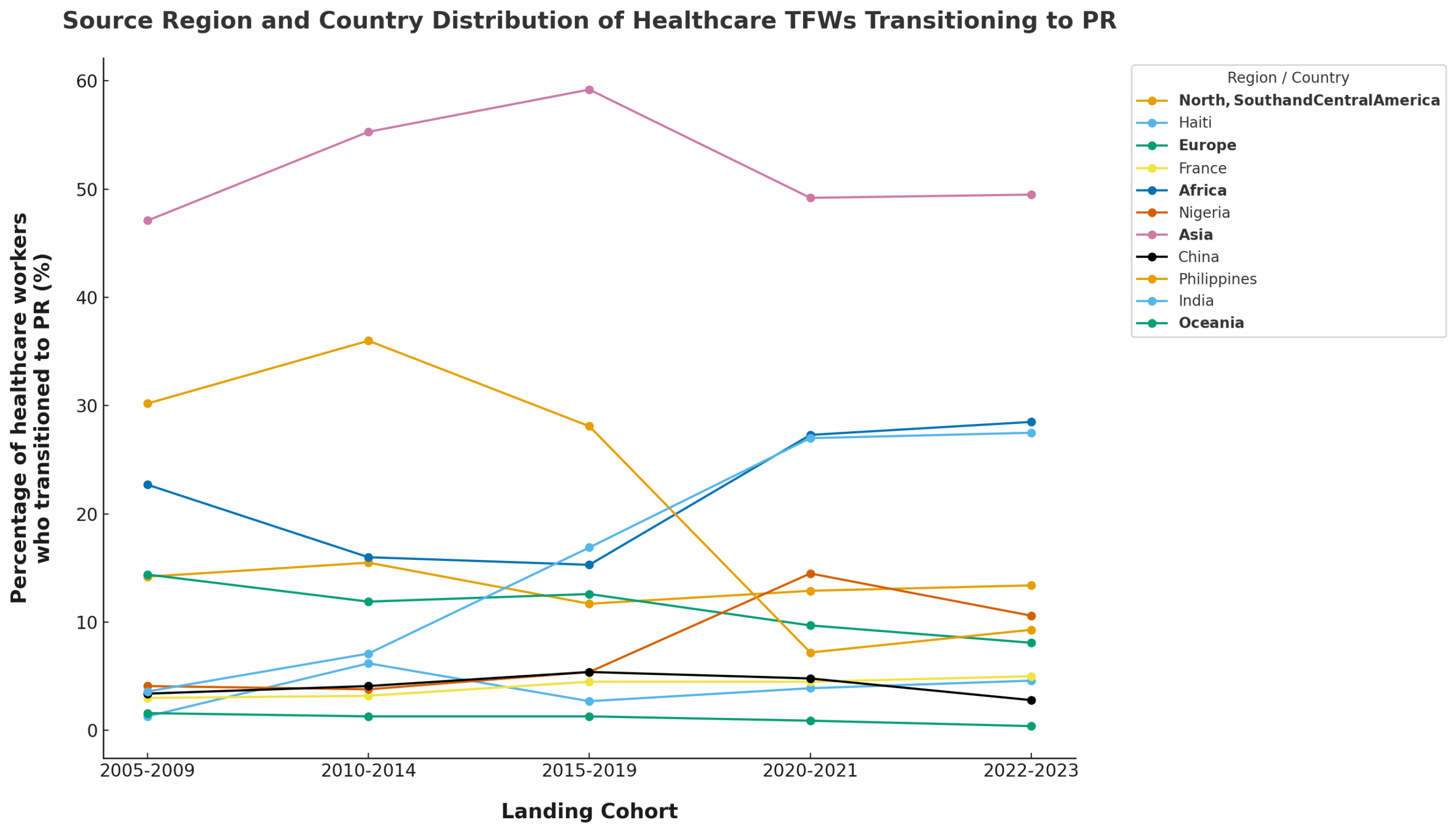
The source countries for these healthcare workers largely remained consistent, with roughly half of all healthcare workers throughout the study period coming from Asia (China, India, and the Philippines).
However, a sharp increase in new PRs from India and Haiti can be observed in more recent cohorts, coupled with a decrease in those from the Philippines:
The importance of foreign workers to Canada’s healthcare system
TFWs have become a cornerstone of Canada’s healthcare workforce, especially during and after the COVID-19 pandemic.
According to Statistics Canada data, between 2000 and 2022, the number of TFWs in health care rose from just 3,200 to 57,500—a 17-fold increase.
During the pandemic, the number of TFWs jumped 50% in a single year, from 26,100 in 2019 to 39,300 in 2020. This dramatic rise reflected urgent needs across hospitals, nursing and residential care facilities, and ambulatory health services, where TFWs stepped in to relieve pressure on overworked domestic staff.
By 2022, TFWs made up 3.0% of workers in ambulatory health services, 1.2% in hospitals, and nearly 5.0% in nursing and residential care facilities. Their role was particularly significant in home-health care, where nearly 8% of the workforce consisted of TFWs.
Provincial reliance on foreign healthcare workers has also grown, though unevenly.
By 2022, the share of TFWs in the health workforce was above the national average (2.7%) in provinces such as Prince Edward Island (3.9%), Nova Scotia (3.8%), New Brunswick (3.4%), and Ontario (3.3%).
Ontario, Quebec, and British Columbia accounted for the vast majority of all foreign health workers, together employing more than 90% of TFWs working in hospitals, nursing homes, and other facilities.
TFWs have therefore become hugely important to Canada’s healthcare system—not only plugging urgent labour shortages but also providing stability in critical care settings. The rapid growth of their numbers and their concentration in provinces with the greatest health care demand is telling of their role in keeping Canada’s healthcare system functioning.
Canadian immigration pathways open to healthcare professionals
Many immigration pathways are specifically built for, or have carve-outs for, foreign healthcare workers, further underscoring the demand for these professionals in Canada.
Among these pathways are:
- Express Entry’s healthcare occupation category;
- The Home Care Worker Pilot (HCWP);
- Specific PNP streams, such as
- The Alberta Dedicated Healthcare Pathway;
- Saskatchewan’s Health Talent Pathway; and
- Nova Scotia’s Labour Market Priorities stream.
In addition, healthcare and social services are also a recognized field of study for Post-Graduation Work Permit (PGWP) eligibility, giving healthcare students studying relevant fields of study at levels even below a bachelor’s degree the opportunity to live and work in Canada after graduating.




















