
Canada News
Forget Vegas and Florida. Canadians are skipping the U.S. for other international spots

By Julia Wong, CBC News, RCI

Travel spending jumped 148 per cent in Buenos Aires, Argentina, 137 per cent in Osaka, Japan, 112 per cent in Copenhagen, Denmark and 101 per cent in Curaçao in the Caribbean, according to Flight Centre Canada data. (Pexels Photo)
‘I just don’t really want to support them right now’: Canadian traveller
As an avid traveller, Kelly Bergquist used to visit the United States at least once a year.
The Edmonton woman was last south of the border in August 2024 when she went to a concert in Las Vegas.
She considered another U.S. trip this year, but the ongoing trade war made her think again.
I just don’t really want to support them right now. If they’re going to do that to us, I don’t want to give any money to them,
Bergquist said.
Bergquist said she may instead go to Mexico in the future, and she is already planning a big trip to the Balkan countries in southeastern Europe for next year.
I could have easily done a Mississippi River cruise or done any kind of cruise that basically goes out of the States or things like that. But as of right now, I’m just putting all that aside until we kind of see where things are going,
she said.

Kelly Bergquist use to travel to the United States at least once a year. Now, with the ongoing trade war, she is reconsidering her travel plans and instead making plans to travel to other international destinations. Photo: CBC / Samuel Martin
Since the start of the recent trade war, some Canadians have been shunning travel to the United States.
Many are opting for trips within Canada instead, but there is new data showing Canadians are turning to international destinations other than the United States.
Data provided by Flight Centre Canada to CBC News shows that travel spending for many countries booked between May 1 to July 30 is up compared to last year.
Travel spending jumped 148 per cent in Buenos Aires, Argentina, 137 per cent in Osaka, Japan, 112 per cent in Copenhagen, Denmark and 101 per cent in Curaçao in the Caribbean, according to Flight Centre Canada data.
Aruba, also in the Caribbean, also saw a 71 per cent jump in travel spending, along with Lisbon, Portugal at 61 per cent.
Meanwhile, Prague, Czech Republic saw an increase of 38 per cent, Barcelona, Spain saw 35 per cent, Dublin, Ireland jumped 29 per cent and spending in Cape Town, South Africa went up 27 per cent.
WATCH | Where will Canadians head instead of the U.S.?
Tourism organizations from several countries are also showing similar trends.
According to the Japan National Tourism Organization, between January and June, Japan saw 335,400 Canadian visitors, compared to 272,264 during the same period in 2024 — an increase of 23 per cent.
Turismo de Portugal told CBC News that, from January to May, the number of Canadian visitors grew 6.
5 per cent compared to the same period in 2024.
Data from Visit Brasil provided to CBC News reveals there were 57,065 Canadian tourists in Brazil between January and June, a 12.9 per cent jump from the same period last year when there were 50,556 Canadian tourists.
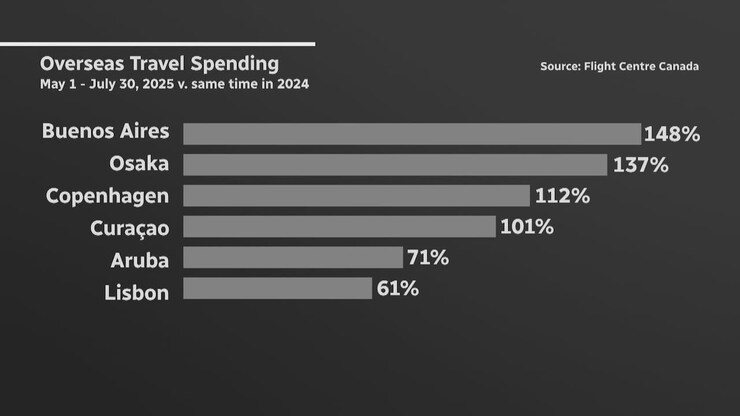
Data provided by Flight Centre Canada to CBC News shows the countries that have seen increases in travel spending by Canadians between May and July compared to the same time last year. Photo: CBC / Adam Ciolfi
Flight options, promotional materials and the exchange rate can all influence how a trip is planned. Andrew Stafford, a manager with Flight Centre in Vancouver, said tensions with the United States are top of mind for clients.
In the scenario that people are choosing not to do those four or five-day trips south of the border, we’re seeing them compile that time and put it into one longer trip to see further-flung destinations,
he said.
People are still travelling at the same rate they were. They’re just choosing different destinations.
Targeted campaigns
Marival Group, a Canadian-owned hotel chain in Mexico, has also seen more Canadians at its three all-inclusive resorts since the start of the trade war, according to Salvador Ramos, vice president of sales and marketing.
Ramos pegs the increase at between five and six per cent, which he said translates to about 15,000 more Canadians at Marival Group’s hotels.
[They] give us the opportunity to show our brand and let them know that we are super welcoming Canadians.
It’s a market that we love, that we care for,
said Ramos when asked how coveted Canadian travelers are right now, adding Canadians make up a sizable chunk of the company’s business year-round.
Feeling safe and welcome
Every year, Joan Allison of Windsor, Ont., would spend four months in Fort Myers Beach, Fla., and a couple other weeks in the U.S. campaign.
After U.S. President Donald Trump took power in January, Allison said she lost her mojo
to be in the United States.
Allison cites a combination of Trump’s pardons for Jan. 6 insurrectionists, border security concerns and the trade war for her changing travel attitudes.
The threats to our economy are massive.
… And so for that reason alone, I have no desire to spend any money in the United States, she said.
An ardent traveller, she is now proactively choosing international travel that does not involve the United States.
Allison said she has booked a trip to Portugal for next year and is mulling another sunny destination as well.
Wayne Smith, the director of the Institute for Hospitality and Tourism Research at Toronto Metropolitan University, said Canadians want to go to places where they will feel safe.
Canadians do like to travel in general. But we’re also seeing that Canadians are changing their travel patterns to go to places where they feel comfortable and welcome,
he said.
Smith also said that Canadians like good value and with rates in cities such as Las Vegas and Los Angeles being seen as expensive and aggressive, he argues that there could be a long-term chill on travel to the U.S.
You add in the social political stuff … and then you add in things like the immigration permits and the potential of dealing with border security and ICE, this is probably not going to be a short-term pattern for the U.S.,
he said.
This article is republished from RCI.




















