
Canada News
N.W.T. to add boat wash station in effort to keep invasive species out

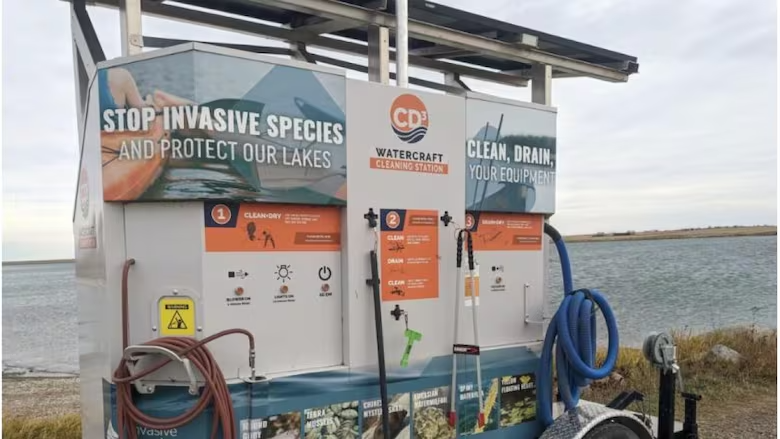
The N.W.T. will install a boat washing station similar to this one, next spring. It’s part of an effort to stop invasive aquatic species such as zebra mussels from entering the territory. (Invasive Species Centre)
Boat washing station will be installed next spring at 60th Parallel Territorial Park, near Alberta border
The N.W.T. government is ramping up its efforts to keep invasive species such as zebra mussels out of the territory with plans to install a boat washing station near the Alberta border next spring.
The station is part of the territory’s effort to collaborate with Canada’s western provinces in order to stop the spread of aquatic invasive species throughout the country, said Rob Gau, the manager of biodiversity conservation for the N.W.T. government.
“Our jurisdiction is a part of several national invasive species working groups,” Gau explained. “We work as close as we can with other jurisdictions and monitor their efforts.”
Gau described the washing station as a “nifty little unit” powered by solar energy that is equipped with an air blower, a wet vacuum, and a grabber to easily remove plants stuck in a propeller or underneath the boat.
It will be installed at the 60th Parallel Territorial Park next spring, and will continue to show up at the park each year between May and September. The park is close to the Alberta border and gets a lot of traffic, making it an ideal location for the wash station, according to Gau.
Similar wash stations are already being used in many other parts of the country.
Many provinces have implemented a protocol called “clean, drain, dry,” which encourages boaters to clean their watercraft after use, drain any standing water and completely dry the boat before transporting it to another body of water.
Following this protocol drastically reduces “almost all the risk” of introducing invasive aquatic species to new environments, said Megan Evans, the executive director of the Alberta Invasive Species Council.
The N.W.T. doesn’t currently require boaters to use wash stations, Gua said. But in places like Alberta and B.C., it’s legally required. Both provinces have boat inspection stations to ensure that people wash their boats properly and stop the spread of invasive species.
Invasive aquatic species harm infrastructure, ecosystems
While all invasive species present risks to aquatic ecosystems, zebra mussels and quagga mussels are particularly dangerous when it comes to competing with native plants and animals.
Described by Evans as “public enemy number one,” these mussels are “very destructive” and “very damaging.”
A single zebra mussel, roughly the size of a fingernail, can filter a litre of water in a day. This means the mussel strips the ecosystem of much-needed plankton and algae which would otherwise provide food and nutrients to native species. These invasive mussels also damage aquatic infrastructure, clogging up hydroelectric pipes and destroying irrigation networks, due to their propensity to stick onto hard surfaces including boats.
Zebra and quagga mussels have not yet made their way to the rivers and lakes of N.W.T., and a boat washing station is a proactive step to stop the spread of these species before it even begins, said Gau.
Once a species invades an ecosystem and becomes established, it can be “extremely difficult and quite costly to control or remove,” explained Katie Church, the aquatic plant coordinator at the Ontario-based Invasive Species Centre. “Prevention is 100 per cent more cost effective than introduction.”
While this is the first time the N.W.T. government will be installing a wash station, if invasive aquatic species become a more significant threat in the N.W.T., Gau said he could see wildlife management officials installing similar machines throughout the territory.
“It’s important to do our part,” he said. “To take the steps in the right direction to make sure that we don’t have those aquatic invasive species.”




















