

By Anthony Bonato, Toronto Metropolitan University; The Conversation
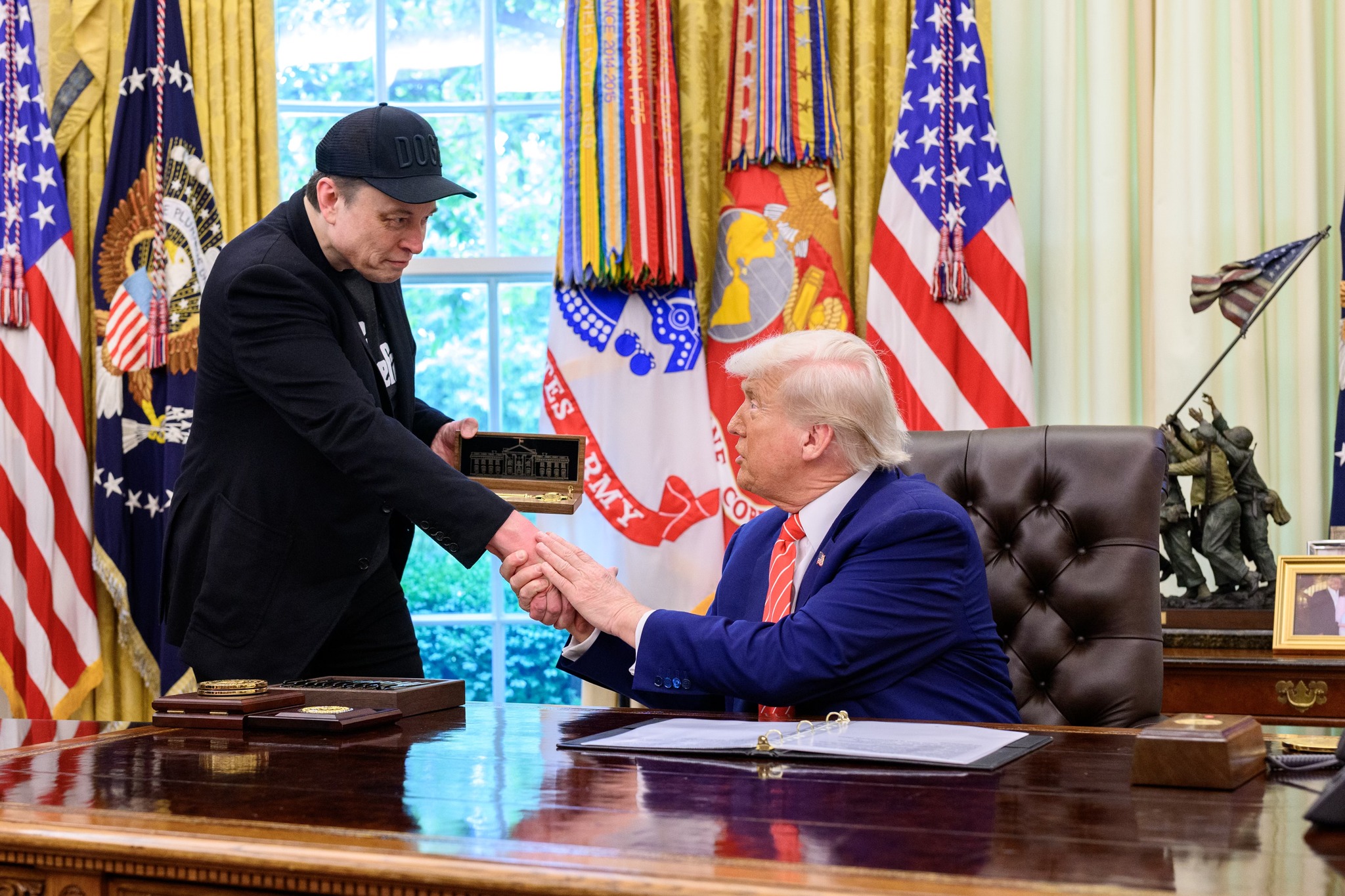
FILE: President Donald Trump participates in a press conference with departing DOGE adviser Elon Musk, Friday, May 30, 2025, in the Oval Office. (Official White House Photo by Molly Riley; The White House/Facebook)
The proverbial gauntlet has been thrown down. The friendship and partnership between United States President Donald Trump and “special government employee” Elon Musk has collapsed in spectacular fashion.
On X on June 3, Musk posted about the so-called One Big Beautiful Bill Act, calling it a “disgusting abomination.”
An argument ensued, and two days later, Trump called Musk “CRAZY” on Truth Social. The fight escalated and Trump’s slur was followed by Musk’s suggestion the president should be impeached and alleging he appeared in the Jeffrey Epstein files.
These Musk posts in particular were seen as a step too far by many in Trump’s circle, even after the Tesla CEO deleted them.
Trump and Musk’s storied bromance contributed to one of the greatest comebacks in American presidential history, with Trump winning a second term despite his numerous legal troubles. Musk actively campaigned for Trump, contributing more than $250 million to his re-election bid.
While we can only speculate about what exactly went wrong between the world’s most powerful man and the world’s richest, their feud reveals a potentially highly impactful disruption in American politics. It also illustrates what happens when social networks fall apart and the impact those types of fissures have on social structures.
Enter Zachary’s Karate Club
Feuds between political figures are nothing new, and neither are fissures in social groups. The latter has been studied for decades by network scientists who measure the strength of ties between people.
Networks, consisting of nodes and links, appear everywhere. They measure interactions and provide us with another lens through which to view the world. For example, we can consider networks of neurons in our brains, networks of banking transactions, or likes and follows on social media.
Over three years from 1970 to 1972, Temple University anthropologist Wayne Zachary studied the social network of 34 members in a university karate club. He observed a split between the club’s instructor and its administrator. What ensued was a partition of the club into factions, centred on the two respective leaders. Zachary referred to this as fission within the group in his 1977 paper.
“Communities” in a social network are groups of like-minded individuals who are more likely to interact with one another than those outside the group. Think of a community as a clique in a high school, with separate groups of teenagers who are into football, members of the math club or fans of Taylor Swift.
The Zachary Karate Club network is a well-cited and early example of the emergence of two distinct communities from one. The network became a popular example of community structure in networks after its use by physicist Michelle Girvan and network scientist Mark Newman in 2002.
How the split could affect voters
The split between Trump and Musk echoes the split in the Zachary Karate Club network. While the Karate Club network is much smaller than the the 160 million-plus group of likely U.S. voters, it does suggest the kind of polarization that can occur when powerful individuals go their separate ways.
Imagine each voter as a node, with two nodes linked if they voted for the same presidential candidate. That would split voters into two main groups: one that voted Republican and the other that voted Democrat, with a smaller group comprising the roughly three million people who voted for independent candidates like Jill Stein in 2024.
U.S. presidential elections can be razor-close, as was the case with George W. Bush and Al Gore in 2000. Even a minor split among voters can upend the results. For example, in the 1992 presidential election, independent candidate Ross Perot garnered almost 19 per cent of the popular vote, which likely siphoned off Republican votes and contributed to George H.W. Bush’s loss.
On June 5, Musk polled X about creating a new political party — The America Party. Within hours, about 80 per cent of 1.3 million people who took his poll supported his idea.
That party could fracture the traditional voting base of Republicans and Democrats, leaving the fate of the White House uncertain for the foreseeable future. While die-hard MAGA voters will likely always support Trump, tech-savvy millennial and Gen Z voters may be more receptive to Musk’s disruptive third-party aspirations.
Friends and enemies
Social networks adhere to two core principles that govern ties between individuals. These principles are well accepted and are also common sense.
The first is the adage that friends of friends are more likely to be friends. Given Musk’s strong past ties to Trump, followers of Musk would more likely consider voting for Trump.
The second and equally important principle is that the enemy of my enemy is my friend. That could be bad news for Republicans, as independent-leaning voters who don’t like Trump but voted for him in 2024 may consider supporting the hypothetical “America Party.”
Another possibility is that the feud ends — Musk is already expressing regrets, saying his posts about Trump “went too far.” That could go a long way to reversing the fissure, though it may not ease the hard feelings that could linger among either Musk or Trump fans.
We can view both Trump and Musk as powerful attractors who influence the social network of U.S. voters.
While the majority of Democrats may reject the policies and ideology of both men, the 49.9 per cent of Americans who supported Trump in 2024 could splinter.
Because this is the official final term of Trump’s presidency, Musk could also support Vice President JD Vance or another Republican frontrunner, dropping his musings about a third party altogether.
Whatever happens next — just like everything else in the Trump presidency — network science tells us it won’t be predictable.
Anthony Bonato, Professor of Mathematics, Toronto Metropolitan University
This article is republished from The Conversation under a Creative Commons license. Read the original article.




















