

By Noam Vogt-Vincent, University of Hawaii; The Conversation
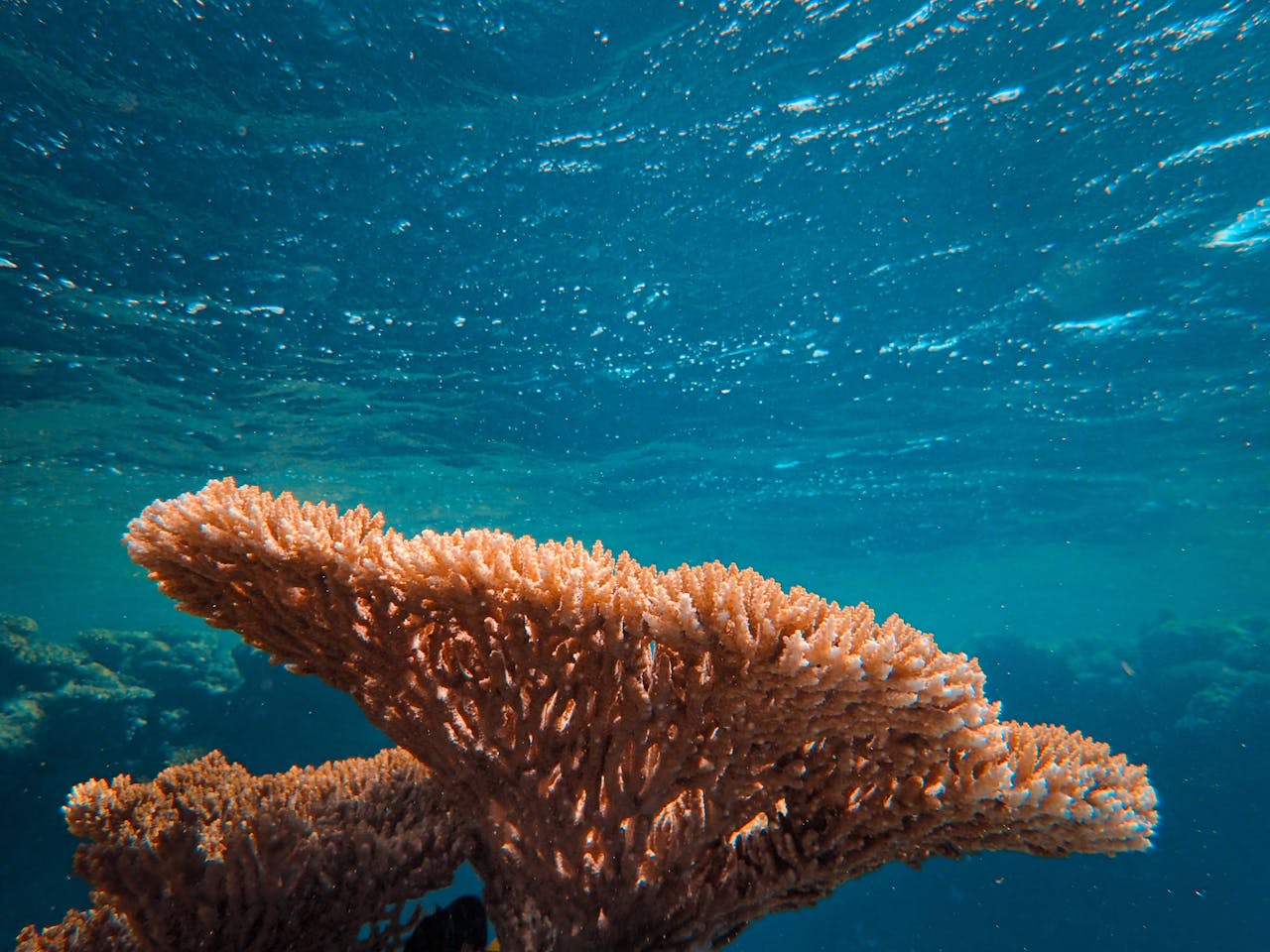
Unfortunately, coral reefs are among the most vulnerable environments on the planet to climate change. (Pexels Photo)
Tropical reefs might look like inanimate rock, but these colorful seascapes are built by tiny jellyfish-like animals called corals. While adult corals build solid structures that are firmly attached to the sea floor, baby corals are not confined to their reefs. They can drift with ocean currents over great distances to new locations that might give them a better chance of survival.
The underwater cities that corals construct are home to about a quarter of all known marine species. They are incredibly important for humans, too, contributing at least a trillion dollars per year in ecosystem services, such as protecting coastlines from wave damage and supporting fisheries and tourism.
Unfortunately, coral reefs are among the most vulnerable environments on the planet to climate change.
Since 2023, exceptionally warm ocean water has been fueling the planet’s fourth mass coral bleaching event on record, causing widespread mortality in corals around the world. This kind of harm is projected to worsen considerably over the coming decades as ocean temperatures rise.
I am a marine scientist in Hawaii. My colleagues and I are trying to understand how coral reefs might change in the future, and whether new coral reefs might form at higher latitudes as the tropics become too warm and temperate regions become more hospitable. The results lead us to both good and bad news.
Corals can grow in new areas, but will they thrive?
Baby corals can drift freely with ocean currents, potentially traveling hundreds of miles before settling in new locations. That allows the distribution of corals to shift over time.
Major ocean currents can carry baby corals to temperate seas. If new coral reefs form there as the waters warm, these areas might act as refuges for tropical corals, reducing the corals’ risk of extinction.
Scientists know from the fossil record that coral reef expansions have occurred before. However, a big question remains: Can corals migrate fast enough to keep pace with climate change caused by humans? We developed a cutting-edge simulation to find the answer.
Field and laboratory studies have measured how coral growth depends on temperature, acidity and light intensity. We combined this information with data on ocean currents to create a global simulation that represents how corals respond to a changing environment – including their ability to adapt through evolution and shift their ranges.
Then, we used future climate projections to predict how coral reefs may respond to climate change.
We found that it will take centuries for coral reefs to shift away from the tropics. This is far too slow for temperate seas to save tropical coral species – they are facing severe threats right now and in the coming decades.
Underwater cities in motion?
Under countries’ current greenhouse gas emissions policies, our simulations suggest that coral reefs will decline globally by a further 70% this century as ocean temperatures continue to rise. As bad as that sounds, it’s actually slightly more optimistic than previous studies that predicted losses as high as 99%.
Our simulations suggest that coral populations could expand in a few locations this century, primarily southern Australia, but these expansions may only amount to around 6,000 acres (2,400 hectares). While that might sound a lot, we expect to lose around 10 million acres (4 million hectares) of coral over the same period.
In other words, we are unlikely to see significant new tropical-style coral reefs forming in temperate waters within our lifetimes, so most tropical corals will not find refuge in higher latitude seas.
Even though the suitable water temperatures for corals are forecast to expand poleward by about 25 miles (40 kilometers) per decade, corals would face other challenges in new environments.
Our research suggests that coral range expansion is mainly limited by slower coral growth at higher latitudes, not by dispersal. Away from the equator, light intensity falls and temperature becomes more variable, reducing growth, and therefore the rate of range expansion, for many coral species.
It is likely that new coral reefs will eventually form beyond their current range, as history shows, but our results suggest this may take centuries.
Some coral species are adapted to the more challenging environmental conditions at higher latitudes, and these corals are increasing in abundance, but they are much less diverse and structurally complex than their tropical counterparts.
Scientists have used human-assisted migration to try to restore damaged coral reefs by transplanting live corals. However, coral restoration is controversial, as it is expensive and cannot be scaled up globally. Since coral range expansion appears to be limited by challenging environmental conditions at higher latitudes rather than by dispersal, human-assisted migration is also unlikely to help them expand more quickly.
Importantly, these potential higher latitude refuges already have rich, distinct ecosystems. Establishing tropical corals within those ecosystems might disrupt existing species, so rapid expansions might not be a good thing in the first place.
No known alternative to cutting emissions
Despite enthusiasm for coral restoration, there is little evidence to suggest that methods like this can mitigate the global decline of coral reefs.
As our study shows, migration would take centuries, while the most severe climate change harm for corals will occur within decades, making it unlikely that subtropical and temperate seas can act as coral refuges.
What can help corals is reducing greenhouse gas emissions that are driving global warming. Our study suggests that reducing emissions at a faster pace, in accordance with the Paris climate agreement, could cut the coral loss by half compared with current policies. That could boost reef health for centuries to come.
This means that there is still hope for these irreplaceable coral ecosystems, but time is running out.
Noam Vogt-Vincent, Postdoctoral Fellow in Marine Biology, University of Hawaii
This article is republished from The Conversation under a Creative Commons license. Read the original article.




















