
Canada News
What, exactly, are Alberta separatists mad about?

By Kevin Maimann, CBC News, RCI
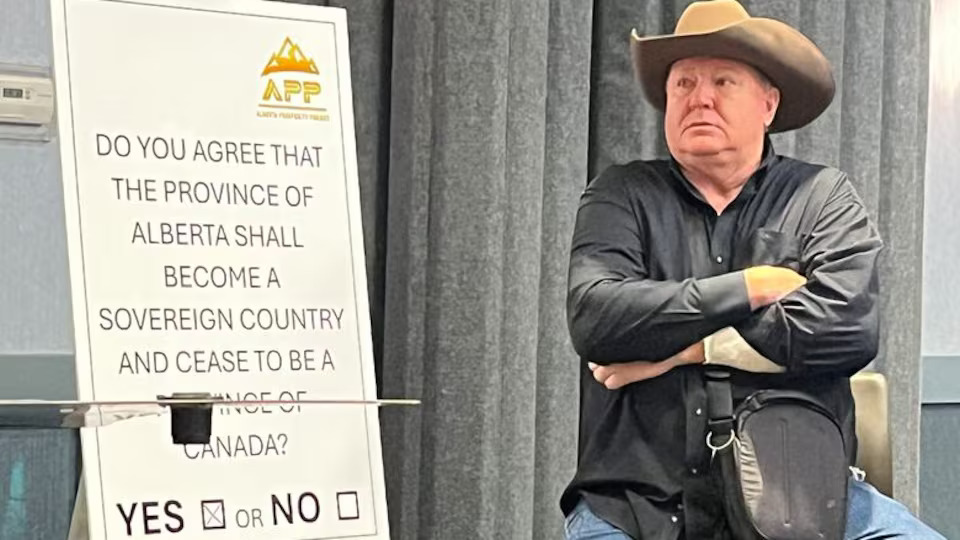
Jeff Rath, a lawyer for the separatist Alberta Prosperity Project, sits beside the group’s proposed question for a potential referendum on Alberta separation, at a Monday news conference. Threats of separation have reached new heights since the April election of Liberal Prime Minister Mark Carney. (Jason Markusoff/CBC) Photo: Radio-Canada / Jason Markusoff
We break down a few key issues driving the province’s separation movement.
Threats of Alberta separation go back decades, and have reached new heights since the April election of Liberal Prime Minister Mark Carney.
The separatist Alberta Prosperity Project is gunning for 600,000 signatures on a petition that would force a provincial referendum on the issue, while the Republican Party of Alberta — led by longtime conservative operative Cameron Davies — is ramping up its separation push.
What we’re looking at is the broken and dysfunctional system that has been in place since Alberta joined Confederation,
Davies, who recently resigned from membership in the governing United Conservative Party, told CBC News.
He says the system was designed to consolidate power in the East, and the West was viewed as nothing more than a resource colony
for Ottawa.
Alberta Premier Danielle Smith has also focused much of her recent public messaging on sovereignty and opposition to Ottawa, making nods to the separatist movement but not outright supporting separation.
So, why do some Albertans feel they’re being treated so unfairly?
Here’s breakdown of a few key issues.
Equalization payments
Equalization payments are a longstanding grievance for some Albertans.
The federal program sees a portion of federal tax dollars distributed to poorer, or have-not,
provinces so all can maintain reasonably similar levels of public services.
While Alberta was once a have-not, it’s been a have
province since the mid-1960s, meaning that it contributes to those payments, but receives none.
Some argue this is unfair, and the money should stay in Alberta.
Davies says the federal government only cares that the taxes keep coming from Alberta so that they can redistribute it to Quebec and the Maritimes.
When Alberta’s then-premier Jason Kenney held a referendum on equalization in 2021, about 62 per cent of voters said they would choose to remove the principle of equalization payments from the constitution.
The current equalization formula was created by Conservative Prime Minister Stephen Harper’s government, in which Kenney served as a cabinet minister.
Andrew Leach, an environmental and energy economist at the University of Alberta in Edmonton, says because of Alberta’s enviable
fiscal position, there is no system of equalization that would mathematically lead
to the province receiving payments.
Quebec received the largest equalization payment in the 2025-26 fiscal year ($13.6 billion), followed by Manitoba ($4.7 billion).
Duane Bratt, a political scientist at Mount Royal Unversity in Calgary, says some of the anger around equalization comes from a misunderstanding among many Albertans of how the system works.
They think that the treasurer of Alberta writes a cheque to Quebec for $12 billion every year,
he said.
Bratt feels the issue has been deliberately misrepresented to stoke anger, and says it’s not clear whether Alberta would be better off without equalization payments.
If Alberta seceded… they would save all that tax revenue, but then they would have to pay for all the things that the federal government currently pays for, and that would become very complicated about whether they would benefit or not,
he said.
Underrepresentation in Ottawa
Davies and others argue Alberta is underrepresented in the House of Commons and the Senate.
Alberta gained three seats in the 2022 federal electoral redistribution and now has 37 of the 343 seats in the House, or about 10.8 per cent, while accounting for about 11 per cent of the country’s population.
If fairness is being judged by percentages, that’s slightly higher than Ontario’s per-capita representation.
The numbers are slightly more skewed toward the smaller Atlantic provinces. For example, New Brunswick has 10 seats — just under three per cent — and under two per cent of the country’s population.
WATCH | Pierre Poilievre addresses Albertans’ frustrations:
Poilievre says ‘we need to unite this country,’ but Albertans ‘have a right to be frustrated’
When asked if he would denounce the Alberta separatist movement, Conservative Party Leader Pierre Poilievre said Albertans have ‘legitimate grievances’ about industry but he is ‘against separation.’
In the Senate, however, Alberta is clearly underrepresented — with six of the 105 senators, or less than six per cent. B.C., Saskatchewan and Manitoba also have six senators each, while Nova Scotia and New Brunswick each have 10.
Maybe it would be nice to have an equal Senate, but right now the Senate doesn’t have a whole lot of power,
Bratt said.
Dennis Pilon, a political science professor at York University in Toronto, says the formulas that led to these numbers are part of a long process of constitutional and court revision.
He says one could argue that there should be a constitutional convention where such issues could be addressed.
However, he says if changes were to be made, other issues should also be considered, such as the overrepresentation of rural ridings.
There are a lot of other problems that actually speak to a much higher level of unfairness, which I don’t hear the Alberta separatists talking about,
Pilon said.
Federal regulations
Davies has a list of complaints about federal regulations, from the long-gun registry to the recently turfed carbon tax — policies he says fit well with Toronto and Montreal audiences but are tone deaf
to Albertans.
Albertans generally just want to be left alone,
he said.
Such complaints usually boil down to the oil and gas industry, and perceived damage done by Liberal environmental policies.
Alberta leaders across parties frequently put oil and gas at the centre of their campaigns, as the industry contributes billions to provincial coffers each year.
But Leach, at the U of A, says it’s not so clear that Ottawa has been detrimental to the industry’s ambitions.
Yes, the federal government has various environmental rules, he says. But it also, for example, has the jurisdiction to force pipeline construction to the coast through B.C.
The Alberta oil and gas industry, left to its own devices, would probably find pipelines extremely expensive to build without federal government legislation. Because it means that any landowner can hold that pipeline up for as much money as they want to try to extract.
In recent years, fights over pipelines led to the federal government rejecting the Northern Gateway pipeline in 2016, Trans Canada pulling out of Energy East in 2017 and Keystone XL to the U.S. being killed in 2021.
But the Trudeau Liberals also pushed through the Trans Mountain pipeline, despite regulatory and legal hurdles, buying it in 2018.
Meanwhile, the industry has continued to grow, raking in record profits and hitting record highs of oil production in the last three years.
Leach finds it curious that Liberal governments in particular have been painted by some as being strictly bad for oil and gas, and says most liquid natural gas projects, and many oil sands projects, that had permits in hand during the Harper era never moved ahead.
There’s sort of this mythology that the conservatives have created about themselves, or that they expect of themselves, that they were fighting tooth-and-nail to get all of these projects built,
he said.
This article is republished from RCI.




















