
News
Gov’t expands earthquake response force

By Darryl John Esguerra, Philippine News Agency
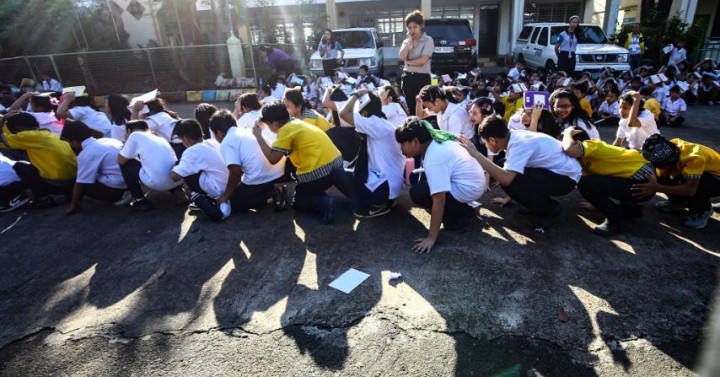
USEFUL DRILL. Students of Pinyahan Elementary School in Quezon City duck, cover and proceed to an open area during the first quarter nationwide simultaneous earthquake drill on March 13, 2025. The government encourages participation in such drills to strengthen instincts and practice in preparation for possible earthquakes and other disasters. (PNA photo by Joan Bondoc)
MANILA – The government is ramping up its earthquake preparedness efforts by expanding its pool of trained emergency responders in anticipation of a possible magnitude 7.2 tremor along the West Valley Fault.
Office of Civil Defense (OCD) chief Undersecretary Ariel Nepomuceno underscored the urgent need to prepare for the so-called “Big One,” which experts warn could severely impact Metro Manila.
“We must prepare now,” he said during the Security Bank’s First Quarter 2025 Townhall on Saturday. “The most effective way to save lives is to start preparing today.
”
Nepomuceno highlighted three main areas for action: infrastructure resilience, public education and bolstering response capacity.
“Compliance with the National Building Code is non-negotiable,” he said, stressing that buildings must be designed to withstand a magnitude 8.5 earthquake.
To support this, the OCD is working with the Department of Trade and Industry and private sector engineers to upgrade construction standards, particularly focusing on steel reinforcement bars and eliminate substandard imports that threaten safety.
He also reiterated the need to avoid construction in high-risk areas such as fault lines and landslide-prone zones.
Nepomuceno also urged the public to learn the basic yet critical survival technique of “duck, cover and hold,” which he said could save lives during the first moments of an earthquake.
The OCD chief acknowledged the country’s limited resources compared to more prepared nations like Japan.
“Unlike Japan, which has over 12,000 highly trained earthquake responders, the Philippines has far fewer. But we are not sitting idle,” he said.
To bridge this gap, the OCD is partnering with the Armed Forces, Metropolitan Manila Developmrnt Authority, Coast Guard, Red Cross and other agencies to increase the number of trained personnel.
Collaboration also extends to the National Service Reserve Corps, student volunteers from the National Service Training Program and private groups such as the Philippine Disaster Resilience Foundation and ARISE Philippines.
“Our goal is to expand, organize and build capacity,” Nepomuceno said.




















