
Canada News
Top election issues shifting from U.S. threats to affordability, health care, Vote Compass data suggests

By Verity Stevenson, CBC News, RCI
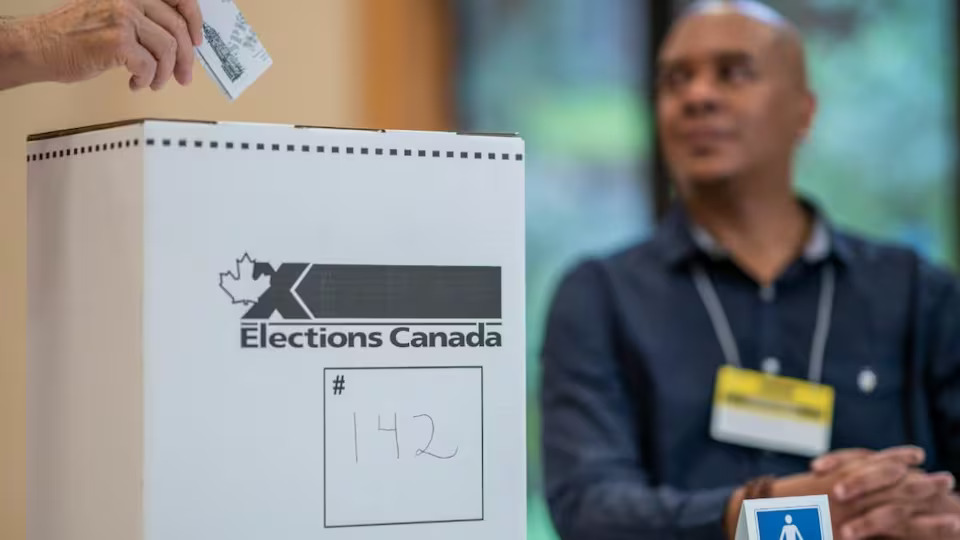
A record 7.3 million Canadians voted in advance polls over Easter long weekend, according to Elections Canada. Photo: Élections Canada
When the election campaign started late last month, the ballot-box question on most voters’ minds appeared to be which leader and political party is best suited to face American threats to Canada’s economy and sovereignty.
But recent Vote Compass data suggests that could be changing.
Ahead of the party leaders’ debates last week, 25.2 per cent of the 319,210 responses to this specific question said Canada-U.S. relations was the most important election issue to them
Now, with an additional 101,295 responses logged after the debates, only 19.6 per cent of respondents said this was the most important issue — and other issues have risen in importance.
The economy and finances is now the top issue, at 24.7 per cent — however that percentage itself hasn’t changed much over time. Instead, other issues are gaining prominence.
For example, before the debates, affordability and the cost of living hovered at about 10 per cent, but jumped to 12 per cent afterward.
The needle moved on health care as well — which NDP Leader Jagmeet Singh brought up frequently in the debates — jumping a couple percentage points, from about six per cent to eight per cent.
Other issues that saw a bump after the debates include housing, social justice, immigration, the environment, education and crime. Energy resources stayed the same at about one per cent, while government operations (public services, corruption, transparency, etc.
), military and defence, social welfare and foreign relations took a dip in importance for users.
Costed platforms are out
With the economy top of mind for voters, the Liberals, NDP and Conservatives have all released their costed platforms.
The Liberals promised to generate revenue by boosting investment. The Conservatives said they would pay for significant tax cuts by slashing government spending and upping revenue from home-building and policy changes, such as repealing Ottawa’s Impact Assessment Act. The NDP said it would invest billions in health care and tax the wealthy.
The NDP, Liberal and Bloc Québécois leaders have all criticized Conservative Leader Pierre Poilievre’s platform because it includes potential revenue streams in its deficit calculations, resulting in a smaller projected deficit than the Liberals.
Those numbers are a joke,
Carney said. The Conservative math is not mathing,
Singh said. They want to cut so much that what I thought at first is: Elon Musk, please get away,
quipped Bloc Leader Yves-François Blanchet.
WATCH | How the Liberal and Conservative platforms compare
Mahmood Nanji, a policy fellow at Western University’s Ivey Business School, points out that all the math could change.
There’s a great deal of uncertainty, so if we do actually end up in a recession a lot of these projections will not be exactly the way that they were supposed to unfold,
Nanji told CBC News on Tuesday.
He says the main difference between the Conservative and Liberal platforms are Poilievre’s focus on affordability and crime, while Carney’s focus is on catalyzing private investment.
Other experts have raised issues with Poilievre’s unorthodox approach of including potential revenue in his costed platform.
It’s part of what prompted Kevin Page, a former parliamentary budget officer, to give the Conservatives only a passing grade rather than a good
one.
It’s not a good budgeting practice,
said Page, who has been crunching the parties’ platform numbers for the Institute of Fiscal Studies and Democracy at the University of Ottawa.
The Liberals remain ahead in voter intentions at roughly 43 per cent, though the gap between them and the Conservative party has decreased slightly, according to CBC’s Poll Tracker (new window).
Developed by a team of social and statistical scientists from Vox Pop Labs, Vote Compass is a civic engagement application offered in Canada exclusively by Radio Canada/CBC.
Submissions to the question of which election issue was most important to users took the form of open-text responses which were then classified into categories using a language processing algorithm.
Unlike online opinion polls, respondents to Vote Compass are not pre-selected. Similar to opinion polls, however, the data are a non-random sample from the population and have been weighted in order to approximate a representative sample. Vote Compass data have been weighted by gender, age, education, region, language spoken in the home, and partisanship to ensure the sample composition reflects that of the voting-eligible population of Canada according to census data and electoral data.
This article is republished from RCI.




















