

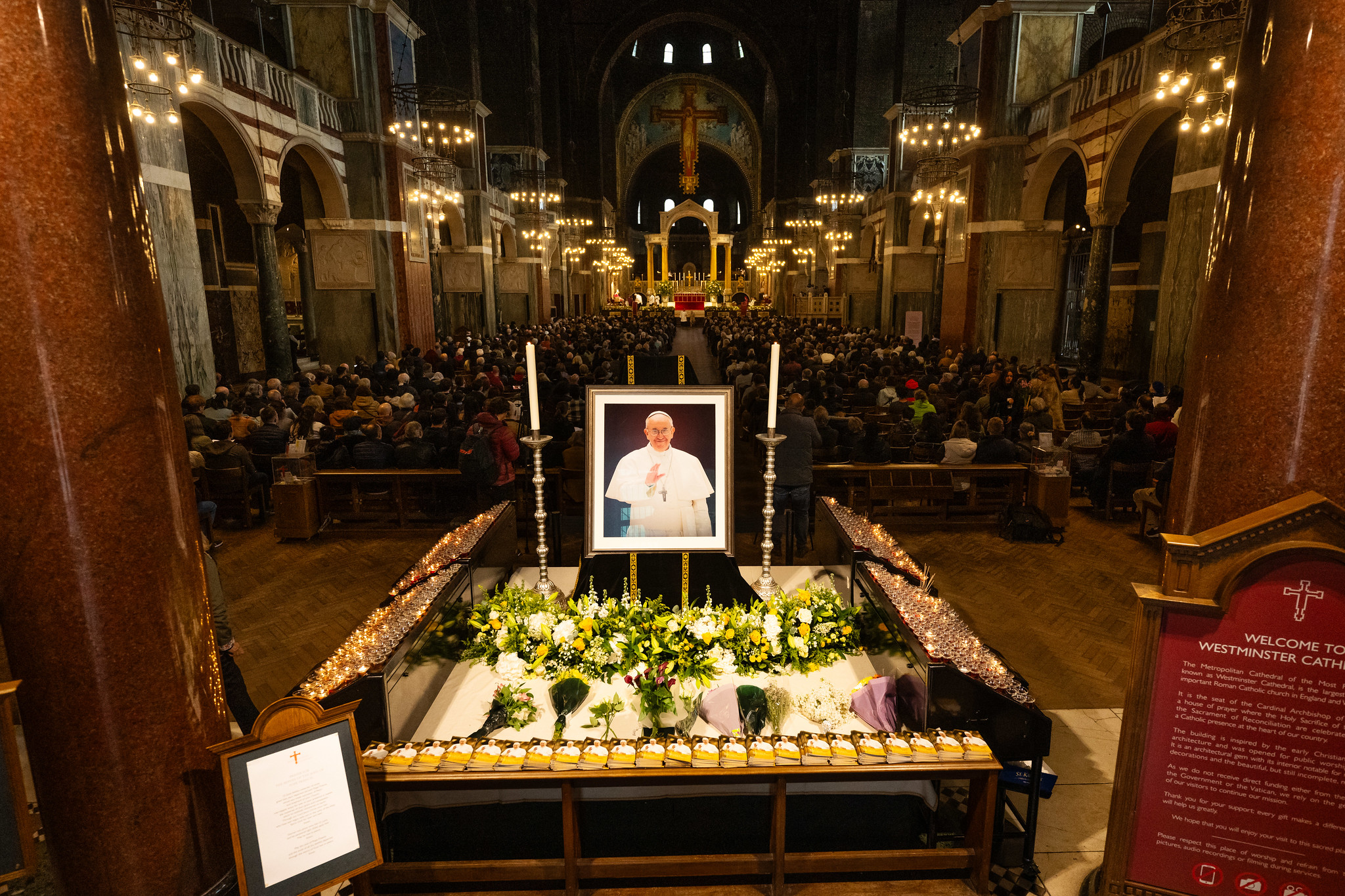
FILE: Requiem Mass for Pope Francis at Westminster Cathedral. (Photo: Catholic Church England and Wales/Flickr, CC BY-NC-ND 2.0)
By Joanne M. Pierce, College of the Holy Cross, The Conversation
The 88-year-old pontiff had been well aware of his fragile state and advanced age. As early as 2015, Pope Francis had expressed the desire to be buried in the Basilica of Santa Maria Maggiore, a fifth-century church in Rome dedicated to the Blessed Virgin Mary. He was so devoted to Mary and her basilica that after each of his more than 100 trips abroad, he would visit it after returning to Rome to pray and meditate.
No pope has been buried in Santa Maria Maggiore since the 17th century, when Pope Clement IX was laid to rest there.
I’m a specialist in Catholic liturgical history. In earlier centuries, papal funerals have been elaborate affairs, ceremonies befitting a Renaissance prince or other regal figure. But in recent years, the rites have been simplified. As Pope Francis has mandated, here are the steps that the ritual will follow.
First station: Preparation of the body
The funeral rites take place in three parts, called stations. The first takes place in the pope’s private chapel, after medical professionals have certified his death. Until recently, this stage had taken place at the pope’s bedside.
After the body lies in rest in the chapel, the cardinal serving as the pope’s camerlengo – the pope’s chief of staff – will make the arrangements for the funeral. He is also tasked with running the Vatican until a new pope is elected. The current camerlengo is Cardinal Kevin Joseph Farrell, appointed by Francis in 2019.
As has been done for centuries, the camerlengo will formally call the deceased pope by the full name given to him when he was baptized as an infant – Jorge Mario Bergoglio. There are narratives or legends stating that, at this time, the pope was also tapped three times on the forehead with a small silver hammer. However, there is no documented proof that this was actually done in earlier centuries to verify a pope’s death.
Traditionally, another ancient rite will also take place after the declaration of the pope’s death: the defacing of the pope’s ring. Each pope wears a custom-made ring with an engraved image of a man fishing from a boat, hearkening back to the gospel of Matthew, where Jesus calls St. Peter a “fisher of men.” This Fisherman’s Ring, with the name of the current pope engraved over the image, could act as a seal on official documents. The camerlengo will break Francis’ ring and smash the seal with a hammer or other instrument to prevent any other person from using it.
The pope’s apartments will also be locked, with no one allowed to enter; traditionally, this was done to prevent looting.
Second station: Viewing the body
The deceased pope will be dressed in his simple white cassock and red vestments, then placed in a simple wooden coffin. This will be carried in procession to St. Peter’s Basilica, where the public viewing will take place for the next three days.
The pope’s body will be left in the plain, open casket during this viewing period in order to emphasize the pope’s humble role as a pastor, not a head of state. The earlier practice would have been to place the body on top of a tall raised platform, called a catafalque; this ended with the funeral of Pope Benedict XVI in 2022.
Pope Benedict was also the last pope to be buried in the traditional three coffins of cypress, lead and elm. Two coffins contained specific documents about his pontificate; the first coffin also held the traditional three bags of coins – gold, silver and copper – representing each year of his pontificate.
At Francis’ funeral, after the public viewing, a plain white cloth will be placed over the pope’s face as he lies in the oak coffin, a continuing part of papal funerals. But this will be the first time that only a single coffin will be used; it will likely contain a document describing his pontificate and a bag of coins from his pontificate as well.
The funeral Mass will then be celebrated at St. Peter’s, most likely inside because of the late winter weather, and there will likely be a crowd of believers outside, assembled on the plaza. The homily will reflect on the life and spirituality of the deceased pope; Francis himself preached at the funeral of his retired predecessor, Pope Benedict. And the future Pope Benedict, as Cardinal Joseph Ratzinger, preached at the funeral of Pope St. John Paul II when Ratzinger was the leader, or the dean, of all senior church officials – what’s known as the College of Cardinals.
The current dean is 91-year-old Cardinal Giovanni Battista Re, and it is unclear whether he will be able to continue this tradition due to his advanced age. Masses will continue to be said in Francis’ memory for nine days after his death – a period called the Novendialis. This ritual was inspired by an ancient Roman tradition prescribing a mourning period ending on the ninth day after a death.
Third station: Burial
Popes in the past have been buried in several different places. Until the legalization of Christianity in the Roman Empire in the early fourth century, popes would be interred in the catacombs, the burial grounds on the outskirts of Rome.
Afterward, popes could be buried in a number of different locations, such as the Basilica of St. John Lateran – the official cathedral of Rome – or other churches in and around Rome. A few were even buried in France during the 14th century, when the papacy moved to the French border for political reasons.
Most popes are buried in the grottoes underneath St. Peter’s, and since Pope Leo XIII’s burial at St. John Lateran in 1903, every pope has been buried at St. Peter’s. According to Francis’ wishes, however, there will likely be a procession across Rome to Santa Maria Maggiore, including the hearse and cars carrying others who will attend this private ritual.
After a few final prayers and sprinkling of holy water, the coffin will be placed in its final location inside the church. Only later will the area be opened to the public for prayers and veneration.
After so many journeys from Rome to visit Catholic communities in countries across the globe, and so many visits to this basilica for prayer and meditation, it seems fitting that, at the end of his life’s journey, Francis would make one last trip to the church he loved so much to be laid to rest forever.
Joanne M. Pierce, Professor Emerita of Religious Studies, College of the Holy Cross
This article is republished from The Conversation under a Creative Commons license. Read the original article.




















