Canada News
Trump’s threats leave Canadian Afghan war veterans feeling angry and betrayed

By Murray Brewster, CBC News, RCI
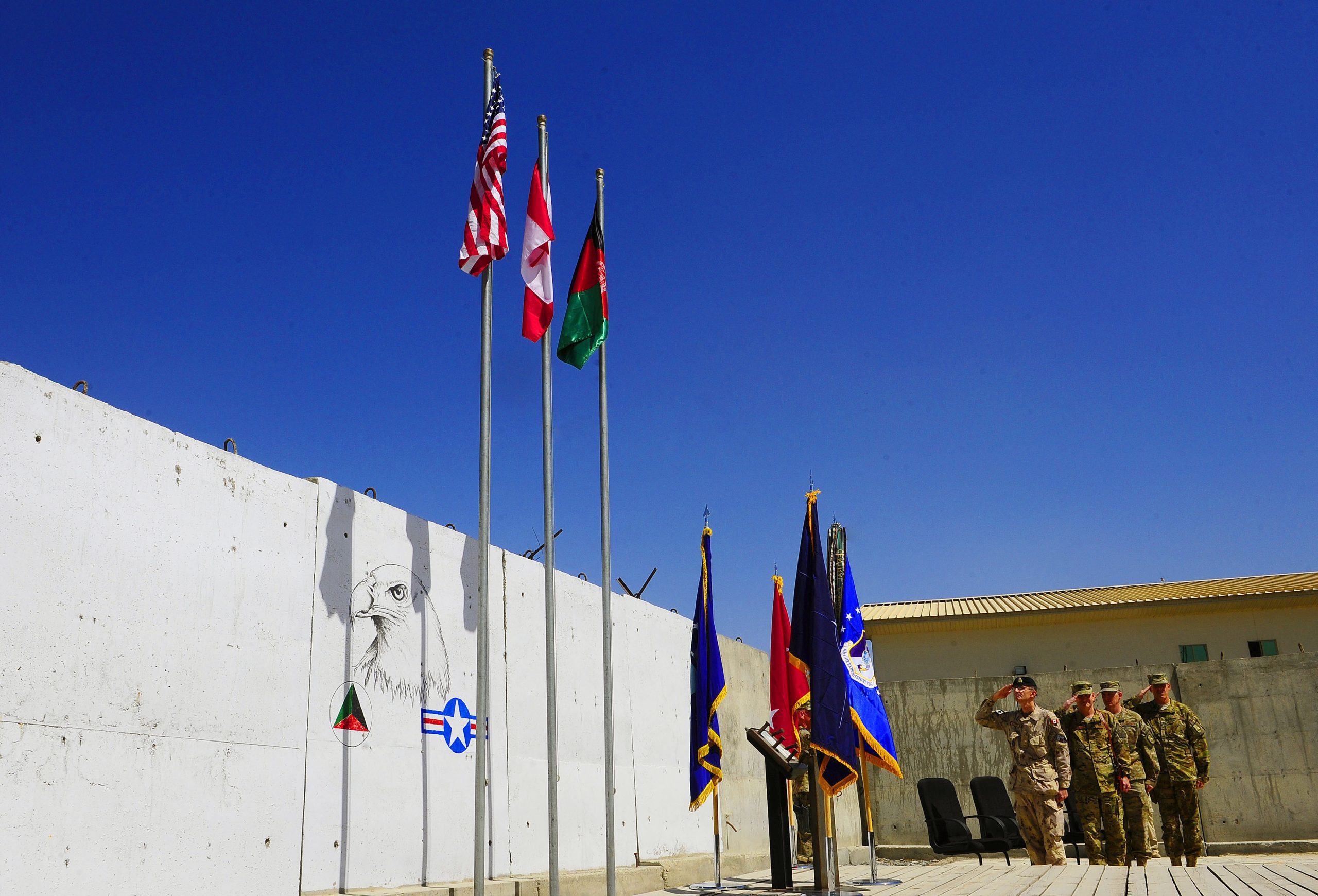
FILE: U.S. Air Force Maj. Gen. H.D. Polumbo, front, and Brig. Gen’s. Timothy Ray, center, and Steven Shepro salute the colors during the 438th Air Expeditionary Wing Change of Command Aug. 15, 2012 at Kabul Afghanistan, International Airport Afghanistan. The ceremony marked two changes of command, one for command of the NATO Air Training Command-Afghanistan and the second for the 438th AEW. (Photo By Staff Sgt. Quinton Russ, U.S. Air Force – NATO Training Mission-Afghanistan, Public Domain)
‘I just think about the idiocy of it,’ says retired corporal about recent events
Canadian and American troops fought together and bled together in the scorched hinterlands of Afghanistan.
And for that reason there is a palpable sense of dismay — even betrayal — among Canadian veterans toward the Trump administration over its threats and treatment of not just Canada, but other allies such Ukraine.
A meme circulating online — a photo of troops in front of the maple leaf rock monument at Ma’sum Ghar, the Canadian forward operating base in western Kandahar — was recently captioned: We went because you were attacked. We didn’t ask for your thanks. Neither did 158 of us who died for you.
The notion that Canadians fought and died in Afghanistan to help defend the United States — because of the terrorist attacks on Sept. 11, 2001 — runs deep among Canadian veterans of that war and their families.
They’re irked by the threats of President Donald Trump to annex Canada through economic force and the trade war. But it was the bullying of the Ukrainian president in the Oval Office and Vice-President JD Vance’s insistence that Volodymyr Zelenskyy show gratitude that set off many veterans.
The anger was perhaps felt more keenly on Wednesday, the 11th anniversary of Canada’s military withdrawal from Afghanistan.
I think if 9/11 were to happen again, I honestly don’t think I would be as willing — or ready — to help the Americans as I did in 2001,
said retired corporal Bruce Moncur, who was gravely wounded when an American ground attack jet accidentally strafed Canadian troops at the start of the milestone 2006 battle known as Operation Medusa.
Down the years Moncur has tried to come to peace with the horrific friendly fire incident that took the life of one Canadian soldier — Trooper Mark Anthony Graham — and wounded 36 others.
But the now outspoken veterans advocate said he can’t help but wonder about the country and the people he willingly defended.
In all of his conversations since Trump’s return to the White House in January, Thompson said he never once got the sense that U.S. soldiers shared the sentiment that Canada should become the 51st state in the union.
It’s not about the United States Army or the United States Armed Forces. It’s about the president of the United States,
Thompson said.
Canadian special forces troops, whom Thompson also commanded, were among the first on the ground in Afghanistan in October 2001 along with their U.S. counterparts in the aftermath of the terror attacks on New York and Washington.
Thompson said the ties between the two militaries run so deep that a U.S. Navy Seal — Senior Chief Petty Officer Thomas Ratzlaff — was awarded in 2010 Canada’s second-highest military decoration for bravery while serving alongside Canadians.
Over more than a dozen years in Afghanistan, 158 Canadian soldiers were killed, along with seven civilians. An additional 2,000 troops were wounded.
It is one of the reasons Trump’s annexation threats are tough for veterans to swallow, even though they know a full-blown invasion is unlikely.
I don’t think it’s a possibility, militarily,
said Thompson. He can certainly make an attempt to tank our economy. And I’m not an economist, but I would suggest that Canadians will take an awful lot of pain before they acquiesce to his demands.
He said he also doesn’t believe that Trump has the support of the American public for his annexation agenda — beyond talking heads in the right-wing punditry.
The risk of civil disobedience in the U.S. is increasing, said Thompson.
I think the United States will have internal problems long before they start turning their attention, before he can start to turn his attention towards actually annexing Canada,
he said.
This article is republished from RCI.