

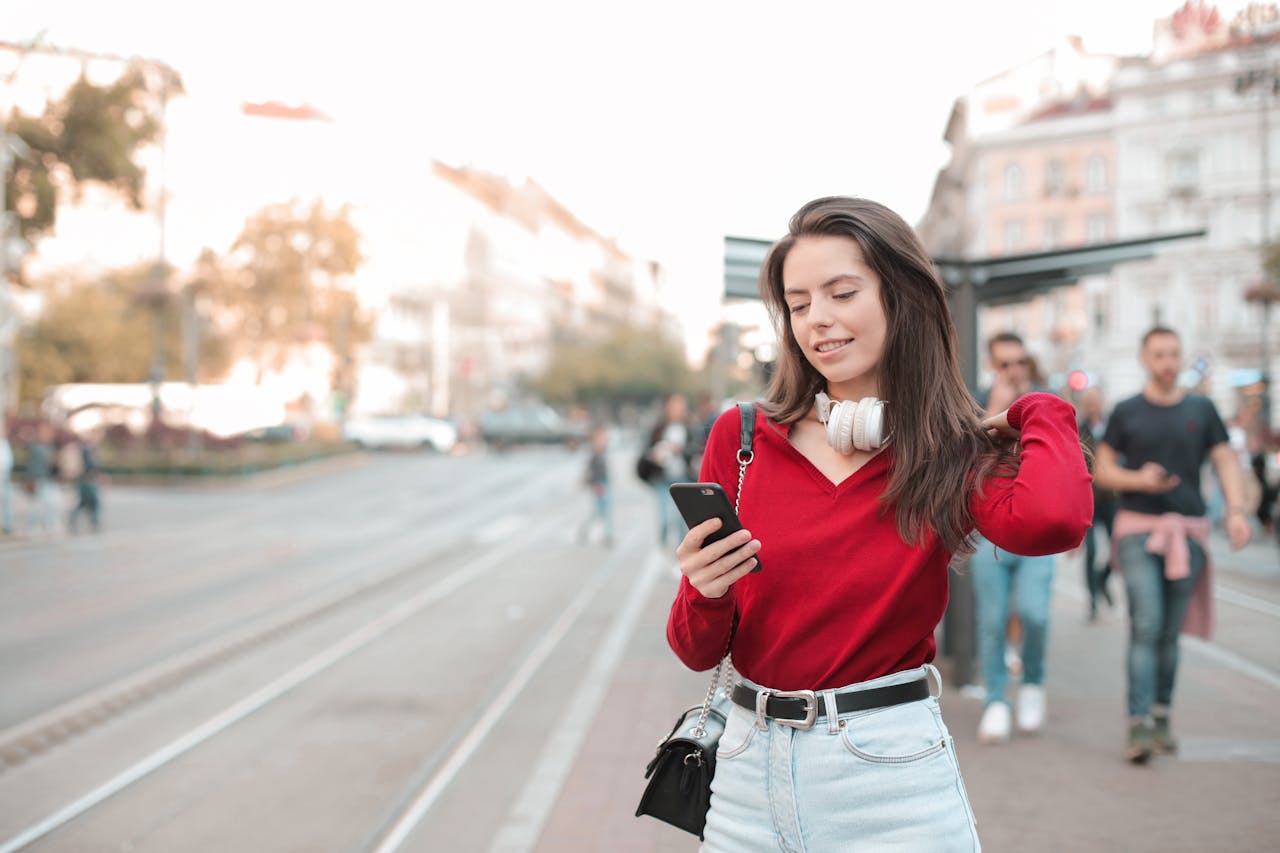
Now our latest study shows that even our body reflects a state of being glued to the screen when we are on social media. (Pexels Photo)
By Niklas Ihssen, Durham University, The Conversation
The typical adult in the UK spends nearly two hours on social media per day. And for younger users, this can easily be up to five hours. The likes of Instagram or TikTok seem to draw us into their ever-changing feeds and it’s difficult to tear ourselves away from these platforms.
Now our latest study shows that even our body reflects a state of being glued to the screen when we are on social media.
We asked 54 young adults to browse their Instagram on their phone for 15 minutes as they would normally do in their daily life. However, in our study we had attached electrodes to their chest and fingers that allowed us to record their heart rate and “skin conductance”, which is an indicator of sweating. Psychologists can use these physiological markers to infer subtle mental states and emotions. We also added a control condition where our participants read a news article on their phone, just before they logged onto Instagram.
What we found was that, relative to the news reading condition, scrolling away on Instagram led to a marked slowing of participants’ heart rate while, at the same time, increasing their sweating response.
From other research we know that such a pattern of bodily responses shows that someone’s attention is fully absorbed by a highly significant or emotional stimulus in their environment – it’s a state of simultaneous excitement and deep immersion into something very meaningful to us.
Importantly, from the control condition we knew that it was not just being on the phone or reading that caused this bodily response. So there seems to be something special about social media that can easily engross us.
The most intriguing effect in our study happened when we interrupted participants at the end of their Instagram stint and asked them to go back to reading another news article. Rather than snapping out of the excitement and returning to a calmer state, participants’ sweating response increased further, while heart rate also increased rather than slowed down further.
Is it addiction?
What was going on? What helped us interpret these effects were participants’ ratings of their emotions. We collected these before their social media bout and at the time we asked them to log off.
Participants reported being stressed and anxious when they had to disconnect from their feed. They even reported having social media cravings at that moment. So it looked like the physiological response that we observed when participants had to log off reflected another form of arousal – but this time it was more negative and stress-related.
Such bodily and psychological stress responses also occur when people with a substance addiction go through withdrawal during abstinence or after quitting “cold turkey”. So were these signs that we observed “withdrawal” from Instagram?
The answer to this question is not straightforward. However, our study may give us some clues. After the experiment, we asked all participants to fill in a questionnaire assessing symptoms of “social media addiction”.
While this concept is controversial and currently not recognised as a mental health disorder, the questionnaire told us something about how social media use can negatively affect someone’s daily life. This can even include their work or school results, or lead to conflict with their partners.
Notably, we did not see any heart rate and sweating differences between participants who scored high or low on these addiction measures. That means, that all our participants showed a pattern of excited immersion during use and stress-related arousal when use was interrupted.
We don’t think that this finding means that we are all addicted to social media though. Instead, we believe that social media offers very powerful rewards. And some of its features may indeed have an addictive dimension, such as the personalised short-video streams that trap us in an endless loop of entertaining content.
Critically however, our previous study shows that it is primarily the social aspect of social media that drives most people to use it so intensively. This also means that – in contrast to drugs – social media taps into basic human needs: we all want to belong and to be liked.
So if we recognise the existence of “social media addiction”, we might also need to recognise a “friendship addiction”. We should therefore exert caution with the term addiction in the context of social media – the risk is that normal behaviour could become “pathologised” and lead to stigma.
And, as our previous research indicates, we may be just fine abstaining or cutting down from social media for a while without experiencing dramatic changes to our wellbeing (either positive or negative). The reason for this is that in contrast to drugs, we can satisfy our needs through other means – for instance, by talking to people.
Niklas Ihssen, Associate Professor, Department of Psychology, Durham University
This article is republished from The Conversation under a Creative Commons license. Read the original article.




















