

By Lauren A. Siegel, University of Greenwich; The Conversation
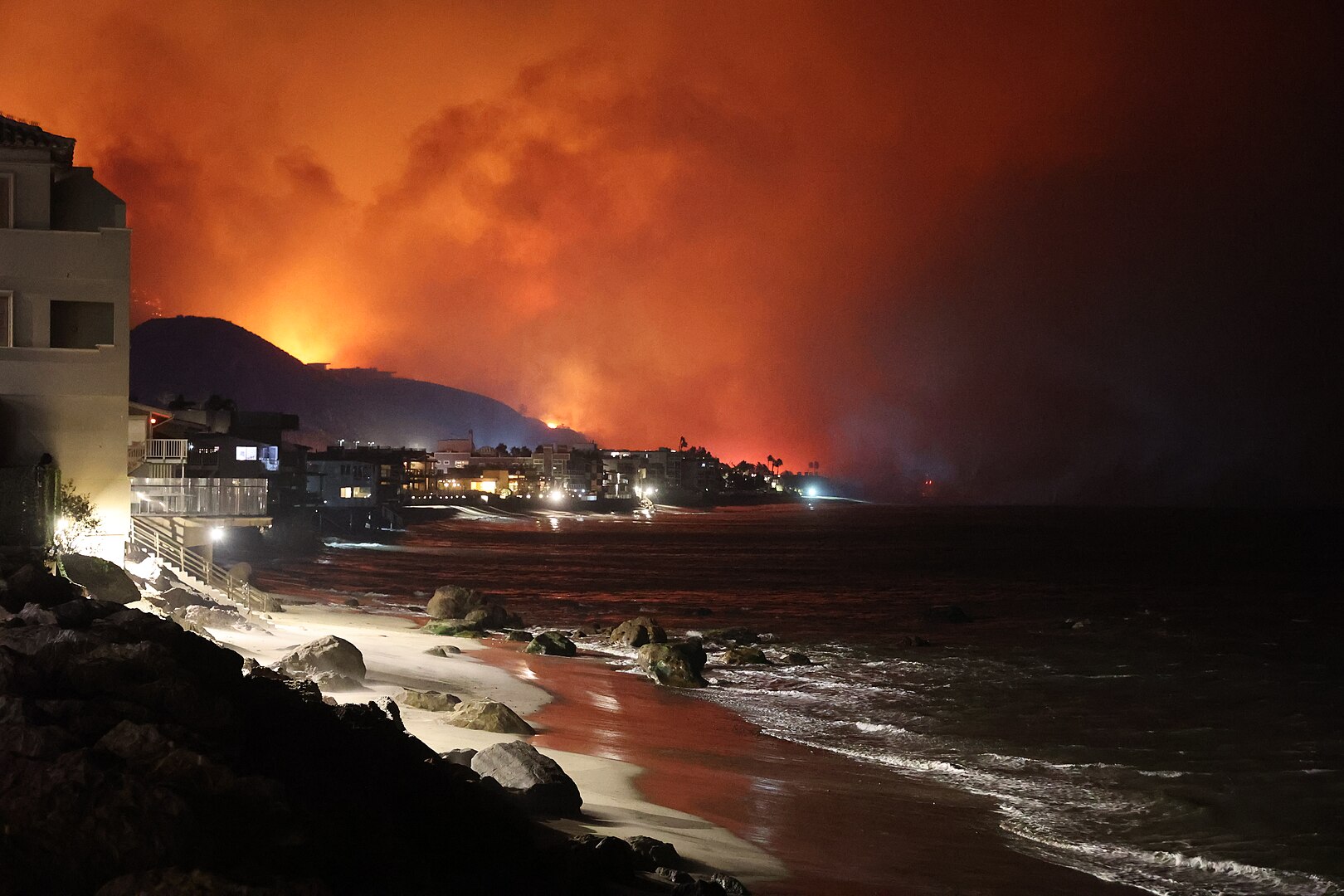
FILE: Palisades Fire viewed from the shoreline. (Photo by CAL FIRE_Official – Palisades Fire/Wikimedia Commons, Public Domain)
As the world has watched the Los Angeles wildfires, seeing the loss and destruction that accompanies environmental disaster, some influencers have seen opportunity.
Selfie-seekers have been spotted using the wildfires as a backdrop for their social media content. Videos have circulated of would-be influencers filming dances and videos in the shadows of the disaster area. Others have faced backlash for making “get ready with me while I evacuate” videos or using the fires to promote wellness products.
As long as there have been front-facing smartphone cameras, people have snapped selfies in inappropriate settings – from Auschwitz to the 9/11 memorial. It also happens at more localised disasters such as motorway accidents and funerals.
Selfie-style content was also rampant during the Maui wildfires in 2023 and, as a result, the local Hawaiian community expressed how troubling it felt that their devastating losses were being turned into a social media spectacle.
In a personal example, I can remember going to Buckingham Palace in London immediately after the announcement of Queen Elizabeth II’s passing, and seeing people filming TikTok dances in front of the palace gates – even breaking out specialist filming equipment like ring lights.
The sight of someone filming for social media amid a sombre physical setting can appear strange. But as someone who researches how people photograph themselves in the social media era, I have come to understand the nuances that cause and accompany this behaviour.
Very often, the background of a photograph or video only carries meaning for the creator insofar as it can be part of their brand. This might, unfortunately, mean there is less concern for the people around them in favour of the audience that will eventually view their post.
As is the case with most self-focused content, the purpose of taking a video is often not to document a memory or to capture something beautiful. Instead, the aim is to perpetuate and maintain one’s own brand through social media.
Influencers’ posts are infused with symbols and subliminal messaging – often through a backdrop – that communicate their social status to their audience. I have researched the social signifiers that creators aim for with their content.
Surrounded by wildfires, the influencer might be trying to communicate heroism, empathy, suffering or understanding. A post from an area with global news attention might show them to be in the “centre of the action”, which carries social capital itself.
Cognitive dissonance
Much content on social media is about self-presentation. To understand it, it’s helpful to turn to the work of influential Canadian-American sociologist Erving Goffman, whose 1956 theory compares self-presentation to an actor performing in a play. This “theatre of the self” includes a frontstage and backstage, with corresponding behaviours for each.
The frontstage is where the performance takes place and is tailored for its intended audience in mind. The backstage is where the preparation for the performance takes place and can often be messy or untidy. Sacrifices are usually made in the backstage in preparation for the frontstage performance.
Today, many frontstage performances happen online. Scholars refer to this as impression management 2.0. When the frontstage is virtual, the backstage remains in our physical world. The sacrifices made to achieve an ideal online impression all fall into our physical surroundings, and wherever the influencer or content creator finds themselves – even in the centre of a natural disaster.
Obviously, creating content amid an unfolding disaster can be considered quite exploitative and widely miss the mark as far as the intended social meanings.
Research shows that those who are more likely to engage in this type of performance for impression management are also more likely to demonstrate a level of cognitive dissonance towards what is unfolding in the physical world around them.
This can be described as narcissism normalisation and is often considered within the context of tourism and social media. Tourists now take photos of themselves with the sites they are visiting as backdrops with the aim to post on social media, rather than taking photos of the sites themselves. The prioritisation of one’s online social environment, where they are the “main character”, can impede concern for the physical world.
Many of the LA selfie-seekers will have a genuine concern for the local community suffering in the wildfires, or they may themselves be part of that community. But their pursuit of impression management could potentially be taking priority over that empathy.
On the other hand, we should not forget that taking selfies and creating content are now normal parts of everyday life. For some, this might be the only (or best) way they know how to express their empathy.
Much good can come out of social media in response to disasters: fundraisers, safety instructions or even the comfort of a shared experience. But as climate change inevitably leads to more frequent natural disasters such as wildfires, this kind of content will become more widespread.
This presents a dilemma – that as we become increasingly exposed to “natural disaster content”, we may become desensitised to it, and even stop feeling the empathy that accompanies these images.
Lauren A. Siegel, Senior Lecturer in Tourism and Events, University of Greenwich
This article is republished from The Conversation under a Creative Commons license. Read the original article.




















