

By Precious Chatterje-Doody, The Open University; The Conversation
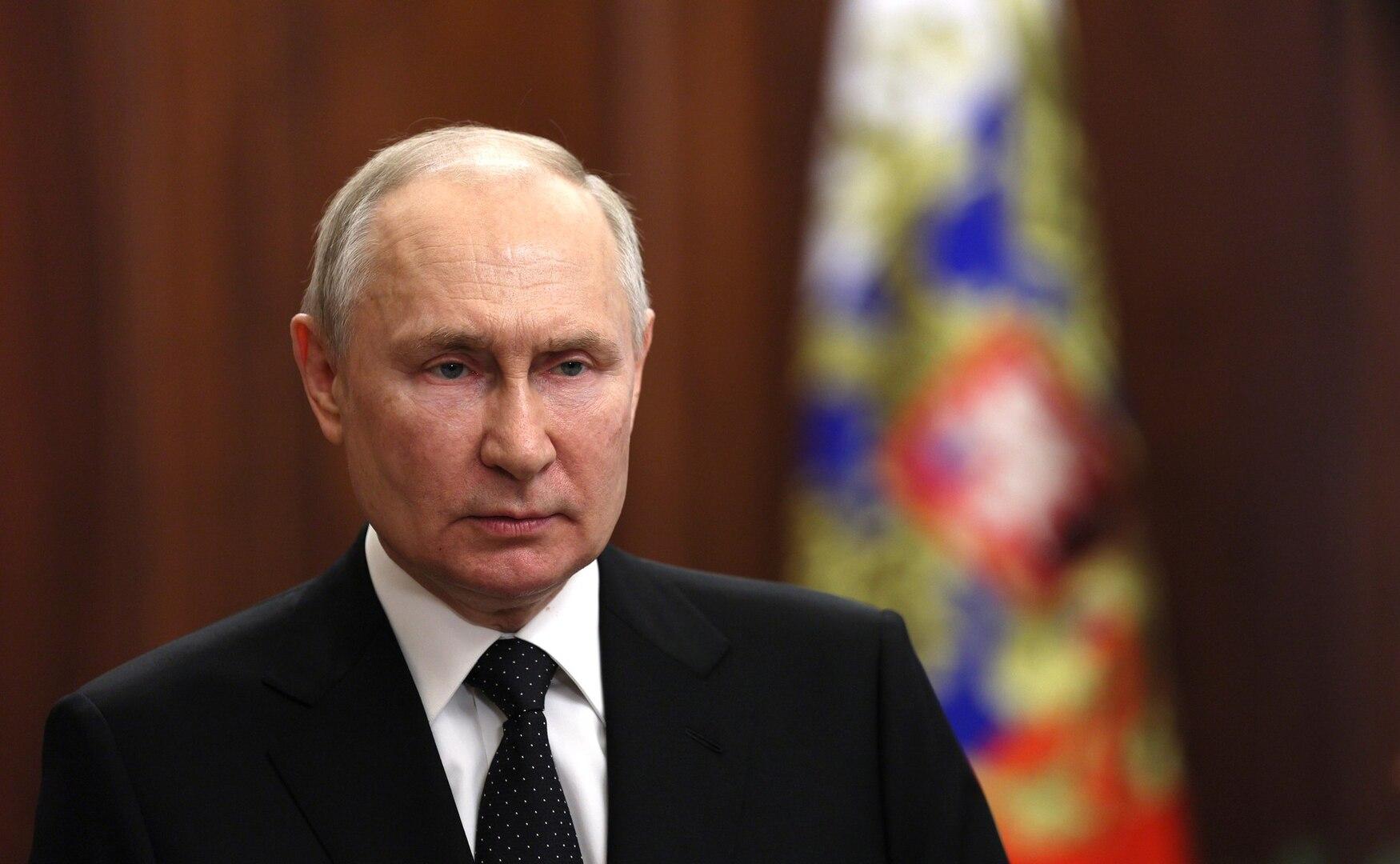
FILE: Putin making an address to the Russian people regarding Yevgeny Prigozhin’s private military company Wagner Group rebellion on 24 June 2023. (Photo By Kremlin.ru/Wikimedia Commons, CC BY 4.0)
Russia’s former president and current deputy head of its security council, Dmitry Medvedev, has declared that the editors of the Times newspaper in the UK are now “legitimate military targets”.
Medvedev, who is one of Vladimir Putin’s closest allies, was responding to the newspaper’s coverage of the recent assassination of Russia’s chemical weapons chief, Igor Kirillov, in Moscow on December 17. The paper’s leading article referred to his killing by an explosive device hidden in a scooter as a “legitimate act of defence by a threatened nation”.
Medvedev took to Telegram to denounce the article, writing: “Those who carry out crimes against Russia … always have accomplices. They too are now legitimate military targets. This category could also include the miserable jackals from the Times who cowardly hid behind their editorial. That means the entire leadership of the publication.”
The assassination of Kirillov, who was in charge of Russia’s chemical, biological and nuclear defence forces, came a day after he had been charged by Ukraine in absentia with war crimes over Russia’s use of chemical weapons in the ongoing war.
Once seen as a liberal reformer when he temporarily took over Russia’s presidency between 2008 and 2012, Medvedev has since reinvented himself as a pro-war hawk who regularly makes outlandish or extreme statements on social media.
In May 2023, following a drone attack on the Kremlin, Medvedev posted a message on Telegram saying there were “no options left other than the physical elimination of [the Ukrainian president] Zelenskyy and his clique”. The post prompted Ukraine’s foreign minister, Dmytro Kuleba, to respond in an interview that “Medvedev should drink less vodka before going on Telegram”.
In his most recent outburst, Medvedev mirrored the rhetoric used in the Times editorial, claiming that by the same logic, all of Kyiv’s “accomplices” – whether decision-makers in Nato or journalists justifying Ukraine’s actions – are active participants in a war against Russia. This makes them “legitimate military targets” who need to “be careful” even in London, where “anything goes”.
Part of a pattern
Medvedev’s comments, while extreme, fall within a broader pattern of Russian officials using humour or courting controversy to justify their positions or ensure international press coverage. But they are also part of an escalation in Russian attacks on freedom of expression and the press.
Prior to the full-scale invasion of Ukraine, Russia’s media environment was restricted. Opposition viewpoints could, however, still be accessed relatively easily from a range of sources, including the regional press, online outlets and the political blogosphere. But the Kremlin has gradually chipped away at these possibilities by increasing restrictions on independent media and social media users alike.
These restrictions were ramped up even further following Russia’s invasion of Ukraine in February 2022. Criticism of the armed forces and spreading what the Kremlin deems “false information” about the so-called “special military operation” were criminalised.
Anti-war activists now routinely face conviction for justifying terrorism, and well-respected news outlets such as Ekho Moskvy have been forced to close. Journalists from Russia and abroad have been tried, convicted and incarcerated for allegedly violating these laws. They are often held in harsh conditions, in isolation and without access to adequate medical care.
But it is not just journalists and activists within Russia who have come under threat from this increasingly authoritarian regime. As well as its military incursions into Georgia in 2008 and eastern Ukraine since 2014, Russian intelligence organisations have been blamed for a number of targeted provocations abroad in recent years. In the case of the 2018 Salisbury poisonings, these resulted in fatalities on British soil.
Russian involvement is, of course, always denied. Kremlin propaganda uses a range of disinformation tactics to hide Russia’s culpability. With the Salisbury poisonings, this included an outlandish television interview on Russia’s RT network, where the main suspects claimed to be visiting health supplements salesmen. My research at the time showed that online audiences universally rejected their story, but incredulity over the interview overtook public anger.
Contrasting values
As my research has shown, extreme statements and conspiracy theories circulate rapidly and widely in today’s international media environment. With this in mind, it is common for the Kremlin and its proxies to mirror accusations back towards other parties and accuse them of hypocrisy.
Taking questions from a US journalist in his end-of-year press conference and phone-in on December 19, Putin was asked about the “failure” of the special military operation in Ukraine. The reporter went on to describe Putin’s position as “weaker” than that of the incoming US president, Donald Trump.
Putin insinuated that the very fact this US journalist was included in the event showed a better treatment by Russia of “esteemed” international journalists than Russian journalists receive from the US.
This is patently untrue. Wall Street Journal reporter Evan Gershkovich was imprisoned in Russia for 16 months on trumped-up espionage charges, after being detained in March 2023 while covering the effect of western sanctions on the Russian economy.
Russia’s crackdown on freedom of speech and freedom of the press is precisely because authoritarian regimes recognise they are incredibly vulnerable to the free and open-ended enquiry that my co-authors and I have argued is so crucial to defend.
As a spokesperson for the UK prime minister, Keir Starmer, noted in response to Medvedev’s latest comments: “A free press is a cornerstone of our democracy.”
Precious Chatterje-Doody, Senior Lecturer in Politics and International Studies, The Open University
This article is republished from The Conversation under a Creative Commons license. Read the original article.




















