Uncategorized
At the border, both Canada and the U.S. are turning to technology to keep migrants out

By Matthew Lapierre, CBC News, RCI
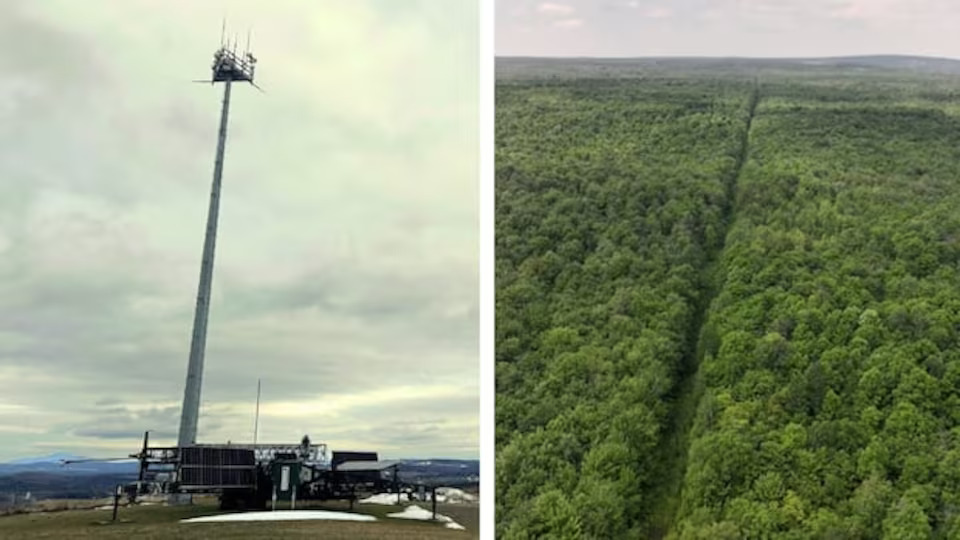
After announcing a $1.3B plan to increase security on the U.S. border, Canadian officials offered an idea of how that money could be spent. Photo: CBC
Border patrol says surveillance makes it easier to monitor vast, unstaffed areas
In Derby, Vermont, a tall, slim tower stands on a hill, observing the landscape.
Atop the tower, cameras face north toward Quebec — just a few hundred metres away.
The tower, and at least two others like it, appeared on the U.S. side, near the Canadian border, at some point over the past two years or so. They’re part of a response to a rise in irregular border crossings in the area, most involving people crossing into the U.S. via Canada.
The towers are new, but they’ve already dotted the Southern U.S. border for years. U.S. border patrol has been installing surveillance towers equipped with cameras and other sensors along the Mexican border since the mid-2000s. The agency also uses drones and a litany of other technologies to deter and catch migrants there.
Now, American officials are deploying the same technologies at the northern border. Canada will soon mirror them by boosting investments in drones, sensors and other tech, including its own surveillance towers — part of a commitment to harden the border to dissuade President Donald Trump from his threat of imposing massive trade tariffs (new window).
But advocates and experts say the deployment of new technologies risks endangering migrants while failing to deter them, poses privacy concerns, and will drive millions of dollars to military contractors.
There’s this normalization of tech at the northern border now … where Canada perhaps feels like it has to acquiesce to what the United States is asking for,
said Petra Molnar, the associate director of York University’s Refugee Lab and the author of The Walls Have Eyes, a book about the confluence of technology and migration.
There’s going to be more towers; there’s going to be more drone surveillance, ground surveillance.
On a recent morning on the U.S. side of the Canadian border near the town of Stanstead, Que., the landscape was quiet. A shallow ditch or a clearing in the forest with intermittent stone markers are among the only things marking the line between the two countries.
But the new surveillance tower looms over the town, and is easily visible from Canada.
Atop its perch on the hill, the tower enjoys a 360-degree view of the surrounding countryside.
It’s a visible symbol of the U.S.’s commitment to monitor its northern border. Documents show that United States Customs and Border Patrol (USBP) plans to lean on remote surveillance in the Swanton sector, a large swath of land near Quebec that includes northern New York and Vermont where most irregular crossings take place.
An environmental assessment submitted by USBP to support the tower construction, which was first reported by VT Digger (new window), says the agency needs more video surveillance in remote areas to monitor illegal entries without committing numerous agents in vehicles to perform the same functions.
The increasing frequency and nature of illegal cross-border activities, as well as the geographic area over which these activities occur, create a need for a technology-based surveillance capability,
the agency said.
USBP intercepted more than 21,000 migrants crossing illegally from Canada in the first 10 months of 2024, according to data published by U.S. Customs and Border Protection (new window), almost 18,000 of them in the Swanton Sector.
Northern border looks more like the south
On Dec. 17, Dominic LeBlanc, Canada’s public security minister, announced $1.3 billion over six years to spend on new security measures at the border.
LeBlanc said the money will go, in part, toward establishing a task force that will provide round the clock surveillance between ports of entry and complement existing foot and vehicle patrols.
The RCMP has been slowly ramping up its use of drones patrolling the border (new window), according to the latest available data. In 2022, it flew drones approximately 120 times for border security-related reasons.
But LeBlanc said the new task force will use aerial surveillance and mobile surveillance towers — essentially moveable versions of the towers on the U.S. side of the border. LeBlanc also said Canada was going to use artificial intelligence to help police the border.
But critics of these technological solutions say they are expensive, difficult to maintain (new window), do little to deter people from trying to cross in the first place — and can endanger migrants by forcing them to take more dangerous routes.
A 2019 University of Arizona study (new window) found that border enforcement infrastructure, including surveillance towers, pushes migration routes into more rugged and dangerous terrain, leading to more deaths in those areas.
Molnar said the technology being deployed on borders — much of which, she said, is tested at the U.S. southern border before being sold elsewhere — dehumanizes people who are trying to cross the border as well as posing privacy concerns about data collection for those who live or travel near borders.
It goes beyond privacy,
she said. The concern is that if we introduce more surveillance that people are going to learn about, they’re not going to stop coming. They’re going to take dangerous routes through frozen farmers fields, rivers. It really is the concern that it’s going to mimic the humanitarian crisis that’s happening at the U.S.-Mexico border.
David Grondin, a communications professor at the Université de Montréal and researcher at the Centre d’études et de recherches internationales, said Canada was pressing the panic button
on border security in response to Trump’s tariff threat.
It’s responding to American concerns but there’s no real guarantee that this will lead to a more secured border,
he said.
Grondin and Molnar said they had attended border security technology expositions. At recent expos, vendors touted drones, sensors and surveillance cameras, in addition to ubiquitous artificial intelligence-powered tools to recognize and catch smugglers and migrants.
This article is republished from RCI.