By Stefan Wolff, University of Birmingham; The Conversation
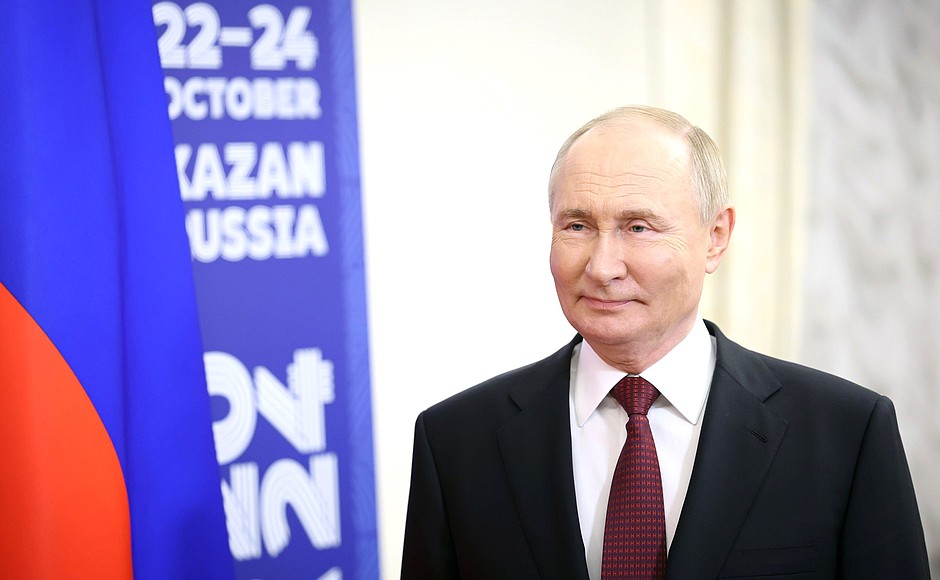
According to a statement by Russia’s president, Vladimir Putin, at a meeting of senior Brics security officials in September, 34 countries have expressed an interest in closer relations with Brics in some form. (File photo by Kremlin.ru, CC BY 4.0)
The recent Brics summit in the Russian city of Kazan was less notable for what happened at the meeting than for what happened before, on the margins, or not at all. Among the notable things that did not happen was another expansion of the organisation.
Since the addition of Egypt, Ethiopia, Iran and the United Arab Emirates (UAE) at the 2023 Brics summit in Johannesburg, which almost doubled the number of member countries from the original five (Brazil, Russia, India, China and South Africa), further enlargement has stalled.
Argentina, which was also invited in 2023, declined to join. Saudi Arabia, another 2023 invitee, has not acted on the offer to become a member either. Its de-facto ruler, crown prince Mohammad bin Salman, was among the notable absentees in Kazan.
And Kazakhstan, Russia’s largest neighbour in Central Asia, decided not to join shortly before the summit. This drew Russia’s ire, resulting in a prompt ban on imports of a range of agricultural products from Kazakhstan in retaliation.
While invitees have declined the opportunity to join Brics, a long list of applicants have not been offered membership. According to a statement by Russia’s president, Vladimir Putin, at a meeting of senior Brics security officials in September, 34 countries have expressed an interest in closer relations with Brics in some form.
This appears to be a substantial increase in interest in Brics membership compared to a year ago, when South Africa’s foreign minister, Naledi Pandor, listed 23 applicants ahead of the 2023 summit.
But the fact that, since then, only six invitations have been extended – and four accepted – indicates that formal enlargement of the organisation, at least for now, has been stymied by the inability of current members to forge consensus over the next round of expansion and the reluctance on the part of some invitees to be associated with the organisation.
Meetings on the margins
The summit declaration may offer little of substance. But there were a number of bilateral meetings before and in the margins of the gathering that are more indicative of the direction of Brics. Perhaps most importantly, India’s prime minister, Narendra Modi, and China’s president, Xi Jinping, held their first face-to-face discussion in five years.
This is a remarkable change from just a few months ago, when tensions between New Delhi and Beijing were intense enough for Modi to cancel his participation in the summit of the Shanghai Cooperation Organisation in Astana, Kazakhstan. Yet, with a deal now reached over their countries’ longstanding border dispute, the two most populous and, in terms of GDP, economically most powerful members of Brics have an opportunity to rebuild their fraught relations.
A warming of relations between China and India could generate more momentum for Brics to deliver on its ambitious agenda to develop, and ultimately implement, a vision for a new global order. Implicit in this would be a shift of leadership in Brics from China and Russia to China and India, and with it, potentially a change from an anti-western to a non-western agenda.
This is, of course, something that exercises Putin. He acknowledged as much when he referred to the global south and global east in his remarks at the summit’s opening meeting. He also emphasised that it was important “to maintain balance and ensure that the effectiveness of Brics mechanisms is not diminished”.
In his own bilateral meetings before and during the summit, Putin drove home the point that, despite western efforts, Russia was far from isolated on the world stage. One-to-one meetings with Xi, Modi, South Africa’s president, Cyril Ramaphosa, and the president of the UAE, Mohammed bin Zayed Al Nahyan, gave Putin the chance to push his own vision of Brics as a counterpoint to the US-led west.
This may be a view shared in the global east – Russia, China and Iran, as well as non-Brics members North Korea, Cuba and Venezuela. But many in the global south – particularly India and Brazil – are unlikely to go all in with this agenda. They will focus on benefiting from their Brics membership as much as possible while maintaining close ties with the west.
Lacking a coherent agenda
India is the most significant player in Brics when it comes to balancing between east and west. Nato member Turkey is the equivalent on the outside. The country’s president, Recep Tayyip Erdoğan, travelled to Kazan and did not shy away from an hour-long meeting with his “dear friend” Putin.
The relationship between Moscow and Ankara is fractious and complex across a wide range of crises from the South Caucasus, to Syria, Libya and Sudan. Yet, on perhaps the most divisive issue of all, Russian aggression towards Ukraine, Turkey has consistently maintained opened channels of communication with Russia and remains the only Nato power able to do so.
The fact that there has been relatively little public pressure from official sources in the west on Erdoğan to stop is probably a reflection that such communication channels are still valued in the west. This, and Nato’s continued cooperation with India, point to a hedging strategy by the west. India cooperates with the US, Australia and Japan – the so-called Quad group of nations – on security in the Indo-Pacific, and it has maintained political dialogue with Nato since 2019.
Turkey and India may not see eye-to-eye with the west on all issues. But neither do they with the global east camp inside Brics, and especially not with Russia. If nothing else, this limits the ability of Brics to forge a coherent agenda, deepen integration and ultimately mount a credible challenge to the existing order.
Relying on India and Turkey to do the west’s bidding in undermining Brics, however, is not a credible long-term strategy. Brics may have achieved little as an organisation, but the Kazan summit declaration indicates that its key players continue to harbour aspirations for more.
However, as the flailing expansion drive of the organisation indicates, there is also an internal battle in Brics over its future direction. This, in turn, creates space and time for the west to exercise more positive and constructive influence in the ongoing process of reshaping the international order.
The global east may be beyond redemption, but there is still a massive opportunity to reengage with the global south.
Stefan Wolff, Professor of International Security, University of Birmingham
This article is republished from The Conversation under a Creative Commons license. Read the original article.