
Headline
In diplomatic spat, Thai junta tries to keep lid on dissent, and good relations with US

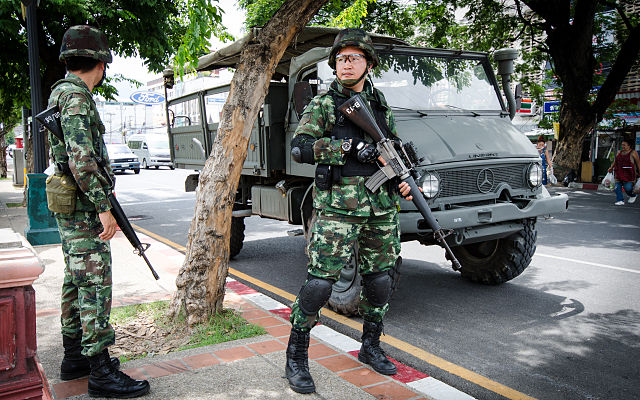
Thai soldiers at the White Elephant Gate, Chiang Mai. Takeaway / Wikimedia Commons.
BANGKOK—When Thailand’s military junta sensed it was being criticized this week, the country’s rulers reacted as they always do: by issuing stern warnings and summoning those responsible for talks army leaders like to refer to as “attitude adjustments.”
But this time, those called to explain themselves were not just domestic opponents of last year’s coup. They included the U.S. charge d’affaires, who was asked to clarify a speech by a visiting senior U.S. diplomat in which he urged an end to martial law and suggested that last week’s impeachment of ousted former Prime Minister Yingluck Shinawatra was politically motivated.
The comments Monday by Daniel Russel, the assistant secretary of state for East Asian and Pacific affairs, triggered a predictable backlash of anti-American sentiment from the junta and its supporters. They denounced what they saw as unwanted interference in Thai affairs and bombarded the U.S. Embassy’s Facebook page with messages like “Yankees go home. It’s none of your business.”
The political spat has laid bare the delicate path Thailand’s leaders have been trying to navigate since toppling a democratically elected government in May, both by keeping a lid on dissent at home and by maintaining good relations with foreign allies abroad.
Although Thai officials are well aware of Washington’s opposition to their seizure of power, Russel’s comments appear to have struck them by surprise.
In a speech to students at Chulalongkorn University, Russel spoke mostly about the importance of the 182-year-old Thai-American alliance, and stressed that Washington would not take sides in Thai politics.
But over the course of a couple of short minutes, he bemoaned junta-imposed constraints on freedom of expression, which have crushed open political debate, and called for an end to martial law, which the army imposed just before seizing power. He then brought up Yingluck’s recent impeachment by the military-appointed legislature for her role in overseeing a money-losing rice subsidy program.
“I’ll be blunt here,” Russel said. “When an elected leader is deposed, impeached by the authorities that implemented the coup, and then targeted with criminal charges while basic democratic processes and institutions are interrupted, the international community is left with the impression that these steps could be politically driven.”
Thitinan Pongsudhirak, director of Chulalongkorn University’s Institute of Security and International Studies, which hosted Russel, said the junta viewed the Yingluck remark in particular as an open attempt to interfere in the country’s politics and legal system.
“That’s why they’re angry. They want the international community’s recognition, and the U.S. is a big part of that,” Thitinan said. Ultimately, he said, the junta wants “approval, not criticism.”
Russel, the most senior American official to visit Thailand since the coup, pointedly avoided meeting military ruler-turned Prime Minister Prayuth Chan-ocha Prayuth, holding talks instead with his foreign minister, other pro-junta politicians and Yingluck.
After the speech, the junta summoned U.S. Charge d’Affaires W. Patrick Murphy, currently the most senior American diplomat stationed in Bangkok, to explain their displeasure. Deputy Foreign Minister Don Pramudwinai said Russel’s comments had “hurt” many Thais.
Prayuth also scolded Washington, saying the U.S. doesn’t “understand the way we work.”
He said: “Our way of life, our political leaders are not like theirs.”
Despite the bluster, Prayuth acknowledged the need to maintain good relations, and move on. Bilateral relations “still exist,” he said. “Trading and investment is still going on. Companies … still come to trade with us.”
Indeed. Bilateral trade between Thailand and the U.S. alone has averaged more than $40 billion in recent years, with Thailand exporting everything from tuna to rubber to jewelry to America.
Overwhelmed for more than a decade by wars in Iraq and Afghanistan, and anxious over the rising power of China, Washington considers Thailand a relatively stable ally that it can’t afford to lose. Although the U.S. suspended $4.7 million in military assistance after the coup, it has done little else to punish the Southeast Asian nation.
And despite speculation that U.S.-led regional Cobra Gold military exercises could be cancelled, the annual Thai-hosted training program is going ahead in February, albeit scaled down with no large live-fire exercises and focusing this year on humanitarian assistance and disaster relief.
“It’s our oldest ally in the region,” said Doug Paal, who served as White House director of Asian affairs in the Reagan and George H.W. Bush administrations. “We have historically and potentially in the future will need to rely on access to Thailand for military operations in various contingencies. We also have deep economic and political ties with the Thai.”
“The new condition on this relationship is that we are in a kind of competition with China for influence. Thailand is geographically central and consequential to the region. As it falls more and more under China’s influence, the direction of ASEAN as a stabilizing organization of friendly states will be put at risk,” said Paal, referring to the 10-nation Association of Southeast Asian Nations.
Thailand has been shifting closer to China for years, and that relationship appears to have grown stronger since the coup. Since October alone, Prayuth has met Chinese Premier Li Keqiang five times, including during a December visit to Beijing. The two governments have signed key deals, including a train project to be built in Thailand. By contrast, Prayuth has met President Barack Obama once, on the sidelines of a regional summit.
China is Thailand’s leading trading partner—followed by Japan, then America—with business between the two nations estimated at around $65 billion per year, according to the Thai Commerce Ministry.
Although one opinion piece in the conservative English-language The Nation newspaper suggested that “Thailand and the U.S. should go their separate ways,” Thitinan said nothing was likely to change in Thailand’s relationship with Washington.
It’s also business as usual, at home.
Russel’s speech appears to have emboldened several members of the ousted former ruling party, who have spoken up or criticized the junta in different ways in the last few days.
The junta summoned four of them for talks this week.
Associated Press writer Matthew Pennington in Washington contributed to this report.




















