News
The West can’t ‘solve’ its Russia problem. Here’s how it should handle 6 more years of Vladimir Putin

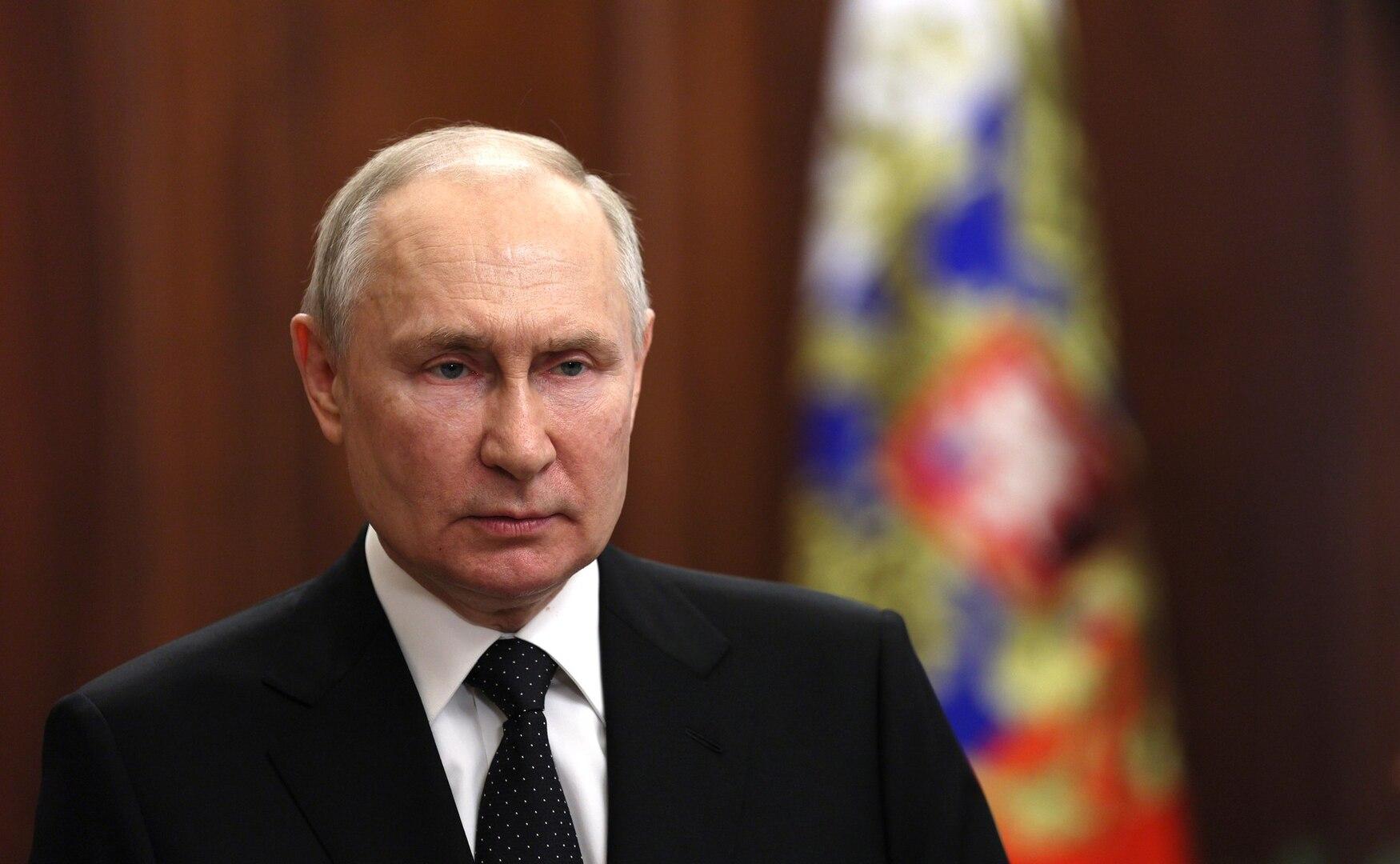
FILE: Putin making an address to the Russian people regarding Yevgeny Prigozhin’s private military company Wagner Group rebellion on 24 June 2023. (Photo By Kremlin.ru/Wikimedia Commons, CC BY 4.0)
In perhaps the least surprising news of the year, Vladimir Putin has triumphed at the Russian ballot box and been enthroned for the fifth time as president. He will serve for six more years.
He will be 77 years old in 2030. According to the constitution, which he re-wrote to his benefit in 2020, he then could stand again for a further six-year term.
To put that in perspective, Putin already has ruled Russia as president or prime minister for 24 years, or the equivalent of eight Australian parliamentary terms. In that period, Australia has had eight prime ministers and changed governing party three times. The United States has had five different presidents; the United Kingdom seven different prime ministers.
In contrast to elections in the West, where the outcomes are genuinely in the hands of the voters and adjudicated by independent electoral commissions, Russia is different. As the former UK ambassador to Moscow, Laurie Bristow, wrote:
In Russia, the purpose of elections is to validate the decisions of its rulers, not to discover the will of the people.
Putin’s jaded view of the West
Putin now will appoint a new government. His picks will be intensely scrutinised for clues to a succession plan and future policies. Although he is a master of surprise, we should not count on Putin leaving any time soon. Only four leaders of modern Russia and the USSR have left the top job alive; the rest have died in office of natural or other causes.
Moreover, Putin’s actions over the past two years have been directed at moving Russia from authoritarianism to semi-totalitarianism. The Carnegie Endowment’s Andrei Kolesnikov has written persuasively of these tectonic shifts that recall the darkest years of Soviet Stalinism.
Putin has explicitly presented his war of choice in Ukraine as a proxy for a wider, long-term conflict with the West. He believes the West is irresolute, in decline, and easily distracted and deflected.
Former US President Donald Trump’s “have at them” attitude towards US allies and partners, and the woeful Western vacillation over further military aid to Ukraine, will only embolden Putin further. Buoyed by his ritual success in this weekend’s election, he will embark on further risky and provocative adventurism.
Consequently, Putin – and the ideology of “Putinism” – pose a serious challenge for Western governments and policymakers who are genuinely accountable to their electorates, the party room, the parliamentary opposition, a vocal and inquisitorial media and an independent judiciary.
As exiled Russian journalist Mikhail Zygar has argued, part of Putin’s statecraft is directed at making common cause with ultra-conservative Western political elements to contest global “wokeness”, demobilise support for Ukraine, and dull resistance to Russian territorial ambitions in its neighbourhood.
How democratic governments need to respond
Putin is well aware that the inherent fractiousness of democracy and the need to court the fickle voters hobbles democratic governments’ long-term planning.
Moreover, our political culture is predisposed to wanting to “solve” issues. Sometimes, though, problems of the scale posed by Russia or the Middle East can only be managed, not solved – and then only through joint efforts with like-minded allies and partners. That requires persistence and resilience to rise above short-term politicking and the twitches of our “instant expert” social media culture.
It also demands constant investment in building and sustaining public understanding of what really is at stake, beyond the borders of Europe that were drawn in the bloodshed and misery of the second world war.
This is difficult anywhere, not least in the West, where we have had it comparatively easy for most of the post-second world war era. We need stalwart and principled leadership now more than at any other point in the last 50 years. Most of all, we need ongoing serious and informed public conversations about what we value in and wish for in democratic societies, and the price we are willing to pay to attain and preserve that.
That sort of discourse can be hard to generate in our politically rather apathetic society. However, it is vital when the institutions of our democracy are barraged by foreign information manipulation and interference designed to sow doubt and distrust and corrode popular faith in the integrity of our form of government.
Especially in Australia, we have allowed our already limited pool of Russia expertise to atrophy to near-extinction. It is well past time to re-invest, modestly but purposefully, in Russian language and associated studies at our universities. We need to boost “Russia literacy” and comprehension of a country that will remain a significant and disruptive player in the world. This matters to countries that matter to us.
We should also honestly and critically assess the mistaken assumptions and indifference that at times have undermined effective Western policies towards post-Soviet Russia. However, we should not succumb to the propaganda peddled by Putin and his proteges abroad that Moscow is a blameless victim of Western perfidy and deception aimed at destroying the Russian state.
Rather, as Australian professor Mark Edele writes in his recent book, Russia’s War Against Ukraine:
Russia never came to terms – either as a society or as a polity – with its transformation from a continental empire with global reach into a nation-state and a regional power.
The Kremlin is marketing Russia as an ally of “the Global South” in resisting resurgent neo-colonialism and championing “multipolarity”.
The Putin thesis is that Ukraine is a patsy of London and Washington, while Moscow is on the side of the formerly colonised. That argument is finding some ready ears, evident in the patchy support for sanctions on Russia. We cannot assume our own Indo-Pacific region is persuaded of the wrongness of the Kremlin’s claims.
The reality confronting us is that of a sullen and resentful Russia, convinced that history, morality and even divinity is on its side in a de facto existential war with the West.
Moreover, as Bristow, my former colleague in Moscow, has written:
we would be unwise to assume that a rising generation of Russians will embrace a more democratic and pro-Western outlook.
Yet, we must not turn away from those Russians – far from an irrelevant minority – who do not share Putin’s view that the future of their country lies in the perceived glories of its past. The challenge is to articulate what a better future would look like for Russia, beyond confrontation, and to keep that alternative clearly in view.
Peter Tesch, Visiting Fellow at the ANU Centre for European Studies, Australian National University
This article is republished from The Conversation under a Creative Commons license. Read the original article.