
Canada News
Brian Mulroney’s tough stand against apartheid is one of his most important legacies

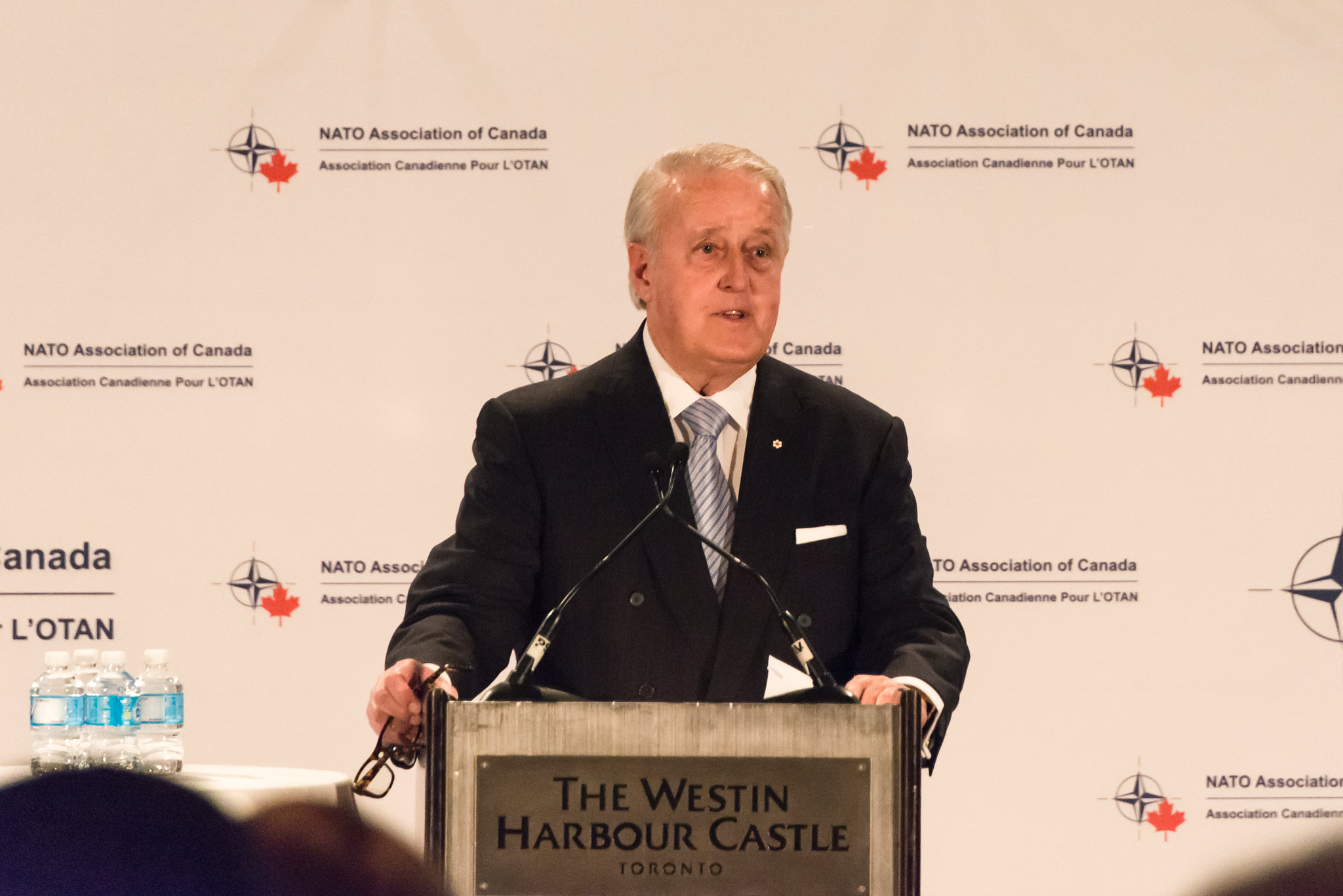
Mulroney was a master of the multilateral system. (File Photo: NATO Association of Canada (NAOC)/Flickr, CC BY 2.0)
With his passing announced on Feb. 29, Canadians have cause to reflect on the legacy of former prime minister Brian Mulroney. What will last when the great book of history is written is that Mulroney played a central role in the dismantling of apartheid in South Africa.
This contribution, along with Canada’s contributions to the First and Second World Wars and the creation of peacekeeping, will stand among the great foreign policy contributions in Canadian history.
At the outset, we must acknowledge that apartheid — the system of racial separation and white domination of Blacks and others in South Africa — was brought down principally by South Africans themselves. Their internal opposition to the regime, their mobilization of world opinion and action against it and their courage and moral clarity was a necessary condition for its end.
But the end of apartheid was accelerated by allies in the democratic West, and at the head of that group stood Mulroney. Indeed, there is good reason why Nelson Mandela made his first foreign visit to Canada’s Parliament after his release from prison in February of 1990.
South Africa awarded Mulroney its highest honour for foreign citizens in 2015 for his “exceptional contribution to South Africa’s liberation movement and his steadfast support for the release of Nelson Mandela.”
It is important that we recognize this accomplishment not only for its moral merits, but because it can teach us how Canadian foreign policy — for moral and instrumental ends — can be done effectively. There are three lessons to learn (or relearn).
Lesson One: Mulroney recognized apartheid as indefensible and immoral
Mulroney’s opposition to apartheid was not driven by simple domestic politics and certainly not by diasporic concerns. Opposition to apartheid was widely held in Canada in the late 1980s and it was a live issue. But it was not one that obviously favoured Mulroney politically. So, why did he oppose it?
First, the issue was to him one of simple justice and morality. Like his early political mentor, John Diefenbaker, he thought the system was indefensible and immoral. It could not be redeemed by instrumental appeals to anti-Communism or whatever other realpolitik defences U.S. President Ronald Reagan or U.K. Prime Minister Margaret Thatcher advanced.
Second, he thought it was contrary to Canadian values, which have their roots in the founding of the country as a place dedicated to bringing different groups closer together, rather than farther apart. To maintain Canada’s credibility in the world as a middle power, Canada had to act in a way that was consistent with a system of values, and not simple power.
Lesson Two: Mulroney leveraged his political and personal power
Mulroney was a master of the multilateral system. By the late 1980s, accelerating and amplifying pressure on apartheid South Africa required ever stronger and tighter sanctions. This required as many nations as possible to agree to as strong a sanction regime as possible.
I had the opportunity to directly ask Mulroney about his international leadership in the campaign against apartheid. As director of the Munk School of Global Affairs and Public Policy, I hosted a conversation with Mulroney in September 2022. When I asked him how he used international institutions, Mulroney said:
People who say that nations only have interests, no friendships, is nonsense. … Everybody has interests but also friendships. And you can’t deal at the international level with any hostility. You gotta try and bring people (together). Canada is a middle power. We’re not a superpower. So we have to leverage our assets as best we can.
By 1987 and 1988, Mulroney had managed to secure the chairmanship of three international organizations covering the majority of the democratic world: The Commonwealth, the G7 and the Francophonie. In each of those organizations, he built personal ties with leaders, reinforced by a deep appreciation for their own domestic concerns and motivations.
When push came to shove on tightening sanction regimes, he had both personal power and agenda-setting power. He could put apartheid on the agenda, and he could use the depth of relationships to push and pull leaders to his own position. We have not had a prime minister since who has combined institutional power and personal connection to such an effect.
Lesson Three: Mulroney played a long game
Mulroney played a long(ish) game. When South African President F.W. de Klerk announced in February 1990 the immediate release of Mandela from a prison off the coast of Cape Town, he did not simultaneously agree to dismantle the laws enforcing apartheid.
Despite this, by Mulroney’s telling, he was under immediate and intense pressure from Thatcher to support the lifting of sanctions. Mulroney refused to do so until the system of racial separation in law was dismantled.
The broader context is important here. The Berlin Wall had fallen the year before and the world was experiencing a menacing uncertainty. Mulroney knew that the creation of a broader rules-based order with greater international security, more trade and more, not less, reconciliation depended deeply on defending democratic values. Those values had to be as deeply defended in South Africa as they were in a soon reunified Germany. They could not be abandoned as soon as attention moved elsewhere.
Mulroney’s legacy
We can arrive at different judgments of Mulroney’s legacy. To me, it is one marked by huge success and risky failures — but always an ambition to do big, consequential things. But in the final judgment, his confrontation of apartheid married moral clarity and effective politics. If only our politics had that same leadership again.
Peter Loewen, Director, Munk School of Global Affairs & Public Policy, University of Toronto
This article is republished from The Conversation under a Creative Commons license. Read the original article.




















