
Canada News
What does Donald Trump’s NATO posturing mean for Canada?

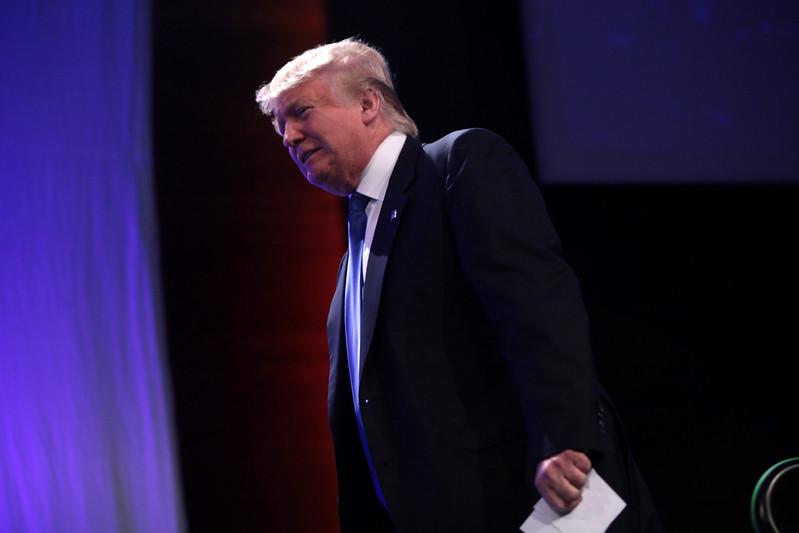
FILE: Former US President Donald Trump at the Iowa Events Center in Des Moines, Iowa. (Photo: Gage Skidmore/Flickr, CC BY-SA 2.0)
Donald Trump’s recent candid admission that he would encourage Russia “to do whatever the hell they want” to NATO members shirking their alliance commitments predictably dominated the news cycle for several days.
What this veiled threat means to Canada, which perpetually fails to meet NATO’s benchmark of spending two per cent of gross domestic product on defence, is uncertain — but certainly worrisome.
Even a potential Pierre Poilievre government would only “work towards” meeting the target. Poilievre’s simultaneous commitment to balancing the budget suggests that any substantial spending increases on the Canadian Armed Forces are unlikely.
Unilateralism, not isolationism
Despite some Republican efforts to calm the waters churned up by former president Trump, a recent survey conducted by the Chicago Council on Global Affairs highlights the decreasing Republican appetite for foreign commitments.
It found that a majority of “Trump Republicans” would prefer the United States was less involved in global affairs. Findings like this predictably inspire headlines about American isolationism. The recent stalled funding for Ukraine in the U.S. Congress reflects this development.
According to historian Walter Russell Meade, Trump pursued a classical “Jacksonian” approach to governance during his presidency: a minimalist government that aims “to fulfil the country’s destiny by looking after the physical security and economic well-being of the American people in their national home, and to do that while interfering as little as possible with the individual freedoms that makes the country unique.”
However, this approach is less about “isolationism” than it is “unilateralism.” It’s in keeping with what Trump announced in his 2017 “America First” national security strategy and later re-emphasized in his 2019 address to the United Nations General Assembly — U.S. domination unshackled by having to work with others.
This is evident in the Chicago poll finding that “half of Trump Republicans (48 per cent) say the U.S. should be the dominant world leader, while a majority of non-Trump Republicans (65 per cent) say the country should play a shared leadership role.” In essence, Jacksonians see no value in working with foreigners because that curtails America’s ability to make decisions solely in its own interests.
What would the end of NATO mean?
A bipartisan bill in the U.S. Senate passed in late 2023 prohibits a unilateral presidential withdrawal from NATO without a two-thirds Senate majority or a specific act of Congress.
However, an American president could easily hobble NATO by withdrawing Europe-based U.S. troops, forgoing active participation in NATO exercises and, more generally, by raising doubts about the sanctity of Article 5 of the NATO treaty, which essentially assures collective defence if any member is attacked.
The end of NATO would mark the destruction of the post-Second World War international system and a return to a balance-of-power arrangement. In such a world, the largest powers would dictate the structures and rules under which their regional spheres of influence would be governed, regardless of the wishes of the citizens of those sovereign nations.
What would this mean for Canada as part of the American sphere? While most of Canada’s trade flows south rather than across oceans — and although the collapse of the post-war multilateral system of relationships would normally be a disaster for a medium-sized trading nation like Canada — it would nonetheless probably be able to weather the storm thanks to its close attachment to the U.S.
But lacking the resources of a great power, countries like Canada rely on established norms, rules and institutions to make the world predictable and stable. These concepts are at significant risk when the great powers start acting unilaterally.
Remaining trans-Atlantic relationships would be of little strategic value to Canada in the face of American abuses of power. Its allies would be of no assistance in remediating mercantilistic behaviour from the United States. Canadian governments have never been able to shift our national economy away from the pull of the U.S. market, and it would be increasingly impossible to do so if NATO no longer existed.
The worst outcome, in fact, would be the strategic confinement of Canada to the North American continent.
Special relationship on life support
The “special relationship” Canada once enjoyed with the U.S. has largely disappeared, save for a residual sense of good will Americans typically reserve for Canada. The Trump administration demonstrated that no such bonhomie existed, and furthermore treated Canada with zero-sum precision in its economic policies.
Still, the complex and intertwined relationship between the U.S. and Canada would be difficult to disentangle, and doing so wouldn’t be painless for the Americans, either. The depth of the cross-border relationship might be its best defence against efforts to undo it.
But Canadians should not expect to be exempt from the growing mistrust within America, especially in the event of a second Trump presidency.
The security of the northern border continues to arouse suspicion. A car accident late last year near the Niagara Falls Rainbow Bridge quickly raised fears of lax Canadian border controls by some American commentators, even though those concerns turned out to be baseless.
The Greek general Thucydides famously observed that “the strong do what they can and the weak suffer as they must.”
An increasingly unilateral America under Trump will be far more predatory towards both Canada and Mexico. Canada’s relative geographic isolation from the world, which historically has kept the country remarkably secure, could then become something of a prison.
Paul T. Mitchell, Professor of Defence Studies, Canadian Forces College
This article is republished from The Conversation under a Creative Commons license. Read the original article.




















