News
1 in 10 US workers belong to unions − a share that’s stabilized after a steep decline


Successful walkouts by Hollywood actors and screenwriters, autoworkers and health care professionals demonstrated how effective strikes can be in achieving union gains. (Pexels Photo)
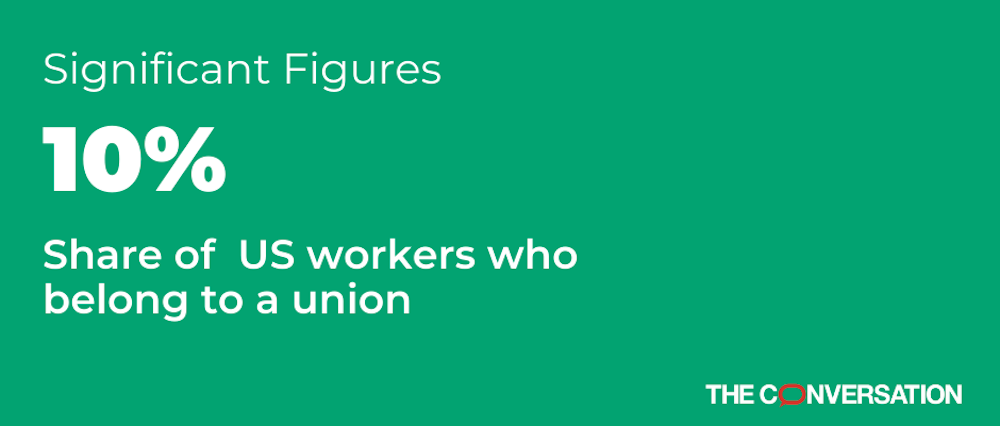
The share of U.S. workers who belong to a union fell slightly to 10% in 2023, from 10.1% a year earlier, according to the Bureau of Labor Statistics.
As a scholar of organized labor, I’m not shocked by this slight decline, although if there was ever a year to expect the unionization rate to increase, it was 2023.
Liz Shuler, president of the AFL-CIO, the nation’s largest labor federation that unites 60 unions, has proclaimed 2023 “the year of labor.” She wasn’t exaggerating.
Successful walkouts by Hollywood actors and screenwriters, autoworkers and health care professionals demonstrated how effective strikes can be in achieving union gains.
And a serious threat of a strike produced a historic contract for hundreds of thousands of UPS workers. Combined with the continuation of union-organizing victories at companies such as Starbucks and Trader Joe’s, it certainly seemed like 2023 was, as a New York Times headline proclaimed, “Labor’s very good year.”
Why would all that successful labor organizing fail to boost growth in the percentage of workers who belong to a union?
Research points to a number of factors, including the difficulties of organizing at a large scale and the pushback by companies facing organizing drives.
Workforce growth
The economy has been growing at a healthy clip, expanding by 4.9% in the third quarter of 2023. The U.S. gained 3 million jobs over the course of 2023.
When the overall labor force grows, unions must recruit new members just to maintain the prior unionization rate. With the size of the labor force today, simply maintaining the status quo requires adding roughly 300,000 new union members annually to keep the level of unionization in the workforce stable.
In 2023, 14.4 million U.S. workers belonged to a union, edging up from 14.2 million the previous year, the government determined. That’s impressive, but not quite enough of a gain for unions to maintain their prior organization rate.
The nation’s unionization rate is the lowest it has been in over a century. While many nations with similar economies have also experienced this kind of decline, the low American rate is both historically and internationally unique.
Sweden’s unionization rate is 6.5 times higher. Canada’s is nearly three times as high.
The decline of union ranks in the U.S. has been sharpest in the private sector, where only 6% of workers belong to a union. Among government workers, nearly 1 in 3 do.
Stalled momentum
Given the difficulties in organizing in the private sector in the U.S., periods of substantial union growth occur in rare spurts. A successful union drive can prove contagious, leading to a rapid wave of union wins in an industry. This is what labor leaders and supporters were hoping for from a string of high-profile victories at Amazon, Starbucks, Trader Joe’s and other big employers.
But for unionization to spread, nonunion workers must be convinced that the very real risks of a unionization drive are worth it.
A union contract can provide evidence that the benefits of organizing outweigh the costs. Without such a contract, many nonunion workers won’t take the risk. Companies know this and employ a number of delay tactics to drag out the process and dampen the early enthusiasm for union recognition.
For example, in the spring of 2022, workers at an Amazon warehouse in Staten Island, New York, voted to unionize – the first union footprint in Amazon’s vast and expanding U.S. workforce. Nearly two years later, that warehouse remains the lone unionized facility among the more than 100 fulfillment centers Amazon operates in the U.S.
The company’s refusal to bargain to a first contract is a big factor stymieing momentum.
Better faith required
Labor actions continue to crop up, with strikes by educators and journalists underway in January 2024. United Auto Workers leader Shawn Fain boldly vows to expand his union’s ranks by organizing employees of electric and foreign-owned vehicle companies.
But without changes to the nation’s labor laws that get more employers to bargain in good faith – and to do so speedily – it’s reasonable to expect to see companies continue to delay and disrupt attempts to negotiate a first contract.
As a result, even another “very good year” for labor won’t translate into substantial gains in the ranks of union members.
Jake Rosenfeld, Professor of Sociology, Washington University in St Louis
This article is republished from The Conversation under a Creative Commons license. Read the original article.