Canada News
What delays to the Artemis II and III missions mean for Canada

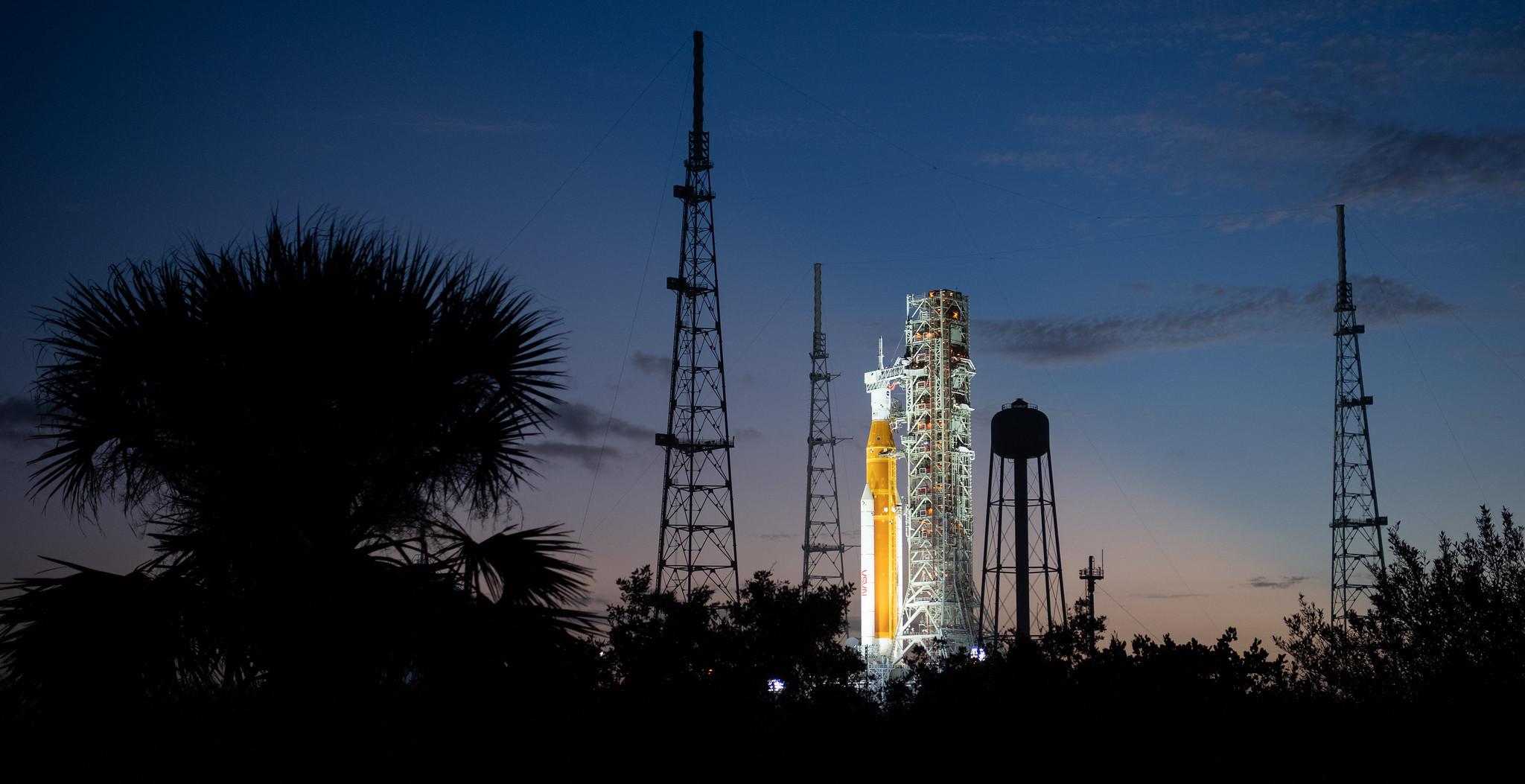
FILE: Artemis I Glows After Sunset (Photo: NASA/Joel Kowsky via NASA’s Marshall Space Flight Center/Flickr, CC BY-NC 2.0)
On Jan. 9, NASA announced it would be shifting the launch of Artemis II to September 2025. Artemis III — the first mission to land humans on the surface of the moon since 1972 — was moved to September 2026.
What do these delays mean for Canada’s plans to explore the moon?
I am a professor, an explorer and a planetary geologist. For the past decade, I have been helping to train Canadian and U.S. astronauts in geology. I am also the principal investigator for Canada’s first ever rover mission, and a member of the Artemis III Geology Team.
The Artemis program
It has been 52 years since humans last walked on the surface of the moon. Since then, humanity has not ventured beyond low Earth orbit, about the distance from Halifax to Fredericton, or Toronto to Ottawa.
In Greek mythology, Artemis was the daughter of Zeus and the twin sister of Apollo — a fitting name for the program that will take humans back to the moon. Unlike Apollo, the Artemis program also has the explicit goals of establishing the first long-term presence on the moon — similar to Antarctica research outposts — and sending the first astronauts to Mars.
The Artemis missions are ambitious to say the least, and represent the next major collaborative international effort, building on the success of the International Space Station.
Indeed, with the addition of Angola in November, 33 nations have now signed the Artemis Accords. The Accords lay out a common set of principles for the exploration and use of outer space. Canada was one of the original eight countries to sign these accords.
A core principle of the Artemis Accords is to enhance peaceful relationships between nations, which is needed now, perhaps more than ever since the Cold War.
Failure is not an option
After the success of the Artemis I mission in late 2022, most people probably thought there would be a quick succession of missions and we would be back on the lunar surface in no time. While the originally planned two years between Artemis I and II may sound a long time, it is in terms of space exploration, where the development of missions is often measured in decades.
The major reason for this is that space is incredibly unforgiving. From withstanding the huge G-forces and vibrations as the rocket accelerates to over 40,000 kilometres an hour during launch — the velocity needed to escape Earth’s gravity — to the extremes of temperature, designing technologies for space is hard and costly.
Every piece of the Artemis infrastructure must be tested and tested again to make sure it can withstand the rigours of space. The environment of the moon is a particularly challenging thermal environment, with a staggering 300 C temperature difference between the lunar day and night.
Some of this testing can be done in a laboratory; however, once a certain scale is reached, this becomes impossible. Take SpaceX’s Starship, the largest and most powerful rocket ever flown and a key part of the architecture for Artemis.
On Nov. 18, its second launch, the Starship exploded after reaching its goal of entering space. SpaceX engineers gathered a wealth of data to improve the design of Starship. However, this test made it clear that this rocket, which will be used to land the Artemis III crew on the surface of the moon, simply wasn’t going to be ready for a 2025 launch.
The astronauts’ long wait
The stakes could not be higher for the Artemis II mission as onboard, for the first time, will be four astronauts, including Canadian Jeremy Hansen.
While not scheduled to land on the surface of the moon, Artemis II is still an incredibly challenging mission that carries with it an element of risk that comes with any “first.” Indeed, this will be the first time humans will fly in NASA’s Orion spacecraft and the first mission to take humans beyond low Earth orbit since Apollo 17 in 1972.
If this mission is successful, these four astronauts will have boldly gone farther from our home planet than any other humans, ever. So it makes sense to take time, especially considering some of the obstacles still facing Artemis II.
On the plus side, the Artemis II crew will have more time for training. Having been involved in providing geology training to two of the Artemis II crew last September — Hansen and Christina Koch — having an additional few months for training will definitely not go to waste.
This delay will also give Canadian astronaut Jenni Gibbons time to come up to speed with training as part of the back-up crew for Artemis 2 — a job she was only assigned in November.
Robots to the moon
On the same day that NASA announced the delays to the Artemis program, the U.S. company Astrobotic announced that its Peregrine lunar lander suffered a “critical loss of propellent” not long after launch. This means there is no chance of it being able to land successfully on the moon.
The lander has been gathering valuable data while its fuel supplies lasted, so all is not lost. This is also the first launch as part of NASA’s new Commercial Lunar Payload Services (CLPS) initiative.
Despite the failures and setbacks in the Artemis and CLPS programs, 2024 promises to be the most exciting year for lunar exploration in decades. Astrobotic is planning two more launches, including NASA’s ambitious Volatiles Investigating Polar Exploration Rover (VIPER).
Two other U.S. companies, Intuitive Machines and Firefly Aerospace, are also scheduled to launch their first lunar missions. And even sooner, the Japanese space agency JAXA has scheduled the landing of its Smart Lander for Investigating Moon (SLIM) on Jan. 19 — if successful, this would make Japan only the fifth country to do so.
I will be watching these upcoming CLPS missions closely, as one of these companies will take the Canadian Lunar Rover to the moon no earlier than 2026. Even before this mission, thanks to the Canadian Space Agency’s Lunar Exploration Accelerator Program, Canadian companies such as Mission Control Space Services and Canadensys are working on software and hardware to contribute to various CLPS missions.
Canadarm3 and the Lunar Gateway
Almost lost in the details of NASA’s announcement about Artemis II and III was the statement that Artemis IV remains on track to launch in September 2028. In addition to landing two astronauts on the lunar surface, a major objective for Artemis IV will be the continued assembly of the Lunar Gateway.
The Gateway is a small space station that will act as an outpost orbiting the moon, providing support for lunar surface missions and, in the longer term, as a staging point for further deep space exploration. The Gateway will be the home for Canada’s biggest financial contribution to Artemis: Canadarm3.
Currently being built by Canadian company MDA Space with the support of dozens of Canadian partners and suppliers, Canadarm3 represents the next generation of space robotics. In contrast to the ISS, astronauts will not always be present on the Gateway, so Canadarm3 is being built with advanced AI-enabled sensors to enable autonomous operations.
Just like what Canadarm did for the Space Shuttle Program and Canadarm2 did for the International Space Station, Canadarm3 will be an iconic reminder of Canada’s international status as a spacefaring nation.
Gordon Osinski, Professor in Earth and Planetary Science, Western University
This article is republished from The Conversation under a Creative Commons license. Read the original article.