
News
Larger and more frequent solar storms will make for potential disruptions and spectacular auroras on Earth

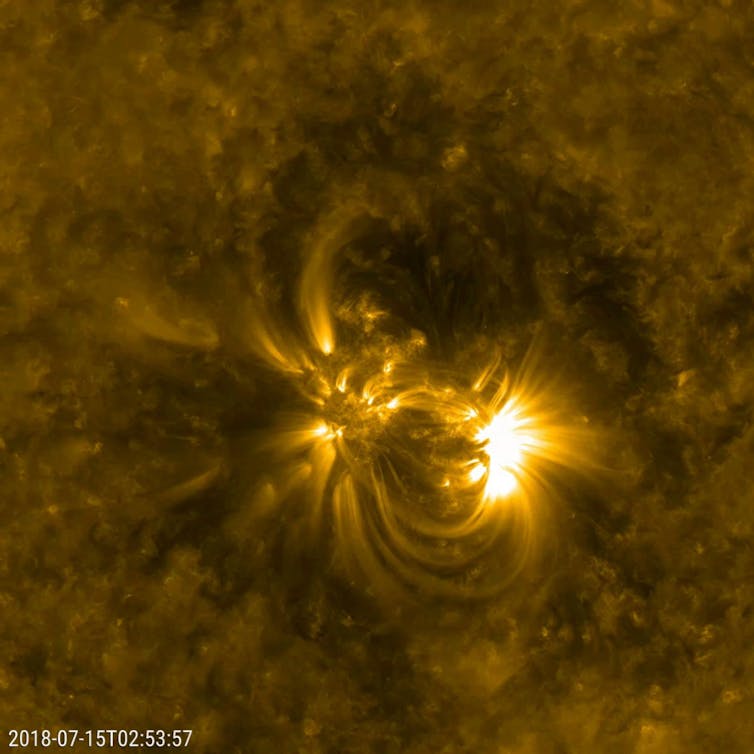
(NASA/GSFC/Solar Dynamics Observatory)
Bright auroras, with dancing lights in the sky, characterize the clear winter nights of northern Canada. Longer nights during the fall and winter also favour seeing more auroras, but the show is best outside of light-polluted cities. Impressive auroral events allowed bright auroras to be seen as far south as the United States recently.
Auroras are produced through the sun’s interaction with the Earth’s magnetic field. The number of auroras is increasing as the sun’s activity becomes stronger, approaching a solar maximum.
Perhaps surprisingly, the same space disturbances that cause auroras can affect our technologies.
In 1859, a geomagnetic storm — the largest in recorded history — disrupted technological systems, such as they were at the time, on Earth. Referred to as the “Carrington Event” after Richard Carrington, the amateur astronomer who made the connection between a bright solar flare and subsequent auroral and magnetic effects.
That Sun-Earth link was slow to be accepted, but we now know that the Sun can trigger disturbances in near-Earth space, although it seems that events as large as that of 1859 are rare.
Night visions
Space is filled with thin hot gas called plasma that carries magnetic fields. The Earth, in the sun’s outer atmosphere, is surrounded by hot magnetic plasma which rushes past us at speeds of several hundred kilometres per second in a flow called the solar wind.
The sun is so massive that loss of the solar wind has a negligible effect on it, but Earth by comparison is a mere speck, three parts in a million as massive. Earth has a magnetic field, which protects us from the solar onslaught, but is pushed back by it as well.
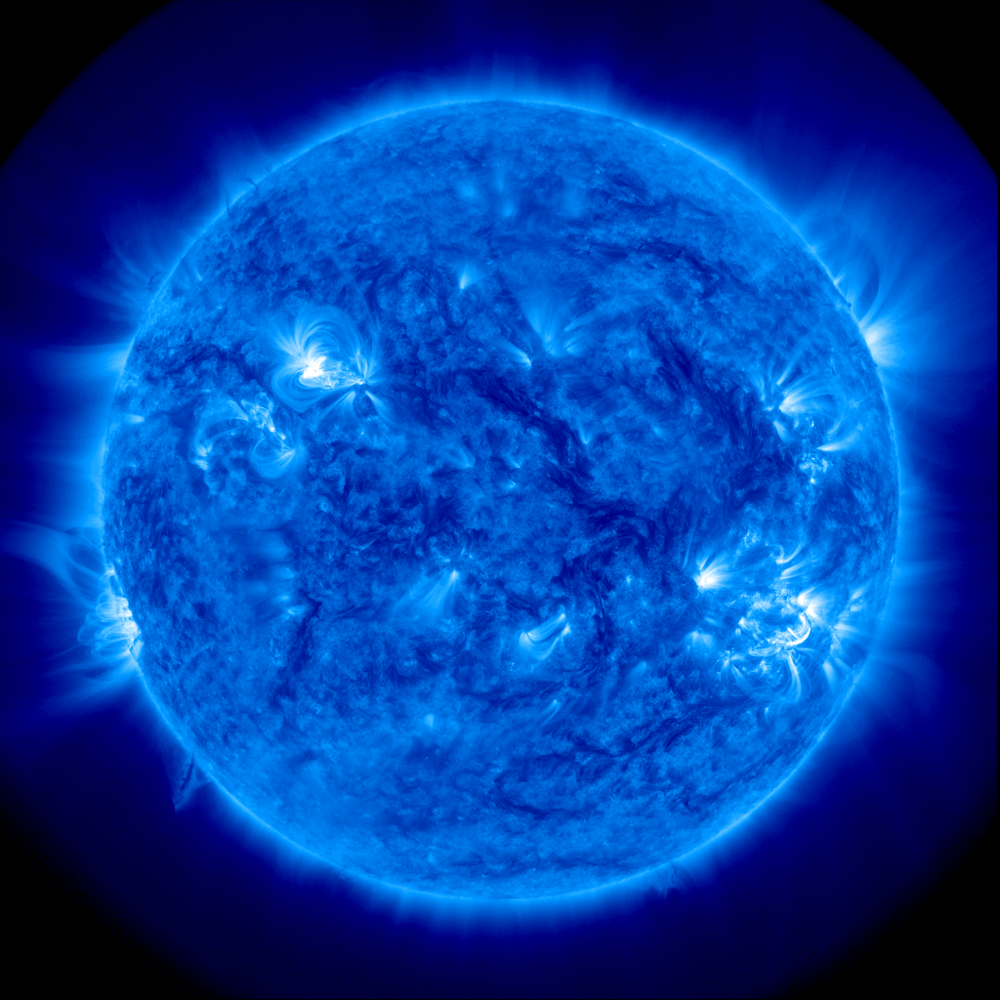
(Solar Dynamics Observatory/NASA)
Under certain conditions, energy can flow into the near-Earth region from the solar wind, largely building up on the opposite side from the sun in a comet-like “magnetotail.”
This can become unstable if too much energy builds up, blasting particles into the nightside atmosphere to light up auroras. This explains why auroras are seen at night: not only is it dark, but the sun’s energy takes an indirect route by first being stored in the magnetotail.
The dancing auroras can also generate magnetic fields, which are strong enough to be detected by a compass, as discovered nearly 300 years ago by Swedish astronomer Anders Celsius.
If the magnetic fields change rapidly, they can affect large regions of the Earth, building up to cause problems for power networks. This notably happened in North America in 1989, on the “day the sun brought darkness.”
Solar cycles
Italian astronomer Galileo studied sunspots in a systematic way in the early 1600s. About 300 years later, American astronomer George Hale showed that sunspots had intense magnetic fields, several thousand times stronger than Earth’s.
In the 400 years since Galileo’s observations, we have found that the number of sunspots varies dramatically over an 11-year long cycle. But it is only recently, in the Space Age, that we can relate its effects on Earth.
Energy storage
Magnetic fields store energy, and sometimes, as in Earth’s magnetotail or near sunspots, this energy can be changed to other forms. In the strong fields of sunspots, it can be released as X-rays in rapid, unpredictable flares.
Sunspots and flares are near the surface or light-emitting layer of the sun, but material can escape from the sun’s strong gravity field. Blobs of gas — coronal mass ejections — can be hurtled into space. Some small fraction of these are shot out toward Earth, and auroras and their magnetic effects occur when they reach Earth’s atmosphere. They can also cause intensification of our radiation belts in ways that can damage satellites.
Counting sunspots on the sun’s surface allows us to get a general idea of what space disturbances may occur as the solar cycle progresses. Similarly, on Earth we can follow the seasons and have a general idea of what storms are likely. In both cases, however, exact prediction is difficult.
Space weather forecasts
From long-term trends, it was expected that the upcoming solar maximum would be small, as indeed the one that peaked in 2014 was. However, in this, the following solar cycle, we have already exceeded predicted numbers of sunspots and had large magnetic storms, so predictions may need to be revised upward.
Although direct measurement of incoming disturbances by satellites in the solar wind gives us only about an hour’s warning of stormy space weather, we can also predict a bit further in advance by watching sunspots rotate into view as the sun turns.
One solar rotation takes about as long as it does for the moon to go around Earth, that is to say, a month. So if a particular sunspot brings lots of activity, it likely will repeat in about a month.
Rare storms
The strongest flare of Solar Cycle 25 so far occurred on Dec. 14, and was the most powerful eruption the sun has produced since the great storms of September 2017.
Large solar storms are rare, but we must calmly prepare for possible space weather impacts that should maximize in a few years. We must be creative, since space weather effects can bring surprises. In 2022, unexpected heating of the atmosphere caused multiple satellite losses.
As our knowledge of space physics steadily improves, so too will the new science of space weather prediction, allowing us to protect our technological assets.
In the meantime, we can look forward to spectacular auroras that should come as we near the 2025 solar maximum, with only measured and reasonable amounts of worry about the potential impacts of space weather.
Martin Connors, Professor of Space Science and Physics, Athabasca University
This article is republished from The Conversation under a Creative Commons license. Read the original article.




















