
Science
Astronomers have discovered a rare ‘polar ring galaxy’ wrapped in a huge ribbon of hydrogen

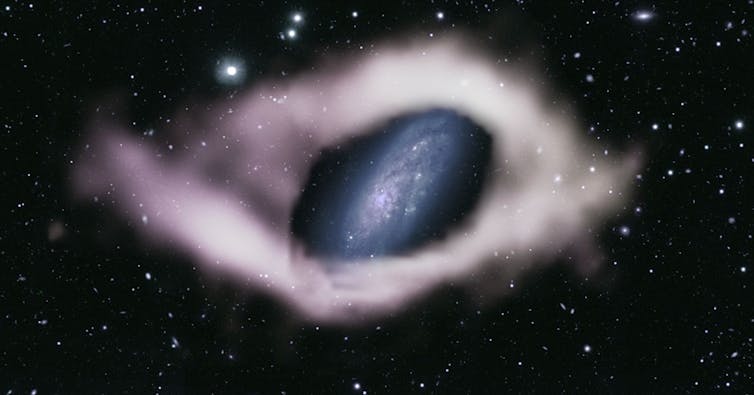
Galaxies come in many shapes and sizes, from giant, slowly rotating ovals and fast-whirling spiral disks to faint ball-shaped blobs and dwarf irregulars. Most large, bright galaxies – including our own Milky Way – are orbited by a gang of much smaller dwarf galaxies.
Most of this we know from optical images, whether taken with small backyard telescopes or much bigger dedicated ground- and space-based telescopes that reveal the light from billions of distant suns. However, as we are discovering, what happens beyond the bright disk of stars may be even more interesting.
With radio telescopes, we can map the distinctive glow of free-floating hydrogen atoms throughout the universe, whether they are inside galaxies, around them, or lurking in the lonely spaces between.
Using CSIRO’s Australian Square Kilometre Array Pathfinder (ASKAP) radio telescope, on Wajarri Yamaji Country in Western Australia, we recently discovered an enormous ribbon of hydrogen encircling a spiral galaxy called NGC 4632. The results are described in a new paper in Monthly Notices of the Royal Astronomical Society.
Galactic leftovers
NGC 4632 appears to be a very rare formation called a “polar ring galaxy”, as the hydrogen ring seems to be rotating over the poles of the galaxy’s disk. The gas in the ring, which makes up about half of the system’s mass, was likely hoovered up from a companion galaxy.
In the words of my colleague Nathan Deg at Queen’s University in Canada, who led the new study:
Polar ring galaxies are some of the most spectacular looking galaxies that we can see. Beyond just being beautiful, they provide important clues about the formation and growth of galaxies over time.
The location and movement of these polar rings can also tell us about the shape of the halo of invisible dark matter astronomers believe surrounds most galaxies.
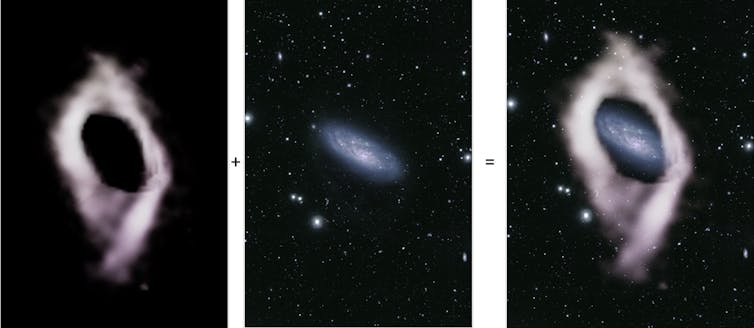
Deg et al. 2023, MNRAS / Jayanne English / Tom Jarrett / Nathan Deg / Wallaby collaborators / CSIRO / ASKAP / NAOJ / Subaru Telescope., CC BY
Spiral galaxies like NGC 4632 are typically rich in cold hydrogen gas. The gas provides the fuel for star formation and typically extends well beyond the bright disk of stars.
In the outskirts of spiral galaxies, we often see that the shape of the gas disk is warped. Why does this happen?
Some warps may be caused by a galaxy wrestling with its neighbours via gravity, stealing gas which collects in the galaxy’s outer disk or forms a polar ring. This is quite a common process by which galaxies grow: our Milky Way galaxy is known to have munched up several small companions.
Hunting hydrogen
I was first inspired to study polar ring galaxies in the 1990s by astronomers Penny Sackett and Linda Sparke. Eager to understand what these strange cosmic structures could reveal about dark matter, I teamed up with Magda Arnaboldi to observe hydrogen in the nearby galaxy NGC 4650A using CSIRO’s Australia Telescope Compact Array (ATCA) on Gomeroi Country, outside Narrabri in north-west New South Wales.
Two big projects, the HI Parkes All Sky Survey (HIPASS) and the Local Volume HI Survey (LVHIS), set the scene for much of my current research on galaxies. As plans advanced for the much larger and more powerful ASKAP telescope, I was one of the founders of the Wallaby project, which uses ASKAP’s capabilities to conduct a huge survey of hydrogen in the local universe.
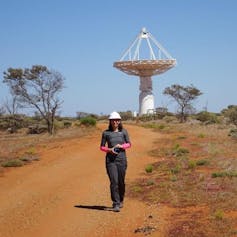
Cornelia Brem, CC BY
ASKAP began full operations in late 2022. The telescope is located at Inyarrimanha Ilgari Bundara, CSIRO’s Murchison radio astronomy observatory: the traditional name means ‘sharing sky and stars’ in the Wajarri language.
ASKAP now produces such vast amounts of data that we need dedicated software running on the Setonix supercomputer in Perth, not only to produce wide-field images and cubes, but also to sift through them for signs of hydrogen in distant galaxies. We can then conduct more detailed studies of the most interesting galaxies.
Visualising galaxies
Our latest paper highlights two galaxies (of 600 found in our first pilot study) that contain unusual structures.
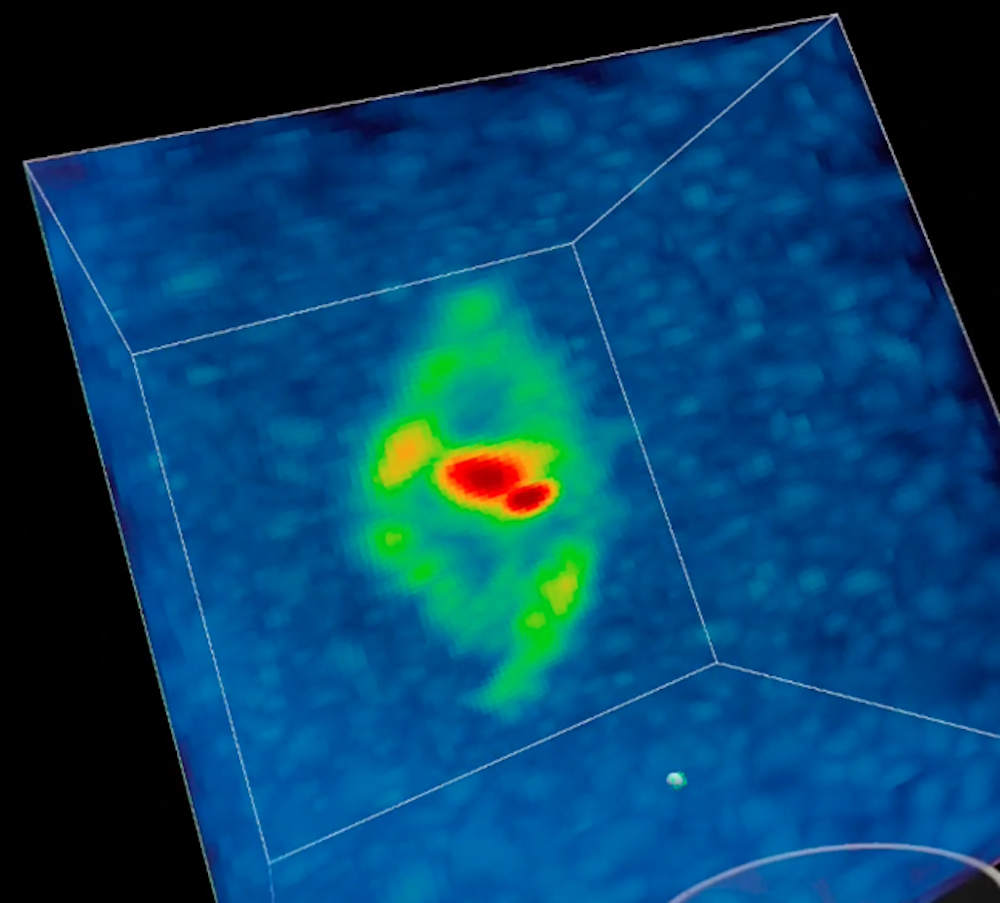
Deg et al. / iDaVIE, CC BY
As Deg puts it, “finding two potential polar ring galaxies in the Wallaby pilot survey is incredibly exciting, as it suggests that these objects may be more common than previously thought”.
To explore the shapes of galaxies we often use 3D visualisation – and even virtual reality software such as iDaVIE.
We expect the full Wallaby survey will reveal more than 200,000 hydrogen-rich galaxies. Among them will be many more unusual objects like the polar ring around NGC 4632, which can then be used to learn more about dark matter. 
Baerbel Koribalski, Senior research scientist, CSIRO
This article is republished from The Conversation under a Creative Commons license. Read the original article.




















