
News
DA says EO 171 extension aims to cushion food inflation

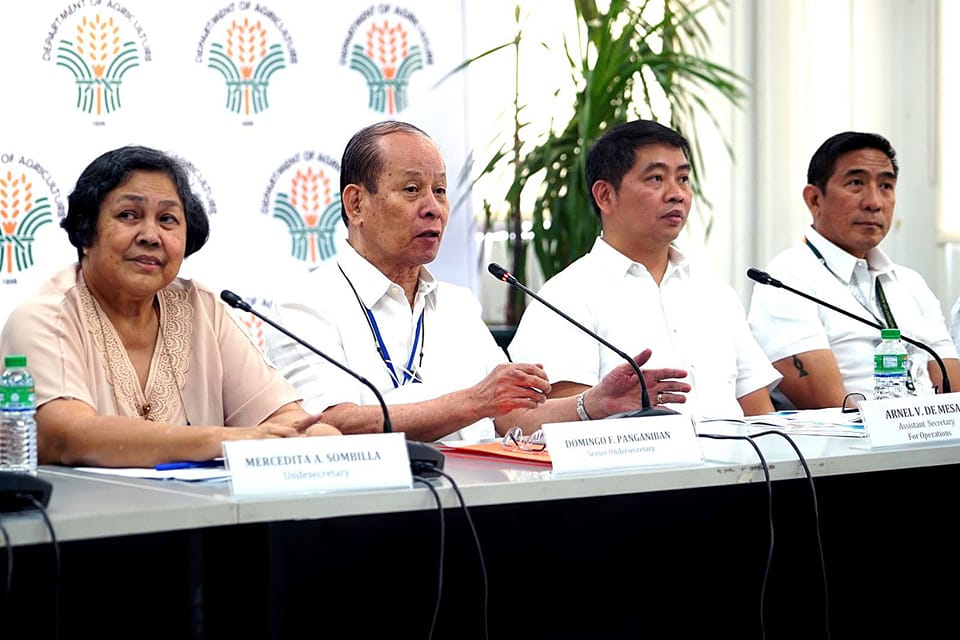
YEAR-END REPORT. Agriculture Senior Undersecretary Domingo Panganiban presents the DA’s accomplishments for this year and plans for the year 2023 in a presser at the DA main office in Diliman, Quezon City on Monday (Dec. 19). (Photo by Ben Briones via Philippine News Agency/Facebook)
MANILA – The Department of Agriculture (DA) on Monday emphasized the need to balance rice imports and local production, following President Ferdinand R. Marcos Jr.’s approval of the extension of Executive Order 171 that modified tariff rates for some imported agricultural commodities.
At a press conference, agriculture officials said the move intends to prevent higher food inflation.
“The President signed and ordered last week containing the provisions of EO 171, and it would continue up to December 2023. I agree with that. But it has to be semestral in nature, and on that basis, sync to the harvesting. Beginning January, February, and March, we shall not be issuing any special permit to import,” Senior Undersecretary Domingo Panganiban said.
“We have to balance all of these with imports. Otherwise, nakita niyo naman, ‘yung (you’re seeing the) inflation rate on food has always been on the rise. And total economy talaga ang maaapektuhan (that’s really affected). So at DA, together with our operating units, we are trying to balance importation as well as production, so that we can stabilize the prices, lower the prices,” Undersecretary Mercedita Sombilla added.
Sombilla mentioned factors including the recent typhoons which affected volumes of agricultural harvests, the effects of the ongoing Russian war, global inflation, high farm input prices, and the coronavirus disease 2019 (Covid-19), among others.
She also noted that the extension of modified tariff rates for agricultural import is not solely in favor of importers, but also consumers who would get access to lower rice prices.
“Prices have really gone down, when we start importing rice, from the PHP40 to PHP42, at the height of rice prices before the tariffication, it has already gone down to PHP37, we are still really trying to get down to the PHP32 to PHP30 level, but again it’s really consensus efforts, between rice production as well as importation,” she said.
No rice shortage
Contrary to several statements, the DA assured consumers that there will be no supply shortage of rice next year, despite the decrease in rice inventory.
“There will be a lot of rice in the country, a lot of importation by the private sector which is not authorized by the department has been confiscated quite recently, and on that aspect, we shall not be importing rice up to next year or the first quarter of next year,” Domingo said.
Agriculture Assistant Secretary Arnel de Mesa also noted that rice shortage is less likely to happen because of the department’s intervention to aid farmers.
“There will be no rice shortage next year. In fact, we’re hoping to maintain the level of production from last year to this year. We had little effect due to the fertilizer price hike, so the president released a PHP4.1 billion budget. We’re working on that, that’s the PHP6600 per hectare additional budget for fertilizer,” de Mesa said in mixed English and Filipino.
De Mesa also noted the DA’s budget increase to achieve targets on food sufficiency.
“‘Yung (This) 2023, this is the first time we will be seeing a significant increase in the budget of the Department of Agriculture by more than 40 percent,” he said.
Under the expected budget, the rice program fund will be doubled to PHP30 billion from this year’s PHP15 billion, PHP5 billion both for high-value crops and corn, which currently have a PHP1-billion and PHP1.5-billion fund, respectively.
The DA, meanwhile, targets to reach at least 20.5 million metric tons of rice production for next year.




















