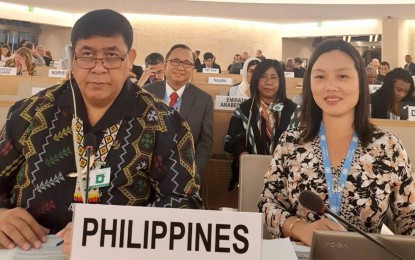
FILE: PH MISSION TO UNHRC. Vice Consul Majella Cristy U. Pua-Diezmos (right) of the Philippine Mission to the United Nations (UN), together with National Commission on Indigenous Peoples (NCIP) Chairperson, Secretary Allen Capuyan, participate in an interactive dialogue at the 42nd Session of the UN Human Rights Council (UNHRC) in Geneva, Switzerland on Thursday (Sept. 19, 2019). During the dialogue, Pua-Diezmos read the Philippines’ response to a UN report that linked the government to cases of intimidation and reprisals. (Contributed photo via PNA)
MANILA – The Philippine Mission to the United Nations (UN) on Thursday said the Philippine government condemns all acts of intimidation by non-state actors amid a UN report naming the Philippines as among the governments of 48 countries linked to cases of reprisals.
Vice Consul Majella Cristy U. Pua-Diezmos of the Philippine Mission to the UN was responding to a report that noted multiple individuals in the Philippines who decried being targets of “harassment, surveillance and stigmatization” for previous inclusion in a February 2018 Department of Justice petition, which sought to declare the Communist Party of the Philippines and the New People’s Army (CPP-NPA) as terrorist organizations.
Speaking during an interactive dialogue with the Advisory Committee and UN Assistant Secretary General for Human Rights Andrew Gilmour at the 42nd Session of the UN Human Rights Council, Pua-Diezmos said the Philippine government “believes that the reports taken up by the Council should be guided by the highest level of objectivity, professionalism and due diligence”.
“Maintaining high standards to ensure that facts — not falsities — are the basis of our discourse, is crucial to preserve the integrity and credibility of the Council in the age of fake news,” she said.
“The Philippines condemns all acts of intimidation and reprisals committed by governments and non-state actors,” Pua-Diezmos said, adding that Manila welcomes efforts from the UN to give Manila sufficient time to respond to the issues in the draft.
On allegations against organizations linked to the communist movement, she cited reports that match the data from another UN office.
“The report of the Special Representative of the Secretary General on Children in Armed Conflict corroborates this information,” she said.
“We draw attention to the need for the international community to exercise due diligence in engaging parties who have abused the good faith of the UN system, masquerading as human rights defenders while actively carrying out terrorism and crime. Evidence was presented on how the CPP-NPA, a terrorist group, and its front organizations, have perpetrated systemic atrocities among its followers and indigenous communities in the Philippines for decades,” she said.
She also asked Gilmour for his views “on best practices to address intimidations and reprisals committed by non-state actors and how to assist states in strengthening their capacities as duty-bearers in this regard.”
Pua-Diezmos, meanwhile, welcomed the work of the Office of the High Commissioner on Human Rights to launch consultation mechanisms within the UN system, as well as with inter-governmental regional organizations and multilateral development banks, on reprisals, with a view to strengthening accountability mechanisms in these institutions.
“We request the Secretary General to keep the Council apprised of progress of these efforts,” she said.
She expressed belief that the Council needs a more considered debate on concerns raised on the use of national security arguments and counter-terrorism to justify reprisals.
“Our conversation should be informed by the fact that terrorism is a grave matter whose full repercussions on the human rights of individuals and communities are understood only by those who have suffered and continue to suffer from it,” she said.