
News
Lion Air crash renews concerns about Indonesia airlines

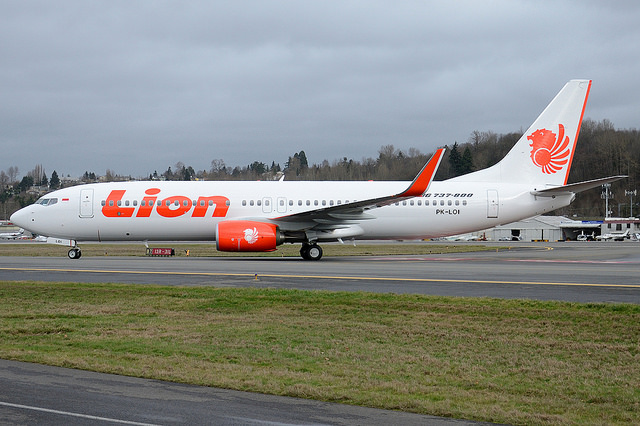
The deadly crash of a Lion Air jet in the Java Sea has renewed questions about the safety of Indonesian airlines soon after U.S. and European regulators removed prohibitions against them. (File Photo: Andrew W. Sieber/Flickr, CC BY-NC 2.0)
The deadly crash of a Lion Air jet in the Java Sea has renewed questions about the safety of Indonesian airlines soon after U.S. and European regulators removed prohibitions against them.
A growing middle class and affordable fares have led to a boom in air travel in Asia, putting pressure on airlines, government overseers and infrastructure to keep up.
The surge has been particularly keen at Asia’s budget airlines such as Lion Air, whose Flight 610 disappeared into the sea shortly after takeoff from Jakarta. The Boeing 737 Max 8 carried 189 people and was bound for Pangkal Pinang on a smaller island in the Indonesian archipelago.
Data pinged from the plane showed erratic speed, altitude and direction in the minutes after takeoff. Safety experts cautioned, however, that the data must be checked for accuracy against the plane’s so-called black boxes, if they are recovered.
Indonesia’s aviation industry has had a checkered past. The United States and the European Union banned its aircraft from their skies in 2007 after a string of accidents.
The Federal Aviation Administration lifted that ban in August 2016. This past June, European regulators — who had already allowed Lion Air and a few other Indonesian carriers to resume flying to Europe — lifted theirs on remaining Indonesia airlines. A spokesman said Monday that the European Commission has no immediate plans to renew the ban on Lion Air, but Australia told government officials and contractors not to fly on the carrier pending findings from the crash investigation.
The bans directly affected few flights, but Europeans were discouraged from flying on Indonesian airlines while visiting the country, where planes are the only practical way to hop among tourist-destination islands including Bali, Java and Sumatra.
Among notable Indonesian accidents:
— In 2015, a turboprop operated by Indonesia’s Trigana Air crashed in Papua province, killing all 54 people on board. Indonesia’s safety agency blamed a number of mistakes by the crew and poor regulatory oversight of the airline.
— In 2014, an Indonesia AirAsia jet flying to Singapore crashed into the Java Sea, killing all 162 passengers and crew members. Investigators blamed a rudder-control system that had malfunctioned nearly two dozen times in the previous year, combined with the pilots’ response.
— Miraculously no one was killed in 2013 when a Lion Air jet descended too low, missed the runway and crashed into the sea off Bali, forcing some passengers to swim for their lives. Investigators blamed the crash during poor visibility largely on pilot errors.
In the only previous fatal accident of a Lion Air flight, a plane skidded off a rain-slicked runway and crashed into a cemetery in Surakarta in 2004, killing 25 passengers and crew. The airline has had other problems too, including the arrests of four pilots for drug possession in 2011 and 2012.
Harro Ranter, who runs the Aviation Safety Network, said Indonesian airlines must contend with difficult terrain in some provinces, frequent bad weather that leads to poor visibility, and shortcomings with air traffic controllers, who have on occasion put two planes on the same active runway. There have also been fears that the country would be unable to train or attract enough qualified pilots and that airlines would struggle to manage rapid growth, he added.
“Indonesia does stand out … they did have some really bad accidents in the past,” Ranter said. “It’s hard to judge if they have made sufficient progress with regard to safety.”
He said it is difficult to pin a specific accident on the safety culture, but that international regulators will be closely watching the investigation into Flight 610.
Boeing and rival Airbus have been stepping up production to meet the seemingly insatiable demand for new planes among global airlines, many of them in Asia.
Traffic on the world’s airlines — measured in the number of miles or kilometres flown by passengers — jumped 8.1 per cent last year, the fastest rate of growth since 2005, according to the International Air Transport Association, a trade group for the industry. It marked the third straight year of traffic growth above the long-term average of 5.5 per cent growth in traffic.
China led the way in most new domestic passengers, by a wide margin. Indonesia ranked sixth.
Aircraft operators in the Asia-Pacific region have had the highest number of accidents in the last five years, accounting for about one-fourth of all accidents, according to the trade group. But the accident rate has declined — from 2.33 every million flights in 2016 to 1.54 every million flights last year.
Southeast Asia and the Pacific have a far lower accident rate than Africa and South America, according to figures from the trade group and the UN’s International Civil Aviation Organization.
The Lion Air crash appears to be the first involving the Boeing 737 Max 8, a more fuel-efficient update of Boeing’s popular 737, the bestselling airliner ever. Lion Air received the jet involved in the crash just two months ago.
In a statement, Chicago-based Boeing Co. said it was “deeply saddened” by the crash and was prepared to offer technical help to investigators.
Boeing shares fell on news of the accident. They were down $12.47, or 3.5 per cent, at $346.80 in early-afternoon trading.
Jim Corridore, an analyst for CFRA Research, said Boeing planes have a good safety record and the accident is unlikely to hurt orders for new planes.
Lion Air became the first airline to get a 737 Max, in May 2017, and has received 13 of the 201 Max planes that Boeing has delivered, according to the Boeing website. Boeing has taken nearly 4,800 orders for the plane, including 201 from Lion Air.
Southwest Airlines was the first U.S. carrier to fly the plane and has taken 23 of them, according to Boeing.




















