
Art and Culture
Exhibit looks at key traumatic moments in Czechoslovakia

“The 20th century is full of traumas,” said Jana Holcova, a Post Bellum spokeswoman. (File Photo: postbellum)
PRAGUE, Czech Republic — The voices of the witnesses are quiet. Their heads are projected on screens behind a chain-link fence in complete darkness at the site of a former monument to Soviet dictator Josef Stalin. Their topic: the most painful moments in the history of Czechoslovakia.
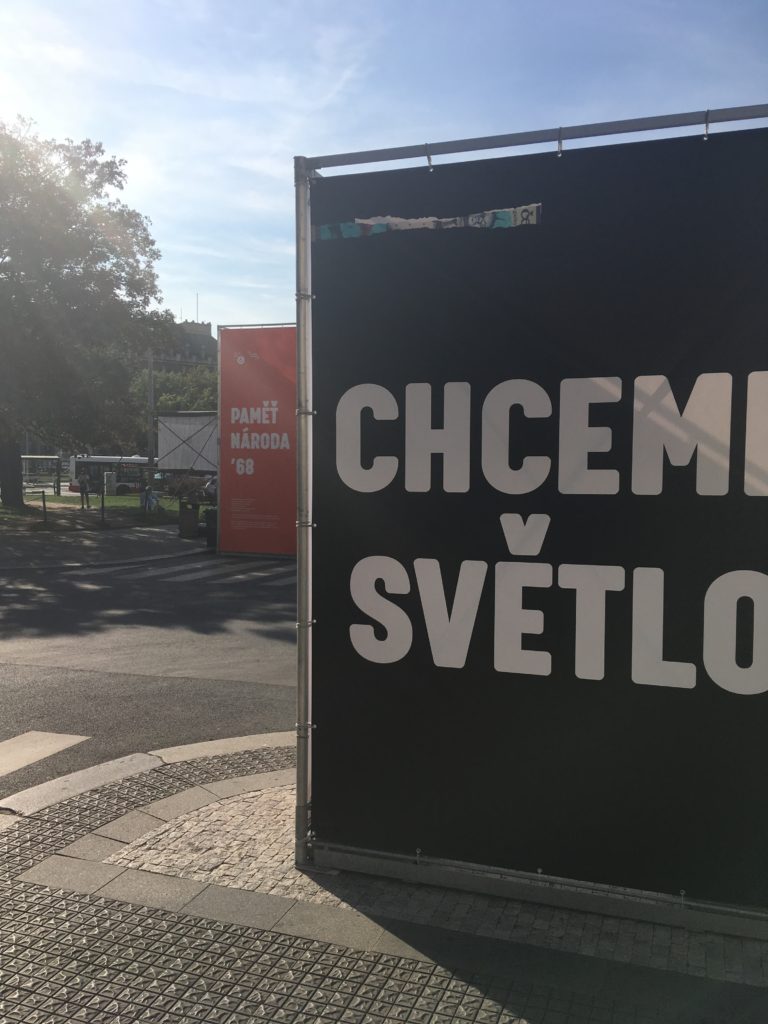
A multimedia exhibition is marking the 100th anniversary of the creation of Czechoslovakia by focusing on the nation’s experience with two totalitarian regimes in the turbulent 20th century: the Nazi occupation in World War II and Communist rule.
“The Memory of the Nation” has been created by the Post Bellum non-profit organization, which has been recording oral histories of those who witnessed key historical moments. It starts in 1939, beginning with the Nazi invasion, and goes until the end of the communist regime in 1989.
“The 20th century is full of traumas,” said Jana Holcova, a Post Bellum spokeswoman.
Czechoslovakia was created as an independent state on Oct 28, 1918, as the Austro-Hungarian Empire collapsed at the end of World War I. It ceased to exist in 1993, after the region peacefully split into two nations, the Czech Republic and Slovakia.
Here’s a look at the exhibit that runs through Dec 9.
———
A FITTING PLACE TO CONTEMPLATE HISTORY
Visitors to the exhibit have a rare chance to see the huge, rarely-opened underground space just under the former Stalin monument site at Prague’s Letna Park.
The almost 16-meter (over 52-foot) granite statue of Stalin with other figures behind him, once considered the biggest representation of the brutal dictator outside the Soviet Union, was unveiled in 1955 after six years of work. Its creator, Otakar Svec, killed himself shortly before that, following the example of his wife.
After Stalin’s Soviet successor, Nikita Khrushchev, denounced Stalin’s personality cult, the monument that was visible from many parts of Prague became a political problem. It was demolished in 1962.
The space has been closed for decades. City Hall has proposed that the National Gallery turn it into a centre for contemporary art while Post Bellum has suggested the current exhibition be expanded into a museum to totalitarianism. No final decision has been made.
———
TRAUMATIC MOMENTS IN A NATION’S PAST
In one section, a video map with sound allows visitors to glimpse a bit of what it was like to be a RAF pilot shooting down a Nazi plane in World War II during the Battle of Britain, in which many Czechs participated. Other sections illustrate Nazi cruelty, an interrogation by the feared Communist-era secret police or the 1968 Soviet-led invasion of Czechoslovakia, which crushed the liberal reforms known as the Prague Spring. A moment from the country’s 1989 anti-Communist Velvet Revolution, which was led by Vaclav Havel, comes at the end as a relief.
Witnesses speaking on the screen include Holocaust survivors, political prisoners and a communist investigator. Subtitles are in Czech and English.
———
THE WALL THAT DIVIDES
The project includes a 5-meter (over 16-foot) high wall that runs for 50 metres (164 feet) and prevents people from seeing the elegant, cobblestoned city of Prague at a popular viewing spot.
Martin Hejl, art director of the exhibition, said the wall symbolizes the country’s totalitarian period, its suffocating censorship, the divisions of its people and “archetypical sites such as the Berlin Wall.”
———
If you go: The site is on a hill at the edge of Letna Park, walking distance from downtown. Hours: Monday – Friday 8.30 a.m. – 7 p.m.; Saturday – Sunday 10 a.m.-7 p.m.; Admission: 100 koruna ($4.70) but free for children, school groups, seniors and the disabled.




















