World News
Japan’s government approves larger military role

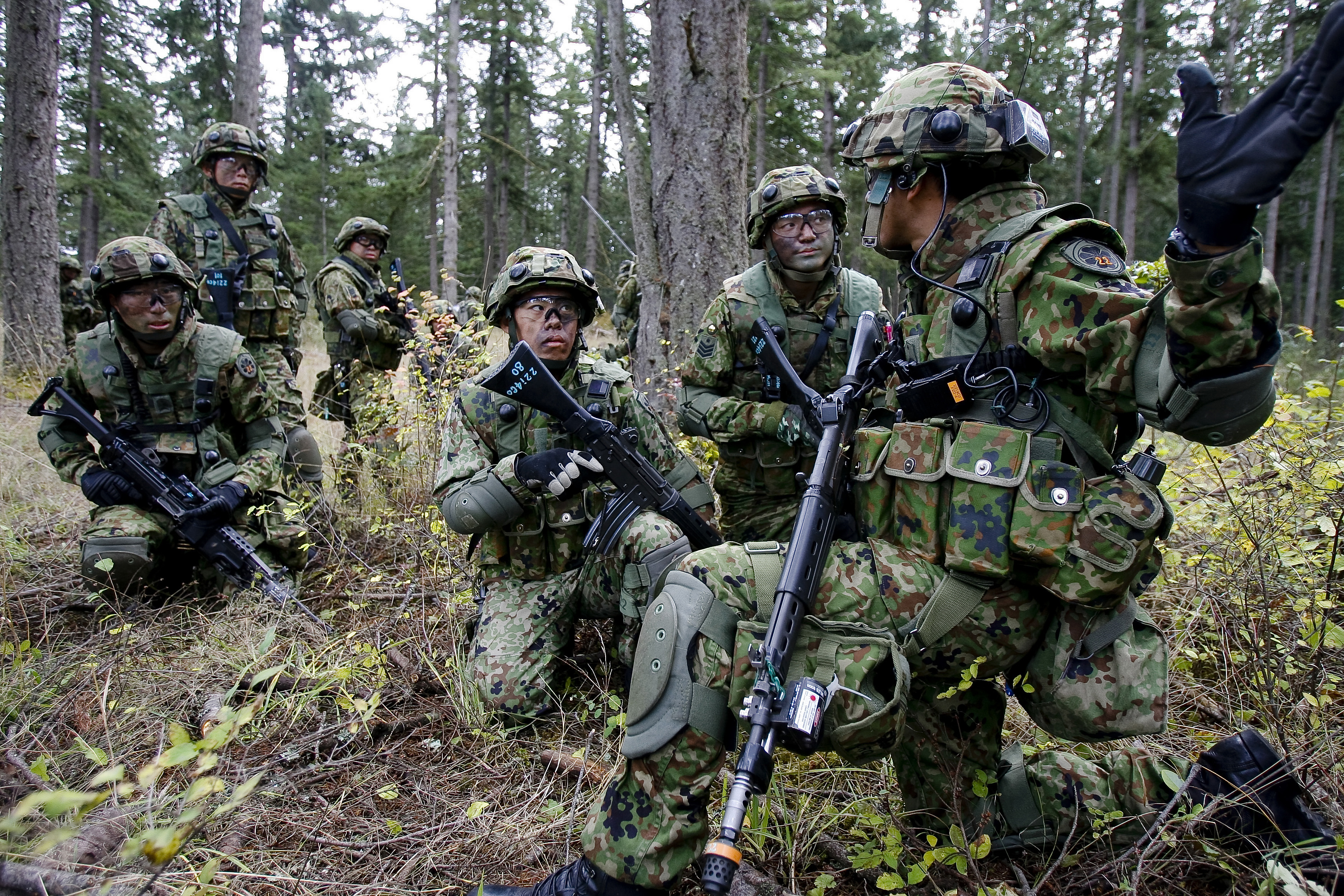
Japan Ground Self-Defense Force / Wikipedia Photo
TOKYO — Since Japan’s defeat in World War II, its military has been shackled by restrictions imposed by a victorious U.S. and that, over time, a majority of Japanese adopted as their own. Now, the shackles are being loosened.
Japan’s Cabinet on Tuesday approved a reinterpretation of the country’s pacifist postwar constitution that will allow the military to help defend allies and others “in a close relationship” with Japan under what is known as “collective self-defense.”
Previous governments have said the war-renouncing Article 9 of the constitution limited the use of force to defending Japan.
Prime Minister Shinzo Abe said the shift is needed to protect the lives of the Japanese people in an increasingly severe security environment. Japanese warships would be able to help protect U.S. ships that were defending Japan, he said.
“Peace is not something you expect to be given, but it’s something that we must achieve on our own,” he said in a televised news conference.
The issue has divided Japan, where many worry about China’s growing military assertiveness but also support the anti-war clause of the constitution and fret about a possible slide toward the militarism that led to World War II.
About 2,000 people protested outside Abe’s office, saying that any change to the constitution should be made through a public referendum, not simply a Cabinet reinterpretation.
“For 70 years, Japan has kept its peace with its constitution,” said 67-year-old protester Toshio Ban. “What are we to do with that stupid man trying to trample over the precious constitution?”
The move drew sharp criticism from China, and a cautious reaction from South Korea, which was colonized by Japan from 1910 to 1945.
“Beijing opposes Japan’s act of hyping the China threat,” Chinese Foreign Ministry spokesman Hong Lei said at a daily briefing. The new policy “raises doubts about Japan’s approach to peaceful development.”
South Korean Foreign Ministry spokesman Noh Kwang-il said: “The South Korean government views it as a significant revision to the defense and security policy under the postwar peace constitution, and is paying a sharp attention to it.”
Written under U.S. direction after World War II, the 1947 constitution says the Japanese people “forever renounce war as a sovereign right of the nation.” The article was crafted to prevent a repeat of Japan’s invasion and brutal occupation of wide swaths of Asia.
America’s position shifted quickly with the outbreak of the 1950-53 Korean War. The U.S. began to see Japan as an ally in the Cold War and pressed its former enemy to rearm. Today, with America’s military financially stretched, the U.S. is backing whatever Japan can do to play a larger role in regional security.
The Japanese, though, particularly older generations, have witnessed Japan’s success under the constitution, even if the postwar economic miracle has lost some luster in the last two decades.
“Most Japanese, over two-thirds, feel that this peace constitution is part of their identity,” said Jeff Kingston, head of Asian Studies at Temple University Japan in Tokyo.
The Cabinet decision is hardly the first loosening of the shackles. The constitutional ban has been relaxed several times over the years, starting with the introduction of a “police” force during the Korean War, which became a military dubbed the Self-Defense Force in 1954.
A major turning point came after the 1991 Gulf War, when a wealthy Japan was criticized for contributing money but not “boots on the ground.” After hostilities ended, Japan sent mine sweepers to the Gulf as part of U.N. mission, triggering massive protests at home.
A special law passed in 1992 allowed the military to participate in U.N. election monitoring in Cambodia, the first overseas deployment of troops since World War II.
Japan enacted a set of laws in 2003 to enable troops to join the U.N. Iraq reconstruction mission. But Japanese soldiers were only allowed to fire in self-defense, and had to be escorted by Dutch, British and Australian troops, something Japanese conservatives saw as an embarrassment.
The government has no immediate plans to change the constitution, which has never been amended. But Abe and subsequent governments will now be empowered to authorize greater military engagement under the new interpretation of the charter.
Opponents worry the new policy could be a step toward eventual participation in joint military actions such as the war in Iraq.
Abe said his government stands by its current position of not sending troops to overseas battlefields. An agreement with junior coalition partner New Komeito includes restrictions on when Japan can exercise collective self-defense.
“Japan’s status as a peaceful country will not change,” Abe said.
Buddhist-backed New Komeito initially opposed the change, and Tuesday’s Cabinet decision came after weeks of negotiations between the two parties.
Takeshi Iwaya, a lawmaker who chairs a ruling party research commission on security, said Japan has long said it won’t repeat the mistakes of World War II, but that is no longer enough to preserve peace.
“Up to now, Japan has said it will never do anything wrong and merely wish for peace,” he said in an interview. “What we are trying to do now is to play a more proactive role.”
Associated Press journalists Koji Ueda and Elaine Kurtenbach in Tokyo, Didi Tang in Beijing and Jung-yoon Choi in Seoul, South Korea, contributed to this story.