
News
Cambodian genocide documented in victims’ preserved clothes

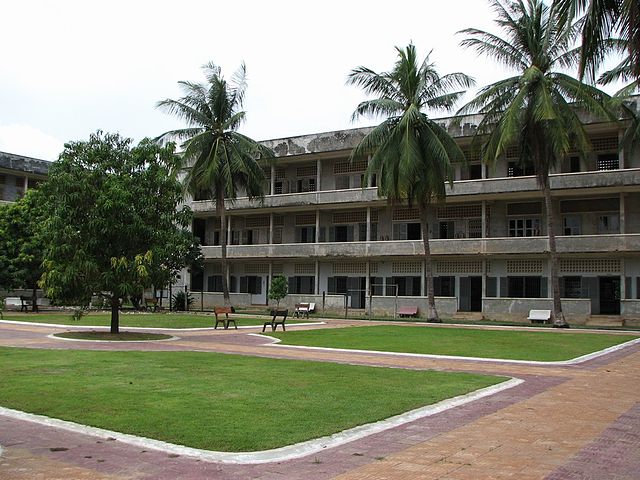
The exterior of the Tuol Sleng Genocide Museum, Phnom Penh (Photo by By Nefelimhg at Dutch Wikipedia, CC BY-SA 3.0)
PHNOM PENH, Cambodia — As a leader in the field of textile conservation, Julia Brennan has worked to preserve many glamorous and historic articles of clothing, from a kimono presented to Babe Ruth, to singer James Brown’s jumpsuit, to a British aristocrat’s coronation gown.
Her profession, however, has also brought her into contact with humanity’s darkest moments, including genocides in Rwanda and Cambodia.
Brennan recently began a project at the Tuol Sleng Genocide Museum in Cambodia’s capital, Phnom Penh, where the Khmer Rouge in the late 1970s tortured as many as 17,000 men, women and children before killing them. The museum’s macabre artifacts include torture devices and displays of skulls.
The most haunting display comprises photo portraits that were kept as part of the meticulous record-keeping ordered by Tuol Sleng’s Khmer Rouge commander, who in 2012 was sentenced to life in prison for crimes against humanity, murder and torture.
But only a small amount of victims’ clothing is displayed; most was stowed away in nooks and crannies, untouched since the museum was established in 1980. Museum director Chhay Visoth felt it was urgent to register and preserve these holdings, and he sought Brennan’s help in 2014.
The 59-year-old Brennan was born to American parents in Indonesia, where her father was on a Jesuit scholarship teaching at universities and doing research. She was raised in northern Thailand, where her father worked for the U.S. government, and when he later worked on a European Union arms control project in Cambodia, Brennan became acquainted with that country’s culture.
Brennan was keenly interested in the Tuol Sleng project, and the U.S. Embassy in Phnom Penh eventually gave a $55,000 grant to support it.
She then began her work to jump-start the preservation of 3,000-5,000 articles of prisoners’ clothing and train Cambodian staff to care for them.
Brennan worked on a similar project for the past two years in Rwanda, where long-standing rivalries between two tribes led to the killings of an estimated 800,000 people in 1994. She helped to preserve clothing at the Nyamata church, where more than 10,000 people were slaughtered as they sought shelter from marauding mobs. The church is now a memorial site, with the clothing an integral part of its exhibition.
The power of clothing in documenting genocide is widely recognized by experts. The collection at the Auschwitz-Birkenau Memorial and Museum in Poland includes 390 striped inmates’ uniforms and 246 Jewish prayer shawls, according to Pawel Sawicki, a press officer for the memorial.
The United States Holocaust Memorial Museum in Washington, D.
C., holds a variety of items of clothing as well.
One of the most striking exhibits is of 4,000 shoes from some of the victims of the Majdanek concentration camp in Poland.
“The exhibit very simply shows the magnitude of Nazi murder while simultaneously allowing the viewer to individualize the horror,” Jane Klinger, the Holocaust museum’s chief conservator, said in an email.
Brennan, who since 1996 has had her own company, Caring for Textiles, in Washington, D.C., made a similar point during an interview at Tuol Sleng.
“You’re not going to necessarily cry or have memories when you see a skull, but when you see a skirt that’s the same pattern as your mother’s, then that’s going to bring these memories that are so palpable, and this is so powerful,” she said.
Less is more in conservation, according to Brennan, “because we want to keep the associated dirt and stains and particles as part of the context and information of the artifact.”
So for Tuol Sleng’s artifacts, she said she has been teaching half a dozen Cambodian colleagues to photograph a piece to identify it for inventory, “then just to surface clean carefully with a vacuum or a soft brush, and then the dirt can be saved as part of the record and some of the surface soiling will be loosened.”
Treatment doesn’t end there. In tropical places like Cambodia, there’s a lot of mildew and mould as well as live insects to deal with. To try to protect the material for the long term, it is put into “micro climates” in which the relative humidity can be reduced. Brennan said she developed this system during her work in Rwanda, putting the items in dry storage boxes with desiccants, pellets normally used in the agriculture industry.
Kho Chenda, a 28-year-old staff member at Tuol Sleng, has taken Brennan’s preservation lessons to heart. She said what she’s learned is vital because of the museum’s mission to teach the horrific legacy of the Khmer Rouge.
“If that clothing gets too old and worn out, then the evidence it offers will be gone, and when you talk to the younger generation, they will not believe you,” she said.
Kong Kuntheary, another of Brennan’s students, echoed the sentiment.
“This clothing is really important evidence, so we have to preserve it to make sure that even in 100 or 200 years, it will not have disappeared,” said the 52-year-old employee of the National Museum in Phnom Penh.




















