Headline
Palace rules out Pax Silica data centers despite provision in House bill

ASM, Philippine Canadian Inquirer
November 25, 2026

Photo courtesy: Philippine News Agency
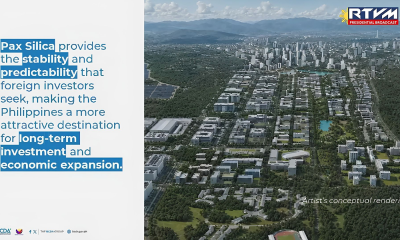
Malacañang has reaffirmed that the proposed Pax Silica industrial hub in New Clark City will not accommodate data centers, even as pending legislation includes such facilities among the investments that could qualify for incentives and certification.
Palace Press Officer Claire Castro said on Tuesday, November 24, that President Ferdinand Marcos Jr. remains firm in his position that the planned development in Capas, Tarlac, should focus on advanced manufacturing rather than data center operations.
The clarification highlights a difference between the administration’s stated plans and House Bill No. 11758, which seeks to establish a special industrial zone in New Clark City.
House bill includes AI computing facilities
House Bill No. 11758, or the proposed Advanced Industries Development Act, seeks to establish an Advanced Industries Zone and a governing authority responsible for overseeing its development.
Under Section 24(c), businesses involved in establishing and operating data centers, artificial intelligence computing infrastructure and high-performance computing facilities could qualify for certification.
The provision has raised questions because it appears to allow activities that the President has repeatedly said would not be part of the proposed hub.
The bill was filed on October 26 by several lawmakers, including Deputy Speaker Ronaldo Puno and Representatives Miguel Luis Villafuerte, Albert Garcia, Alfredo Marañon III, Rolando Valeriano and Ramon Jolo Revilla III.
Congressional records show that the measure remains pending before the House Committee on Economic Affairs.
Its provisions therefore represent proposed legislation rather than an approved development plan or authorization to construct data centers.
Asked whether Malacañang would request the removal of the provision, Castro said lawmakers were already aware of Marcos’ position and should ensure that their proposals reflected the administration’s intended direction.
She did not explicitly announce that the Palace would seek an amendment to the bill.
Marcos says no agreement has been signed
The President addressed concerns surrounding Pax Silica during a press conference in Shenzhen, China, on November 20, following his participation in the Asia-Pacific Economic Cooperation meetings.
Marcos said the Philippines had not finalized or signed an agreement with the United States covering the proposed development.
He also questioned criticism directed at provisions that remained subject to negotiation.
His remarks followed heightened public scrutiny of the project, particularly over the possibility of large-scale data centers and their potential environmental impact.
The Philippine government had earlier considered completing discussions on a framework agreement before the end of 2026.
However, officials confirmed that no agreement would be signed during US President Donald Trump’s November visit to Manila.
Trade officials have also emphasized that any future arrangement must comply with Philippine laws and respect the country’s sovereignty.
New Clark City project focuses on advanced industries
The proposed Pax Silica development is intended to attract investments in semiconductor manufacturing, critical minerals processing and other high-technology industries.
The project covers approximately 1,620 hectares within New Clark City in Capas, Tarlac.
It forms part of a broader effort to position the Philippines within international supply chains for advanced technologies, including components used in artificial intelligence systems.
Philippine Ambassador to the United States Jose Manuel Romualdez earlier explained that officials increasingly describe the proposed site as a manufacturing hub rather than a data center complex.
The development could also accommodate companies from countries other than the United States, depending on the final investment framework.
The Department of Trade and Industry has presented the project as an opportunity to create higher-value manufacturing activities and increase domestic processing of critical minerals.
Such industries could allow the Philippines to move beyond exporting raw materials and participate in more advanced stages of global production.
Environmental concerns remain part of discussions
The proposed development has also attracted attention from environmental groups and communities concerned about its potential effects on land, water and electricity resources.
Critics have questioned whether large industrial and computing facilities could increase pressure on local infrastructure and natural resources.
Concerns have also been raised about the possible effects of development on Indigenous communities and existing land use.
The Bases Conversion and Development Authority has previously rejected descriptions of the project as a massive data center complex.
Officials have said the intended development would focus on industrial manufacturing and would include measures to address its infrastructure requirements.
Even without data centers, large-scale industrial activities would still require reliable electricity, water supplies and transportation facilities.
These requirements are among the issues that would need to be addressed as the proposed hub moves through planning and regulatory processes.
Proposed legislation remains under congressional review
The Palace’s latest clarification places renewed attention on how Congress will define the industries permitted within the planned advanced industrial zone.
House Bill No. 11758 proposes a regulatory and investment framework, but the measure has not been approved and does not establish a finalized agreement between the Philippines and the United States.
Trade officials have indicated that discussions on the proposed framework are continuing, while the President has publicly maintained that data centers will not form part of the project.
Congressional records show that House Bill No. 11758 was filed on October 26, read on November 10 and referred to the appropriate House committees for consideration.
Section 24(c), which includes data centers and AI computing facilities among potentially eligible enterprises, remains part of the proposal identified in the latest reporting.
That provision is now a central point of distinction between the pending legislation and the administration’s stated plans for the New Clark City development.