Headline
Citi says Philippines already facing ‘stagflation’ amid weak growth, high inflation

ASM, Philippine Canadian Inquirer
November 10, 2026
Photo courtesy: BusinessWorld
Global banking group Citi believes the Philippine economy has already entered a period of stagflation, citing sluggish economic growth, persistently high inflation and rising unemployment.
Johanna Chua, Citigroup’s global head of emerging market economics, said the latest economic figures point to what she described as “stagflation or slowflation.”
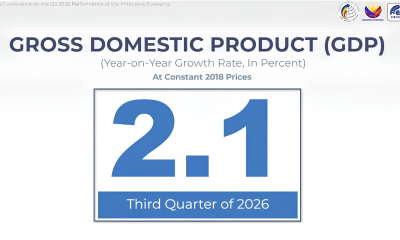
Her assessment follows the release of third-quarter gross domestic product (GDP) data showing that the economy grew by just 2.1%, far below its historical growth pace.
Meanwhile, inflation accelerated to 7.8% in October, nearly double the upper end of the Bangko Sentral ng Pilipinas’ (BSP) 2% to 4% target range.
Citi sees signs of stagflation
Speaking at a press briefing on Monday, November 9, Chua said the gap between economic growth and inflation had become increasingly concerning.
“Obviously, by that definition, you can call it stagflation or slowflation,” she said.
Stagflation generally refers to an economy experiencing weak growth alongside high inflation and elevated unemployment.
For the Philippines, the latest figures show that businesses and households are facing higher costs while economic activity continues to slow.
Citi had expected the economy to expand by 3.8% in the third quarter. That forecast was already higher than the market consensus of 3.1%.
However, actual growth reached only 2.1%, prompting the bank to reassess its outlook.
Chua described the difference between expectations and the official figure as a substantial miss.
Rising prices and unemployment add pressure
The Philippine Statistics Authority reported that inflation rose from 7.2% in September to 7.8% in October.
Higher transport, electricity and housing costs contributed to the increase.
Meanwhile, the unemployment rate climbed to 5.4% in September from 5.3% in August.
The number of unemployed Filipinos also increased to approximately 2.86 million, compared with 2.77 million in August and 1.96 million a year earlier.
These conditions have placed additional pressure on household finances.
Higher prices reduce consumers’ purchasing power, while weaker economic activity can limit employment opportunities and business expansion.
Citi Philippines Chief Executive Officer and Banking Head Paul Favila also acknowledged the difficult economic environment.
He pointed to global developments, including geopolitical tensions and fluctuations in oil prices, as challenges that could limit the government’s ability to address the slowdown.
Citi expects more interest rate hikes
Despite weaker growth, Citi expects the BSP to raise borrowing costs further to contain inflation.
The central bank recently increased its benchmark policy rate by 50 basis points to 5.5%.
Citi anticipates two additional increases of 25 basis points each, potentially bringing the rate to 6%.
The bank expects one increase in December 2026 and another in early 2027.
However, these are Citi’s forecasts, not confirmed decisions by the BSP.
Higher interest rates can help control inflation by reducing demand and limiting price pressures. They can also make borrowing more expensive for households and businesses.
Chua acknowledged the difficulty of balancing inflation control with the need to support economic growth.
Citi expects the BSP to begin easing monetary policy again in 2028.
Economy could recover in 2027
Despite its concerns, Citi sees the possibility of stronger Philippine economic growth next year.
The bank projects that GDP growth could recover to as much as 5.8% in 2027.
However, the outlook depends on several factors.
These include easing geopolitical tensions in the Middle East, improving public investment and declining inflation.
A recovery in government infrastructure spending could also encourage more private investment and support economic activity.
Government remains cautious about stagflation label
The government’s assessment differs from Citi’s.
Department of Economy, Planning, and Development Secretary Arsenio Balisacan has cautioned against declaring that the country has entered stagflation based on the latest indicators alone.
He said a broader review of economic conditions, including full-year data, would provide a clearer assessment.
Balisacan acknowledged that high food and energy prices have weakened consumer spending, while tighter financing conditions have affected investment.
The government is pursuing measures to accelerate infrastructure projects, attract investment and strengthen economic activity.
For Citi, however, the latest figures already reflect a difficult combination of weak growth, elevated inflation and rising unemployment.
Its outlook now points to continued monetary tightening in the near term, followed by a possible economic recovery in 2027 if price pressures ease and investment strengthens.