Headline
PBBM: Oil excise tax cut possible if Dubai crude tops $80 per barrel

By Ruth Abbey Gita-Carlos, Philippine News Agency
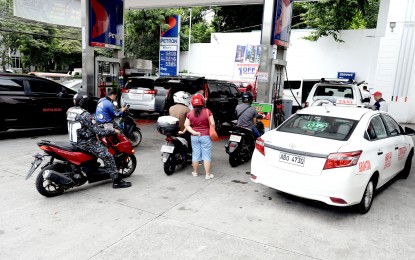
EXCISE TAX CUT. Motorists queue at a gas station along Visayas Avenue in Quezon City. In a press conference on Tuesday (March 3, 2026), President Ferdinand R. Marcos Jr. said reducing excise tax on petroleum products is among the contingency measures if Dubai crude exceeds USD80 per barrel. (Photo: PNA)
MANILA – President Ferdinand R. Marcos Jr. on Tuesday said he may seek “emergency” powers to reduce excise tax on petroleum products, if Dubai crude exceeds USD80 per barrel.
Speaking at a press conference at Malacañan Palace in Manila, Marcos said the proposed tax cut amid the Middle East crisis is “not yet a sure thing.”
“There is also a proposal that we will examine further. I am going to talk to the leaders in both the House and in the Senate,” Marcos said.
“This is something that we are discussing and it could be helpful – to give me, the President, the authority to reduce excise tax on petroleum products, should Dubai crude exceed USD80 per barrel.”
Speaking to reporters, Finance Secretary Frederick Go said the contingency plan to slash excise tax still depends on two variables –the price of oil and the duration of the increase.
Go said the price of Dubai crude is currently trading at around USD76 to USD78 per barrel.
“Even if it exceeds USD80 per barrel, doesn’t mean we react right away. It also has to exist for a certain period of time. Kasi kung tumaas ang presyo ng 80, isang araw lang, bumaba naman next day ulit ng 77, ba’t tayo magre-react (If it goes up to USD80 for just one day and then drops back to USD77 the next day, why should we react),” he said.
Marcos said any excise tax cut would be temporary.
“So, I will discuss it with the leadership of Congress and to see if it’s going to be an emergency measure. It is not going to be a permanent measure. It will be something that we will dispose of as soon as the crisis is over,” he said.
Marcos hoped that the tensions in the Middle East would ease, so the government would no longer need to implement such contingency measure.
Stockpile sufficient
Marcos assured the public that the country has sufficient oil supply, with stockpiles ranging from 29 to 67.5 days depending on the product.
He said diesel has 50.5 days of supply, fuel oil and gasoline, 51.5 days each; kerosene, 67.5 days; jet fuel, 58 days; and liquefied petroleum gas (LPG), 29 days.
“So, we are okay for that period of time,” Marcos said. “First of all, let me assure everyone that we have sufficient supply of oil.”
Marcos added supplier countries also maintain their own stockpiles, which could serve as additional potential sources.
He, however, acknowledged that exporting nations may limit shipments to protect domestic reserves amid the crisis.
Other contingency measures
Marcos said the government has prepared scenarios should Dubai crude range between USD80 and USD90 per barrel for two months.
Among the interventions being considered are targeted fuel subsidies for the transport and agricultural sectors, as well as fisherfolk.
He said fertilizer, a petroleum derivative, could also be affected by higher oil prices.
Marcos said funds may be sources from programs such as the Pantawid Pasada Program and existing subsidies for farmers and fisherfolk.
He said the government is also studying the possibility of easing transport costs for workers, including free bus rides on major routes and measures to keep public transport fares stable.
Marcos said the Department of Energy has coordinated with oil companies to implement any price increases in a staggered manner to cushion the impact on consumers.
“Para hindi naman bigla-biglang tataas ang presyo ng petroleum products ng langis. Ito ang mga produkto na ginagamit ng taumbayan ay dahan-dahan lang paakyatin (There will be no sudden increases in the price of petroleum products. Adjustments should be done gradually),” he said.
Senators back excise tax suspension
Senators expressed support for Marcos’ plan to suspend or reduce fuel excise taxes once global oil prices reach USD80 per barrel amid tensions in the Middle East.
Senate Majority Leader Juan Miguel Zubiri said granting the President authority to lower the excise tax would help shield consumers from the ripple effects of rising fuel costs on food, transport and electricity.
“I am in favor of granting the president those powers to be able to lower the excise tax on fuel. That move will definitely help cushion the impacts on high fuel cost due to the ongoing conflict in the Middle East,” Zubiri said.
Senator Erwin Tulfo said the Senate is ready to back the proposal, noting that the President would seek congressional authorization if crude prices hit the USD80 threshold.
“Of course, susuportahan po namin… magkaroon ng automatic suspension ng excise tax kasi mabigat po ‘yan (Of course, we will support it… to have an automatic suspension of the excise tax because it is burdensome),” Tulfo said.
The Senate Foreign Relations Committee is set to hold a hearing on Friday morning to discuss the proposed tax suspension, fuel subsidies and other contingency measures amid the crisis.