Canada News
With Trump’s Venezuela move and Greenland threats, are Canadians vulnerable?

Mike Crawley, CBC News, RCI
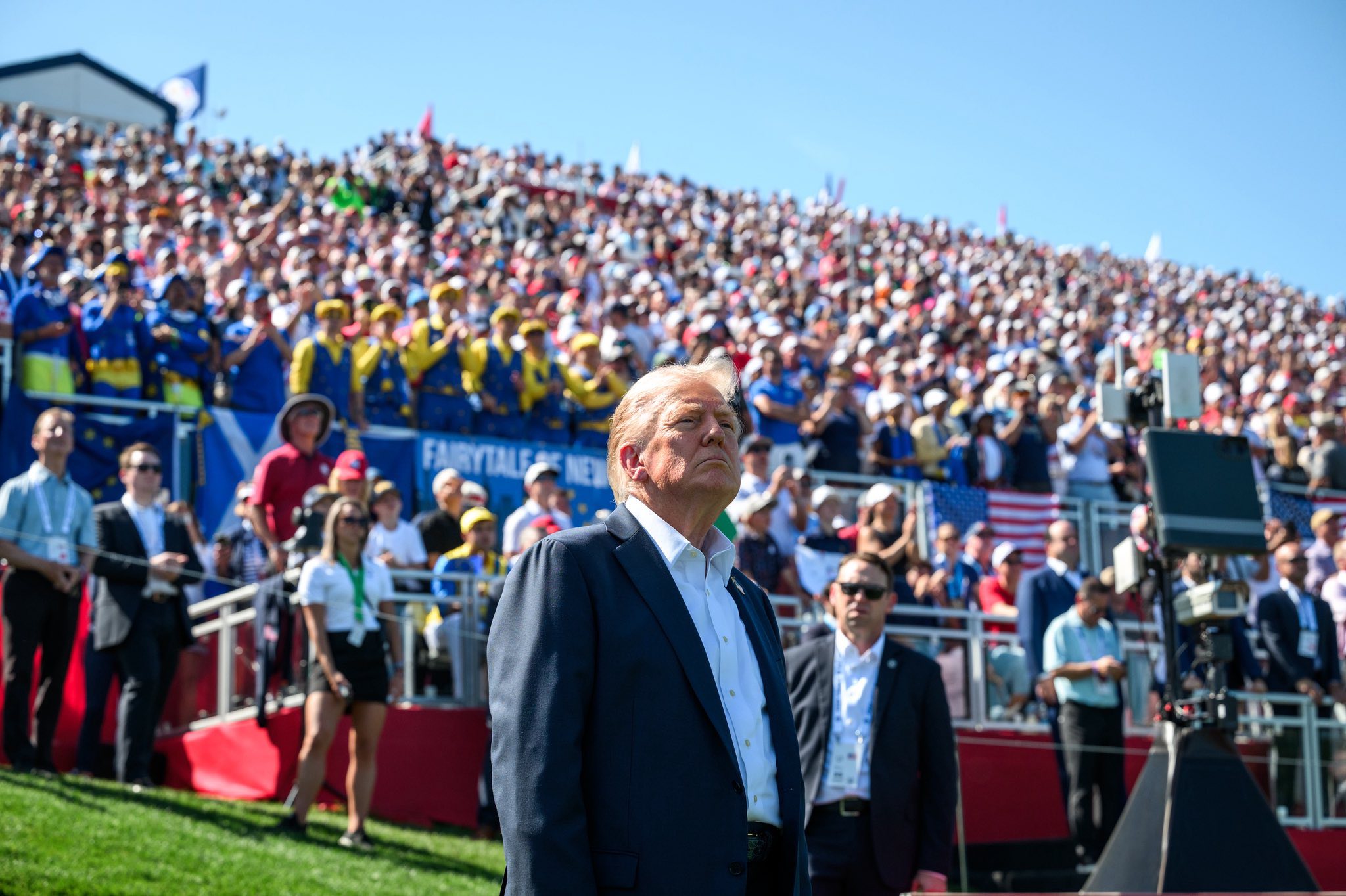
President Donald J. Trump (Donald J. Trump/facebook)
New U.S. national security strategy to enforce ‘American pre-eminence in the Western Hemisphere’.
U.S. President Donald Trump’s increasingly bellicose stance on taking over Greenland and the capture of Venezuelan President Nicolás Maduro are combining to trigger questions and theories about what the White House may have in mind for Canada.
The Trump administration’s moves come on the heels of its vow to reassert and enforce
American pre-eminence in the Western Hemisphere, spelled out officially in a new national security strategy (new window).
The White House said this week that using military force to obtain Greenland (new window) remains an option despite the fact it’s a semi-autonomous territory of Denmark, a NATO ally, while Trump has also floated intervention (new window) against Colombia’s president and Mexican drug cartels.
Whether he would be prepared to use military force against Canada — previously dismissed as wild speculation — is now a subject that’s up for debate.
Among those raising the alarm that it’s a possibility is Bob Rae, the former ambassador to the United Nations. In interviews with multiple media outlets this week, Rae said Canadians would be wrong to think their country is not on the menu
for U.S. aggression.
The Trump administration doesn’t take Canada’s sovereignty seriously,
he told the Globe and Mail (new window) on Tuesday.
Trump sees acquiring Greenland as a national security priority
The White House says U.S. President Donald Trump and his team are considering a range of options in efforts to acquire Greenland as the ouster of Venezuelan leader Nicolás Maduro continues to reverberate in the Western Hemisphere.
Adam Gordon, a visiting fellow of the Cascade Institute at Royal Roads University, says there’s mounting evidence suggesting a real risk of the Trump administration using military coercion against Canada.
Gordon, who served as a senior adviser to Foreign Affairs Minister Anita Anand and her predecessor Mélanie Joly, pointed to what he calls a pattern of behaviour and statements
from the Trump administration, including the U.S. president’s calls for Canada to become the 51st state, as well as the text of its national security strategy and its attitude toward international law.
‘We need to be prepared for that’
We can’t take off the table anymore the idea that it is at least plausible that there would be some use of force or threat of use of force, and we need to be prepared for that,
Gordon told CBC News on Wednesday.
When the U.S. strategy was made public in December, Gordon says it was unclear how seriously the administration would pursue the policies laid out in the 30-page document (new window).
Cross Country Checkup is asking: from Venezuela to Greenland to Ukraine, what questions do you have about U.S. foreign policy and what Canada should do about it? Leave your question here (new window) and we may read it or call you back for Sunday’s show.
I think we have our answer now, in that we’ve seen them really go for it in Venezuela,
he said.
Gordon says Trump’s justification for removing Maduro from power — that Venezuela is a source of drug trafficking to the U.S. — is the same justification underpinning some tariffs on Canadian exports.
Should Canada be concerned about U.S. territorial ambitions?
Following the U.S. actions in Venezuela over the weekend, Adam Gordon, a visiting fellow with the Cascade Institute, says there is a real risk President Donald Trump will use military coercion against Canada. Gordon, who also served as senior legal and policy adviser to foreign affairs ministers Mélanie Joly and Anita Anand, says the country needs to be prepared and weighs in on Ottawa’s response so far.
Other seasoned observers of U.S. foreign policy caution against concluding that Trump’s actions elsewhere in the Western Hemisphere put Canada in the crosshairs of U.S. military action.
At the same time, those observers acknowledge Canada does face real threats from the Trump White House.
Gerald Butts, who has served as an adviser to both Carney and former prime minister Justin Trudeau, predicts that the administration will do everything it can to gain leverage over Canada in trade talks. That could include trying to influence Canadian politics, he says, but he does not see military action on the table.
I don’t think we’re going to see any kind of kinetic intervention in Canadian life, but we’re going to see a lot of threats, and we’re going to see a lot of seeding of pro-American activity by the Americans in Canadian life,
Butts told the CBC podcast Front Burner (new window) this week.
Butts is now vice-chair of the Eurasia Group, a global political risk firm, which publishes an annual list of what it views as the top 10 risks (new window) facing the planet.
At the top of the list: U.S. political revolution, with Canada feeling the impact more than any other country.
Christopher Hernandez-Roy, deputy director of the Americas program at the Center for Strategic and International Studies, a think-tank in Washington, D.C., says the U.S. push to control Greenland does have implications for Canada’s sovereignty in the Arctic.
Hernandez-Roy points out that Trump’s key stated reason for wanting to acquire Greenland is to deter U.S. adversaries in the region, chiefly Russia and China, which have recently been increasing their Arctic military co-operation, according to security analysts (new window).
It raises the spectre of the U.S. wanting to patrol the Canadian Arctic for the same reasons,
Hernandez-Roy said in an interview.
It might just be that much more tempting for the United States to assume, on Canada’s behalf, perhaps, more patrolling of the Canadian Arctic,
he said.
Any increased U.S. military presence in and around Greenland could actually draw in more Russian and Chinese vessels, Hernandez-Roy said.
Some Colombians fear Trump could target their country next
After U.S. President Donald Trump suggested he might target Colombian President Gustavo Petro next, some in Colombia worry what it could mean for their country.
In turn, that could trigger the U.S. to push for increased use of the Northwest Passage, further pressuring Canada’s sovereignty over its Arctic waters.
It’s important for Canada to show it has the strength to patrol its own Arctic so that the Americans don’t feel that they need to,
said Hernandez-Roy.
Deterring Russian, Chinese aggression
The president has been very open and clear with all of you, and with the world, that he views it in the best interest of the United States to deter Russian and Chinese aggression in the Arctic region,
White House press secretary Karoline Leavitt told reporters in Washington on Wednesday.
Imran Bayoumi, associate director with the Scowcroft Center for Strategy and Security, part of the Atlantic Council think-tank in D.C., doubts there is imminent risk of U.S. military action towards Canada.
However, he says Canada faces a challenge in navigating the increasing tensions between Europe and the Trump administration over Greenland.
The U.S. approach toward Greenland is not constructive. There are ways to bolster co-operation and partnership without threats,
Bayoumi told CBC News.
To counter Russia and China, he says the administration should instead be working with Canada, Greenland and Denmark to build an allied approach to Arctic security and defence, including by scaling up U.S. presence and economic activity in the region.
It’s totally valid for the U.S. to address its security concerns, but threats of annexation are not the way to get that done productively.
This article is republished from RCI.