Headline
Nicolàs Maduro ran a country but now sits in a Brooklyn jail. What are his defences?

Verity Stevenson, CBC News, RCI
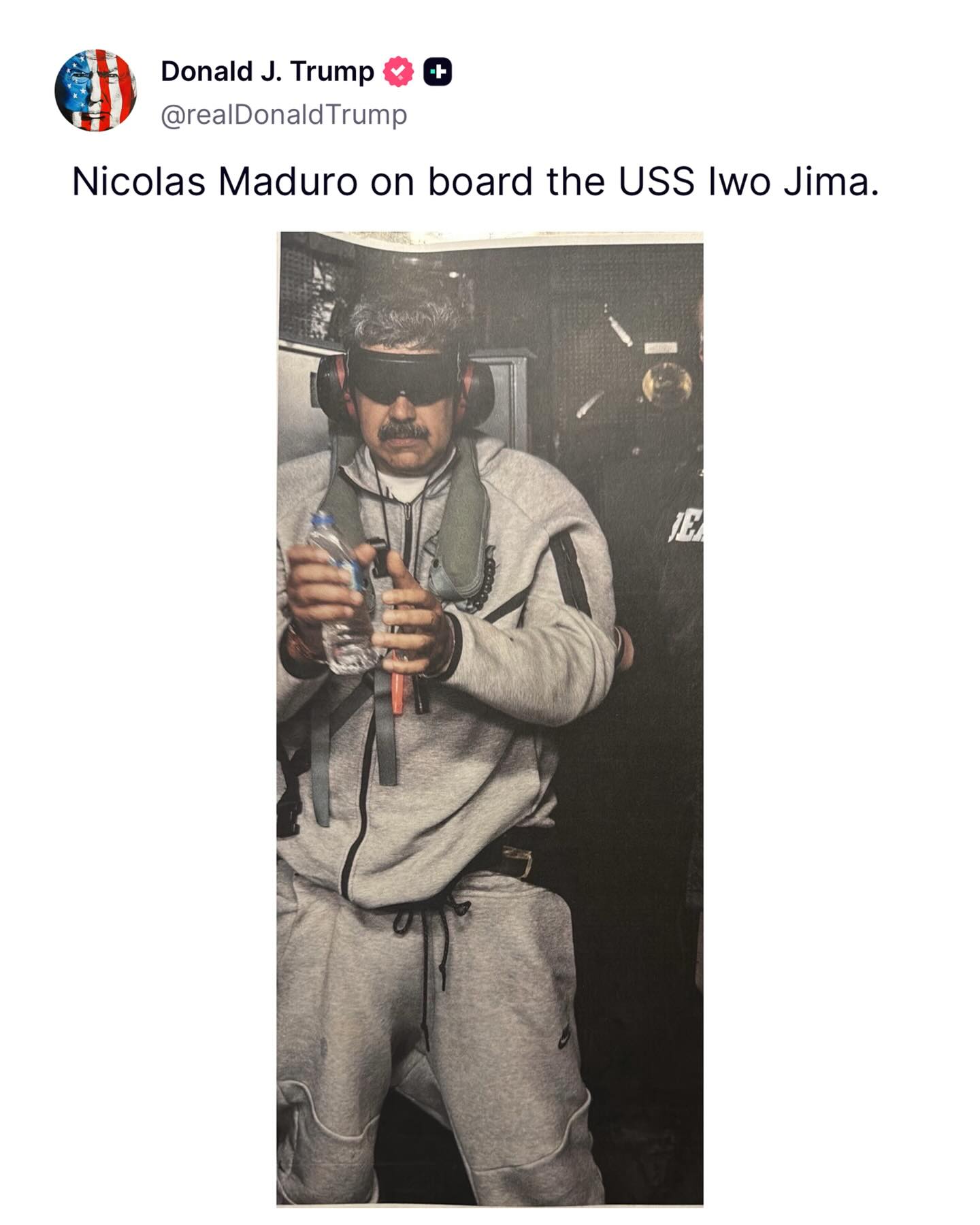
(photo Donald J. Trump/facebook)
Heads of state are typically immune from prosecution. The U.S. says it doesn’t recognize Maduro as leader.
Ousted Venezuelan leader Nicolàs Maduro — who is in custody in a Brooklyn jail with his wife Cilia Flores after a dramatic pre-dawn arrest and capture in Caracas Saturday — is expected to argue he is immune from prosecution as a head of state, an argument his lawyer hinted at in court Monday.
The United States, on the other hand, will likely argue it does not recognize Maduro as the legitimate leader of Venezuela, and hasn’t since 2019, when it said his re-election was fraudulent.
There may be issues with both arguments, though.
I could see the Department of Justice convincing a judge of their position that he actually isn’t a true head of state and he was not properly elected, and I think most nations in the world would agree with that,
said Margaret Donovan, a Yale Law School lecturer and former U.S. federal prosecutor.
Still, the defence is a natural choice to lean toward, according to Donovan. “And of course we have a leader here in the United States … who is very keen on having immunity from criminal offences (new window) when you are the head of state,” she said.
Toward the end of the brief court appearance, where both Maduro and Flores pleaded not guilty, Maduro’s defence lawyer, Barry J. Pollack, said his client is head of a sovereign state and entitled to the privilege
that the status ensures.
Pollack said there were questions about the legality of his military abduction
and that there would be voluminous
pretrial filings to address those legal challenges.
What’s happening with the U.S. effort to prosecute Maduro?
Margaret Donovan, a former assistant U.S attorney and visiting lecturer at Yale Law School, breaks down the details of the indictment against ousted Venezuelan leader Nicolás Maduro and explains what may happen next.
Maduro and Flores, along with Maduro’s son and three others, are accused of working with drug cartels to facilitate the shipment of thousands of tonnes of cocaine into the U.S.
The charges they face are of narco-terrorism conspiracy, possession of machine guns and destructive devices, and conspiracy to possess machine guns and destructive devices. If convicted, they could face life in prison.
Differences between Noriega and Maduro cases
The U.S. has drawn several parallels between its arrest of Maduro and the arrest of Panama’s Manuel Antonio Noriega, which happened almost exactly 36 years before Saturday’s military operation.
But despite the assets — such as the Panama Canal and Venezuelan oil — that the U.S. may have been trying to secure, there are differences between the two cases.
Noriega’s argument that he was immune to prosecution as head of state did not hold up at the time. He never held the title of president during his six-year de facto rule, leaving a string of puppets to fill that role.
In contrast, Maduro claims to have won a popular mandate three times.
Although the results of his 2024 re-election are disputed (new window), a number of governments — including China, Russia and Egypt — recognized his victory.
Before you ever get to guilt or innocence, there are serious questions about whether a U.S. court can proceed at all,
said David Oscar Markus, a Miami defence lawyer who has handled several high-profile criminal cases including some involving Venezuela.
Maduro has a much stronger sovereign immunity defence than did Noriega, who was not actually the sitting president of Panama at the time.
The charges against Maduro come a month after U.S. President Donald Trump pardoned another former head of state for similar offences.
Former Honduran president Juan Orlando Hernández was sentenced last year to 45 years in prison for his role in a drug-trafficking operation that moved hundreds of tonnes of cocaine to the U.S. In early December, he was released from prison (new window).
I was asked by Honduras — many of the people of Honduras,
Trump told reporters on Air Force One after the announcement. The people of Honduras really thought he was set up and it was a terrible thing.
Will the narco-terrorism charge stick?
In Maduro’s case, the U.S. is positioning the trafficking of cocaine as a type of weapon used against the U.S. Hence, the charge of narco-terrorism,
which appears to combine matters of criminal justice with national security.
It’s a charge former U.S. federal prosecutor Joseph Moreno says he’s rarely seen.
It’s creative and it sounds good on television,
he said. The administration is trying to use a confluence of terrorism and narcotics trafficking.
Moreno believes the charge could eventually be watered down as Maduro will no doubt challenge the allegation that he is, in fact, the head of an illegitimate terrorist organization.
At an emergency United Nations Security Council meeting Monday, the U.S. presented two types of justification that speak to the intertwined nature of the layers of government and international law.
UN Security Council largely condemns U.S. action against Maduro in Venezuela
The 15-member United Nations Security Council met at UN headquarters in New York just hours before Venezuelan President Nicolás Maduro appeared in a Manhattan federal court on drug charges, including narco-terrorism conspiracy. Most member countries explicitly condemned the U.S. for its actions, and Secretary-General Antonio Guterres, in a statement read by UN political affairs chief Rosemary DiCarlo, said ‘I am deeply concerned about the possible intensification of instability in the country.’
First, it positioned the capture and arrest of Maduro as a criminal justice operation that was simply facilitated by the U.S. military.
Mike Waltz, the U.S.’s ambassador to the United Nations, called it a surgical law enforcement operation … against two indicted fugitives of American justice.
Second, the U.S. has not framed this weekend’s events as an act of war — but it nonetheless appears to be preparing a defence against those who may see it that way.
Waltz said Maduro was responsible for attacks on the people of the United States
through drug trafficking and for destabilizing the Western Hemisphere and illegitimately repressing the people of Venezuela.
Cocaine — not fentanyl
Notably missing from the indictment against Maduro and Flores is any mention of fentanyl.
Trump used fentanyl trafficking as a justification for multiple strikes on boats leaving Venezuela, killing more than 100 people.
The administration has been saying that these boats are trafficking fentanyl and that they are a threat to American lives and that’s why we can use military force. And so the absence of the mention of fentanyl … is quite interesting,
said Donovan, the former U.S. prosecutor.
Why is the U.S. attacking boats near Venezuela?
For weeks, U.S. forces have been destroying suspected drug-smuggling boats off Venezuela’s coast, leaving at least 20 people dead. For The National, Eli Glasner explains what’s behind the military campaign in the region and why some experts warn it may violate international law.
The trafficking charges are for cocaine, not fentanyl.
Trump repeatedly accused Venezuela of being a hub for fentanyl trafficking, though records have shown that Mexico is the main source of the deadly drug.
While cocaine does come to the U.S. from Venezuela, experts say it likely amounts (new window) to about 10 per cent, with the bulk coming from nearby Colombia.
This article is republished from RCI.