

By Sambit Bhattacharyya, University of Sussex; The Conversation
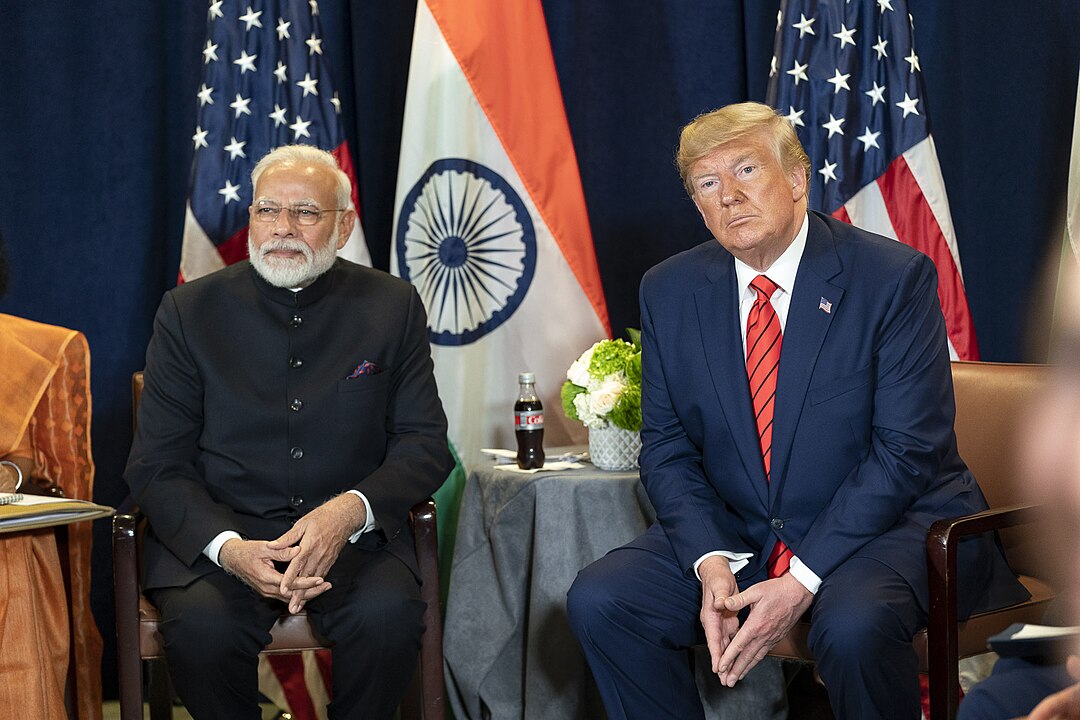
FILE: President Donald J. Trump and India’s Prime Minister Narendra Modi, joined by members of their delegations, participate in a bilateral meeting Tuesday, September 24, 2019, at the United Nations Headquarters in New York City. (Photo by The White House from Washington, DC – #UNGA, Public Domain)
Donald Trump’s tariff policy seems to have morphed into as much of a tool of foreign policy as an economic strategy. But the administration’s decision to impose a 50% tariff on India, a key US ally as part of the Quad (Quadrilateral Security Dialogue) along with the US, Australia and Japan, could have significant repercussions – not just for international trade, but for global geopolitics.
The US rationale for the tariff hike is primarily political. The White House argues that India has been profiteering from buying and reselling Russian oil, in defiance of sanctions imposed after the invasion of Ukraine in 2022. This has helped Russia weather the effects of the sanctions and continue to fund its war in Ukraine.
Needless to say, the tariff policy and subsequent statements from both Washington and New Delhi have ruined a burgeoning bilateral relationship to the extent that the Indian prime minister, Narendra Modi, has been refusing to take Trump’s phone calls. For his part, Trump is no longer planning to visit India for the Quad summit later in the year.
India’s prime minister, Narendra Modi, attended the Shanghai Cooperation Organisation (SCO) summit in Tianjin, China, from August 31 to September 1, along with the Russian president Vladimir Putin. The three leaders were photographed together in cordial discussion and Modi met separately with both Xi and Putin on the sidelines of the summit, which was billed as presenting an alternative to the US-led hegemonic order.
It now seems clear that raised US tariffs won’t deter India from buying Russian oil. On the contrary, Modi has reaffirmed India’s commitment to not only continue buying Russian oil but to increase volumes.
This is unsurprising. India’s stance on Russia as a net crude oil importer is not driven by any grandiose geopolitical objective but the mundane economic reality of controlling inflation.
When it comes to energy, India is heavily dependent on imports and its consumers, the overwhelming majority of whom are poor and vulnerable, depend on stable and affordable energy prices. No amount of pressure from the US or its G7 allies would change that simple economic reality.
America’s loss is Russia’s gain
One consequence of the US tariffs is that Indian exports of clothing and footwear to the US could decline as big western brands seek to substitute their Indian suppliers with cheaper suppliers from other countries. This will push up prices for consumers in the US.
But it’s unlikely to be that damaging for Indian suppliers as there’s considerable global demand for clothing and footwear. It wouldn’t be difficult for Indian suppliers to find alternative markets.
Another of India’s big exports is gemstones, in which it has a dominant position in the global market. US tariff pressure is unlikely to change that as India exports gemstones to a range of different countries (although the US is a big buyer).
Closer trade ties between India and Russia will open up new opportunities for mutual investment. Russia’s economic position, meanwhile, is likely to improve overall as a result of the tariffs. Not only has India signalled it is likely to increase its oil imports, but Russia is also likely to get the benefit of importing clothing and footwear from Indian suppliers at a favourable price, as Indian suppliers look to redirect their US exports elsewhere.
Closer economic ties with India with the aim to increase bilateral trade to US$100 billion (£74.5 billion) by 2030 will give Russia another large market outside of China to sell its products. Russia will also get access to another major supplier of the sort of consumer goods that it typically imports to keep local prices low for Russian consumers.
An end to US dollar primacy?
There’s a danger for the west that if the tariff situation escalates into harsher financial sanctions, it could divert Indian investment away from the US and G7 countries towards Russia and China. Indian investors have significant presence in the automotive, pharmaceutical, and IT and telecom sectors in the west, which could be directed elsewhere.
But there are growing signs of increasing cohesion, not only from the SCO, but from an expanding Brics group of trading nations. This is now made up of original members, Brazil, Russia, India, China and South Africa, plus recent joiners Egypt, Ethiopia, Iran, Indonesia and the United Arab Emirates.
These growing economies are already working towards setting up technical mechanisms for mutual investments and trade settlements in their local currencies rather than the US dollar.
The global trade shocks prompted by US imposition of tariffs have led to a short-term decline in the value of the US dollar. While not drastic from a historical trend perspective, these short-term trends mask a broader long-term risk.
Not from trade transactions – trade accounts for only a fraction of dollar transactions. The long-term risks are from a potentially reduced role of the dollar in transactions associated with asset management, investment, finance and international reserves.
In particular, the dollar’s near exclusive status as a reserve currency for Brics and global south nations is at risk.
Any policy that puts that status at risk would compromise US prosperity and security. The concern is that any financial and trade policies that drive the US’s big trading partners closer to Russia and China will do just that.
Sambit Bhattacharyya, Professor of Economics, University of Sussex Business School, University of Sussex
This article is republished from The Conversation under a Creative Commons license. Read the original article.




















