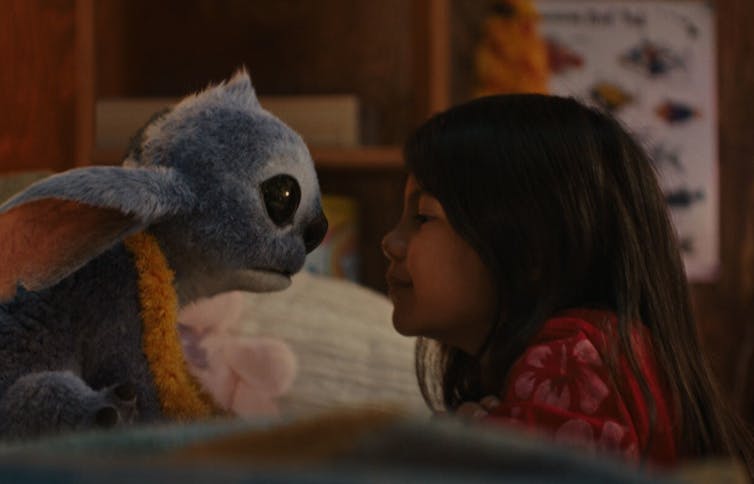
(Disney)
By Elena Merenda, University of Guelph-Humber, The Conversation
This story contains spoilers about Lilo & Stitch.
At first glance, Disney’s Lilo & Stitch, set in Hawaii, seems like a playful, heartwarming film about an alien’s misadventures and a young girl’s search for connection and friendship. But there’s a deeper story — one about childhood grief in the life of the main character, Lilo, and how she navigates the loss of her parents.
Lilo’s story offers a meaningful glimpse into how grief shows up in children through their emotions and actions.
Grief in childhood is often misunderstood and overlooked. A common misconception is that children don’t grieve because they’re too young to understand loss. But just because children don’t express grief the way adults do, it doesn’t mean they aren’t grieving.
As an early child educator who teaches families and post-secondary students about children’s grief, I often say this: anyone who is capable of loving is capable of grieving — and children are deeply capable of love.
Children express grief through behaviours
Lilo’s grief is never directly named in the film, but it’s everywhere — she lashes out, isolates herself and clings tightly to Stitch. These behaviours mirror how many children express grief through actions rather than words.
Research from the National Child Traumatic Stress Network notes that young children often grieve through behaviour — aggression, regression, somatic complaints or withdrawal. This is tied to their stage of cognitive development.
As the theory of cognitive development by renowned psychologist Jean Piaget outlines, children aged two to seven think concretely and egocentrically, making abstract concepts like death hard to understand.
In one scene, Lilo insists on feeding a sandwich to her pet fish Pudge, believing he controls the weather — an imaginative ritual that helps her feel a sense of control in a world that feels uncertain and unstable. In multiple scenes she refuses to listen to her sister Nani, reflecting how grief often shows up through routines, symbolic actions or emotional withdrawal.
Grief can make children feel ‘different’
The Canadian Alliance for Children’s Grief estimates that one in 14 children in Canada will lose a parent or sibling before age 18. Yet despite how common it is, childhood grief is often overlooked — especially in schools, where emotional pain may go unnoticed.

(Disney)
In Lilo & Stitch, we see this reality through Lilo. She knows she doesn’t fit in and asks her sister why no one likes her. Her classmates tease her for being “weird” and emotionally reactive. In one scene, she tries to share a handmade bracelet during dance class, only to be mocked and excluded. The moment may seem small but it reveals a deeper truth: grief can make children feel isolated, overwhelmed and fundamentally different from their peers.
Research confirms this. Studies in the Journal of School Psychology show that bereaved children often describe themselves as “not normal” or “different,” especially when their peers haven’t experienced a similar loss. Without safe, validating spaces to process their grief, these feelings can lead to loneliness, behavioural struggles and low self-esteem.
Grief grows with us
Grief in childhood isn’t a single moment — it evolves and deepens over time. As children grow, so does their understanding of what they’ve lost. They often revisit their grief at new developmental stages, carrying it in different ways.
Lilo & Stitch reflects this beautifully. Lilo doesn’t talk much about her parents’ death, but we see her grief in the routines she clings to — like listening to Elvis or sharing old family photos. These aren’t just quirks; they’re ways she keeps her parents close.
This reflects what grief researchers call the continuing bonds theory, which emphasizes that maintaining emotional connections to the deceased can support healthy adaptation. Grief isn’t something children “get over.” It’s something they learn to carry — with support, connection and love.
Healing doesn’t mean Lilo returns to who she was before her parents’ deaths. Her grief remains, but she begins to rebuild her world with Stitch, Nani and her new ‘ohana (family).
They don’t replace what was lost, but they become a space where grief and love can coexist.
One of the film’s most memorable lines captures this truth:
“This is my family. I found it, all on my own. It’s little and broken but still good. Yeah… still good.”
Connection is the path to healing
Just as grief is rooted in love, healing is rooted in connection.
Lilo’s healing comes from presence. Despite the chaos he brings, Stitch stays. Nani, overwhelmed and unsure, keeps showing up.
Their love and steady, unconditional presence allow Lilo to begin feeling safe enough to grieve and grow.
This reflects what attachment research tells us: strong, secure relationships are among the most powerful protective factors for children navigating loss. When a child feels emotionally safe with a caregiver, they’re better able to regulate emotions, build resilience and integrate the pain of loss into their development. In bereavement, the presence of a stable, responsive adult can determine whether a child’s grief becomes traumatic — or transformative.
In Lilo & Stitch, connection becomes both the container for Lilo’s grief and the bridge to her healing. The film gently reminds us: love may be the reason we grieve, but it’s also the most powerful way through it.
How caregivers can support a grieving child
1. Maintain routine and consistency.
In times of grief, structure helps children feel safe. Predictable routines — like mealtimes, bedtime rituals and daily rhythms — offer a sense of stability when everything else feels uncertain
2. Normalize and validate emotions.
Help your child name what they’re feeling and let them know it’s OK. Say things like, “It’s OK to feel that way,” or “Whatever you feel is welcome here.” Validation helps reduce shame and gives children permission to process their grief openly.
3. Answer questions honestly.
Children need truthful, age-appropriate information about what has happened. Avoid euphemisms like “went to sleep” or “passed away,” which can cause confusion. Instead, use clear, simple language: “Their body stopped working and they died.” Honesty builds trust and supports children’s cognitive and emotional development as they process the permanence of death.
4. Seek support.
Grief can feel overwhelming — for children and their parents or caregivers. Reach out to school counsellors, grief therapists or local support groups, because support can reduce isolation, support expression and improve coping in grieving families.
Elena Merenda, Associate Head of Early Childhood Studies, University of Guelph-Humber
This article is republished from The Conversation under a Creative Commons license. Read the original article.