

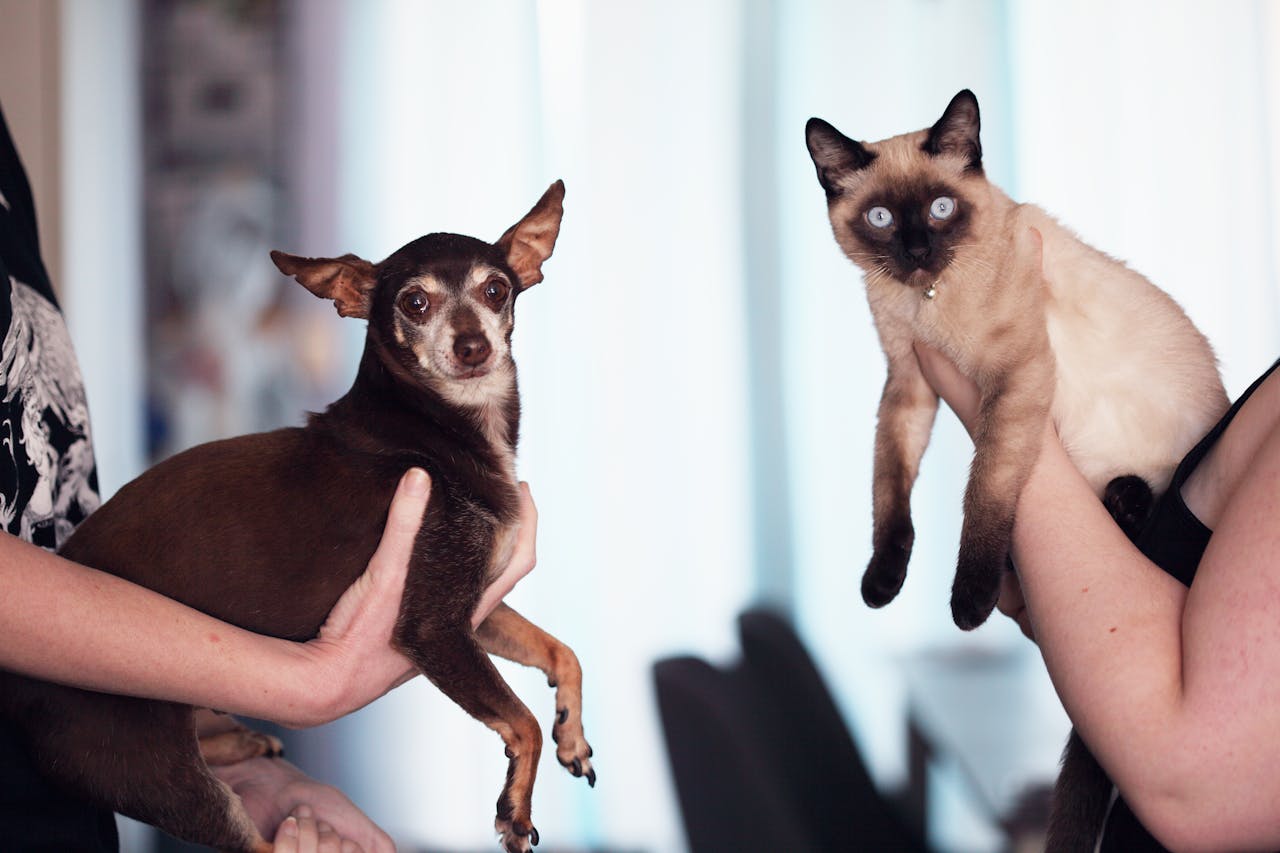
Photo of People Holding Siamese Cat and Chihuahua. (Pexels Photo)
By Grace Carroll, Queen’s University Belfast, The Conversation
Domestication has made cats and dogs more diverse, but also curiously alike – with serious implications for their health and welfare, new research shows.
At first glance, Persian cats and pugs don’t seem like they’d have much in common. One’s a cat, the other’s a dog, separated by 50 million years of evolution. But when evolutionary biologist Abby Grace Drake and her colleagues scanned 1,810 skulls of cats, dogs and their wild relatives, they found something strange. Despite their distant histories, many breeds of cats and dogs show striking similarity in skull shape.
In evolutionary biology, divergence is a common process. In simple terms, divergence is where two organisms that share a common ancestry become increasingly different over time, while convergence means becoming more similar. As populations of animals split and adapt to different environments, they gradually develop new traits, a process known as divergent evolution.
This is one of the main ways new species form different traits, causing populations to evolve along separate paths. But sometimes, evolution can take a different direction. Convergence happens when unrelated species, shaped by similar pressures, independently evolve similar features.
In the case of domestic cats, dogs and many other domesticated species, intentional and unintentional selection by humans seems to have created convergence, accidentally steering different species toward similar traits.
Despite a long history of evolutionary separation, flat-faced breeds like the Persian cat and pugs share similar skull structures.
To investigate how far domestication has reshaped skull structure, Drake and her colleagues analysed 3D scans of skulls from museum specimens, veterinary schools and digital archives. Their dataset included domestic cats such as Siamese, Maine coon and Persian breeds, as well as over 100 dog breeds from short-muzzled dogs like pugs, to long-muzzled breeds like collies.
Their findings showed that domestication has not only increased skull shape diversity beyond that of wolves and wildcats, but also led some cat and dog breeds to resemble one another, with convergence towards either long or flat faces. Wild canids (the group of animals that includes dogs, wolves, foxes and jackals) tend to share a similar elongated skull, while wild felids (the group of animals that includes domestic cats, lions, tigers and jaguars) show more natural variation.
Yet domestic breeds of both species now span a more extreme range at both ends of the scale. This trend can be seen in the emergence of cats bred to resemble XL bully dogs.
Domestication has long shown that when humans intervene, even distantly related species can end up looking, and sometimes suffering, in similar ways.
Selective breeding has exaggerated traits across species. Many other human-made changes can push animals beyond what their bodies can naturally support. For instance, some chickens bred for their meat carry 30% of their body weight in breast muscle, which often results in heart and lung problems.
The human preference for flat-faced pets taps into some of our most fundamental instincts. Humans are hard-wired to respond to infant features like rounded heads, small noses and large, low set eyes. These traits, which are exaggerated in many flat-faced cat and dog breeds, mimic the appearance of human babies.
Of all species, humans are among the most altricial, meaning that we are born helpless and dependent on caregivers for survival, a trait we share with puppies and kittens. In contrast, precocial animals are able to see, hear, stand and move shortly after birth. Because human infants rely so heavily upon adult care, evolution has shaped us to be sensitive to signals of vulnerability and need.
These signals like the rounded cheeks and wide eyes of babies, are known as social releasers. They trigger caregiving behaviour in adults, from speaking in higher-pitched tones to offering parental care.
Herring gulls (a type of seagull) are an example of this in non-human animals. Their chicks instinctively peck at a red spot on the parent’s beak, which triggers the adult to regurgitate food. This red spot acts as a social releaser, ensuring the chick’s needs are met at the right time. In a similar way, domesticated animals have effectively hijacked ancient caregiving mechanisms evolved for our own offspring.
These traits may give pets an advantage in soliciting human care and attention, but they come at a cost.
The UK government commissions its Animal Welfare Committee to provide independent expert advice on emerging animal welfare concerns. In reports they produced in 2024, the committee raised serious concerns about the effect of selective breeding in both cats and dogs.
The reports highlighted that breeding for extreme physical traits, like flat faces and exaggerated skull shapes, has led to widespread health problems, including breathing difficulties, neurological conditions and birth complications.
The committee argues that animals with severe hereditary health issues should no longer be used for breeding, and calls for tougher regulation of breeders. Without these reforms, many popular breeds will continue to suffer from preventable, life-limiting conditions.
Selective breeding has shown how easily humans can bend nature to their preferences, and how quickly millions of years of evolutionary separation can be overridden by a few decades of artificial selection.
In choosing pets that mimic the faces of our own infants, we have, often unwittingly, selected for traits that harm the animals. Understanding the forces that drive convergence between species is a reminder that we play a powerful and sometimes dangerous role in shaping it.
Grace Carroll, Lecturer in Animal Behaviour and Welfare, School of Psychology, Queen’s University Belfast
This article is republished from The Conversation under a Creative Commons license. Read the original article.




















