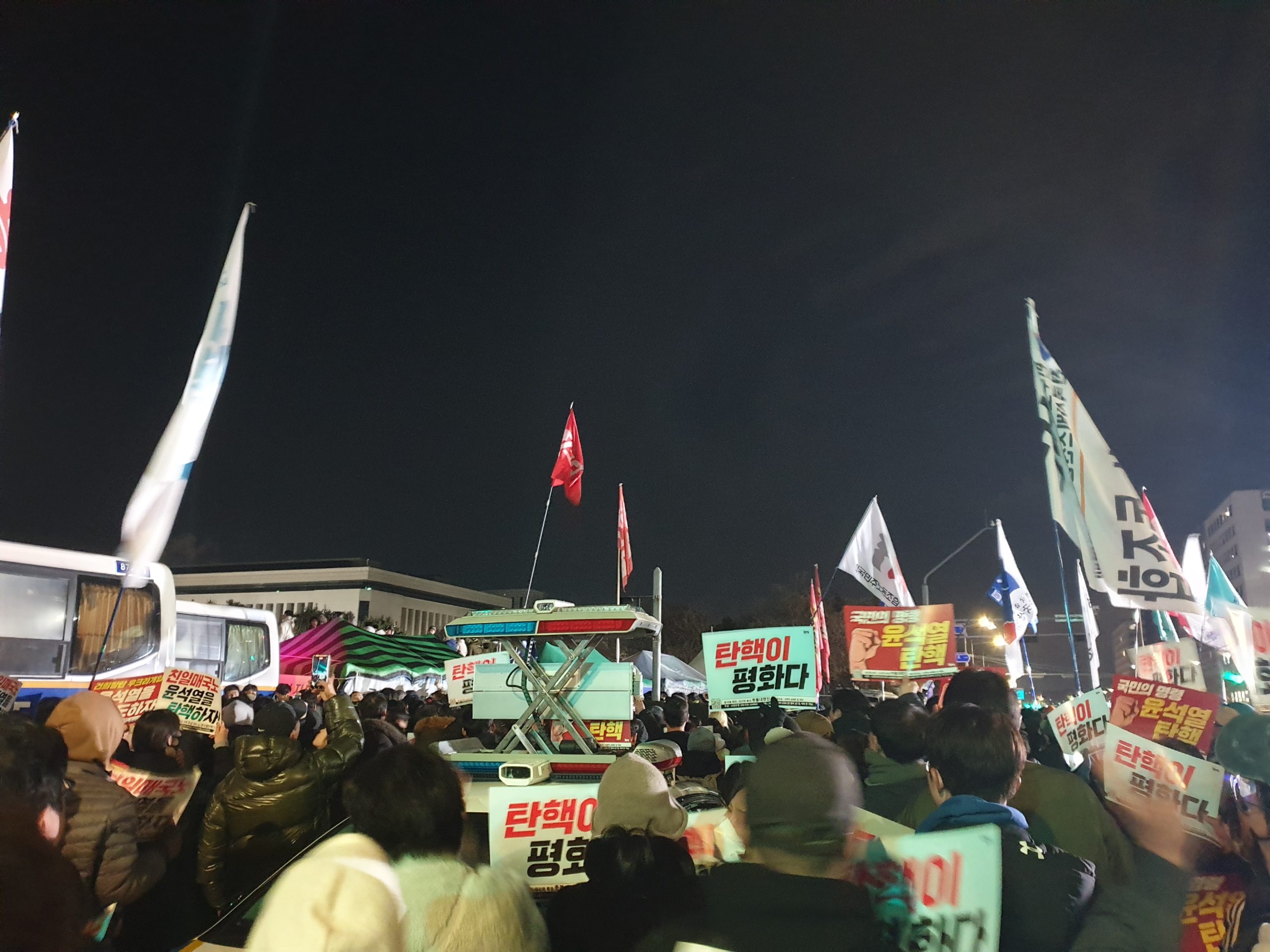
A martial law proclamation was then issued stating that all political activities were now banned – including the work of the South Korean parliament. (Photo By Hashflu/Wikimedia Commons, CC BY-SA 4.0)
By Myunghee Lee, Michigan State University, The Conversation
During a whirlwind few hours in South Korean politics, President Yoon Suk Yeol placed the country under martial law on Dec. 3, 2024, only to lift it just a short while later.
It marked the first time that a South Korean leader has imposed the emergency power since 1979. And although short-lived, the measure provoked concerns of the country backsliding into authoritarian rule.
To explain what happened and what it means for South Korean democracy, The Conversation U.S. turned to Myunghee Lee, an expert on authoritarianism, democracy and South Korean politics at Michigan State University.
How did all this unfold?
It was a crazy few hours, and I’m still trying to get my head around it – and a lot is still unknown as to why President Yoon did this.
But at around 9:30 p.m. Korean time on Dec. 3, rumors started circulating among journalists that Yoon was planning an emergency press conference.
And then at 10:20-ish, Yoon gave a short speech in which he blamed certain pro-North Korean and anti-state forces in South Korea of trying to destabilize the country. In effect, he was pointing the finger at opposition parties who have been blocking his policies and trying to impeach some of his appointees.
He declared the situation unacceptable and said there was no way for him to continue to smoothly run the county, and as such he was declaring emergency martial law to save the nation from pro-North Korean and anti-state forces.
The minister of defense then held a meeting with major military personnel, set up a martial law headquarters, and Army Chief of Staff Gen. Park An-su was appointed as martial law commander.
A martial law proclamation was then issued stating that all political activities were now banned – including the work of the South Korean parliament. This all took place within around one hour of Yoon’s declaration.
Despite the proclamation, legislators headed to the National Assembly, where some were blocked from entering. But many did get in, and, at around 1 a.m. local time, legislators voted against the martial law – in effect forcing Yoon to repeal his declaration.
He did this but not for another three and a half hours, during which the situation was very tense. He relented at around 4.30 a.m., held another press conference and announced that he was lifting the emergency measure.
Why did he declare martial law now?
That’s what many people – myself included – are trying to work out. This shocked a lot of people, and it appears many were taken unawares. Obviously some people were in the know, such as the defense minister and army general appointed martial law commander. But it appears even some in his own party were unaware that Yoon was planning to do this.
For sure, some opposition politicians have been warning about something like this happening since September. And Yoon has become increasingly frustrated by both divisions in his own party and moves by the opposition in the National Assembly to block key parts of his agenda. Also Yoon is facing numerous influence-peddling scandals involving both himself and his wife.
This wasn’t a declaration made from a position of strength then?
Hardly. Yoon is in an incredibly weak position: His approval rating has been hovering around the 20% mark.
He presides over a divided party, a gridlocked parliament and a population in which he has become very unpopular.
So was this an act of desperation?
I don’t think so, no. The suggestion that Yoon took this step before the opposition could impeach him? That doesn’t make sense to me. He was already facing calls for impeachment – but I’m not sure that before this episode there was appetite in the country for a second impeachment, following the 2016 impeachment of President Park Geun-hye over a corruption scandal.
So on that front, despite the scandals and the political issues he faced, I don’t think this can be characterized as an act of desperation. Especially as those calls for impeachment and removal from power have only been intensified by his actions.
I think Yoon declared martial law out of anger – he was angry, and resentful at the opposition blocking him repeatedly. But then again, I can’t read his mind.
For many, it is regarded as a foolish move – he was in such a weak position politically, it would have seemed unlikely that this tactic would succeed. But he and some of the plotters must have calculated politically that this tactic would give them a chance to gain support from his core base. The real puzzle is what drove him to make that political calculation.
Is Yoon known to be an authoritarian figure?
People certainly have aired concern over his autocratic tendencies. Even before this martial law incident, some of his decisions have prompted concerns. He has ignored legal procedures and tried to circumvent the National Assembly. He has certainly shown an illiberal streak at home, attacking the media as “fake news” while smearing opponents as communists and North Korean sympathizers.
But that’s not always the way he is perceived in the West. Since the Russian invasion, there have been attempts by foreign policy types to divide the world into two blocs – a liberal one and an illiberal one. Yoon, as a key ally to the U.S., is framed in Washington as a defender of democracy. At home, however, it’s a different story.
With the declaration of martial law, his authoritarian tendencies have been amped up for the world to see, and it’s difficult to imagine that won’t be part of his legacy. But even before this decision, he was known for being authoritarian.
How does that legacy fit into the political history of South Korea?
South Korea has a long history with martial law and autocratic, even military, rule.
This latest declaration of martial law is by some counts the 17th instance in Korean history. The last time it was declared was in 1979 following the assassination of Park Chung-hee, a dictator who ruled South Korea during the 1960s and 1970s. That period of martial law lasted until 1981, during which Chun Doo-hwan, another dictator, came to power through a coup and perpetrated a massacre in Gwangju.
Martial law hasn’t been declared since the 1980s, but certainly many older Korean people can still remember that occasion, when troops brutally cracked down on protesters. But since becoming a democracy in 1987, there hadn’t been a declaration of martial law until now.
Interestingly, in a straw poll of my family, age factored into the response to Yoon’s move. Older family members very much feared the declaration of martial law. For younger family members and friends, it was met not as a joke, but certainly as a foolish move that wouldn’t actually result in a prolonged period of martial law.
What happens next?
My guess would be President Yoon’s days are numbered – and that this episode will hasten his political demise.
Before the events of Dec. 3, there were still many people in the parliament and the public at large resistant to the idea of another impeachment following the last one in 2016. But there appears to be a groundswell of opinion in the parliament that the president should be removed, and it is echoed by the public.
Myunghee Lee, Assistant Professor, Michigan State University
This article is republished from The Conversation under a Creative Commons license. Read the original article.