
Canada News
How high-speed rail would change Ontario and Quebec — if it actually happens

By Benjamin Shingler, CBC News, RCI

If it goes ahead, the train could travel up to 300 kilometres per hour — more than double the speed of Via Rail’s current trains. (Pexels Photo)
Research suggests potential to transform smaller cities and reduce housing costs
A high-speed rail line linking Canada’s two largest cities, Montreal and Toronto, has been the stuff of dreams — and political campaigns — for decades.
But with the federal Liberal government poised to announce more detailed plans (new window) for the project, that dream is a step closer to reality.
In Ontario, the line would include stops in Peterborough and Ottawa. In Quebec, it would stop in Laval, Trois-Rivières and Quebec City.
For me, it’s really something that could revolutionize Quebec and Canada,
Stéphane Boyer, the mayor of Laval, located just north of Montreal, told Radio-Canada.
To better connect cities, in a more environmental way, is a game changer.
If it goes ahead, the train could travel up to 300 kilometres per hour — more than double the speed of Via Rail’s current trains. But will it actually happen any time soon? And what could it look like if it does?
Here are some things to consider.
How would it affect the region?
More than half of Canada’s population (new window) lives along the corridor between Quebec City and Windsor, Ont., which some rail proponents hope is eventually included in the route.
Research from Japan (new window) suggests high-speed rail can help ease the cost of housing and congestion on the roads, by making it easier to live further from urban centres.
Overall, high-speed rail has made mid-sized cities become more attractive,
said Yonah Freemark, a researcher specializing in transit at Urban Institute, a think-tank in Washington, D.C.
For example, Lille, the French city located between Paris and London, saw a huge expansion in the business district
after the rail line connecting the two centres was completed.
He said cities like Peterborough and Trois-Rivières could see a similar economic benefit, while Quebec City would likely also see more tourists and business activity.
The corridor would be mostly electrified — a low-emissions travel option that could take thousands of cars off the road.
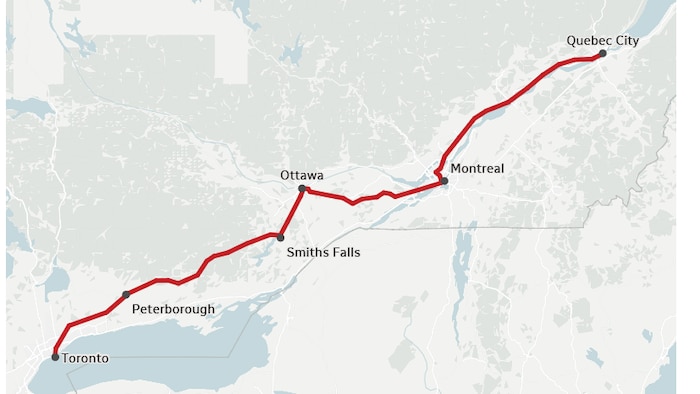
The federal government is set to announce plans for a train linking Toronto with Quebec City.
Photo: CBC
Do we have the population? Look to Italy
The proposed line is comparable to high-speed rail in Italy between Turin and Naples in terms of the population served and distance covered, said Freemark.
It demonstrates that actually if you provide very high-speed service with frequent trains and affordable prices, you can get a lot of people to take the trains,
he said.
He said that Italian high-speed corridor is one of many examples around the world that has shifted travellers’ habits away from planes and cars.
Freemark said a rail corridor between Calgary and Edmonton also has potential. It’s a scenario being studied by the federal government.
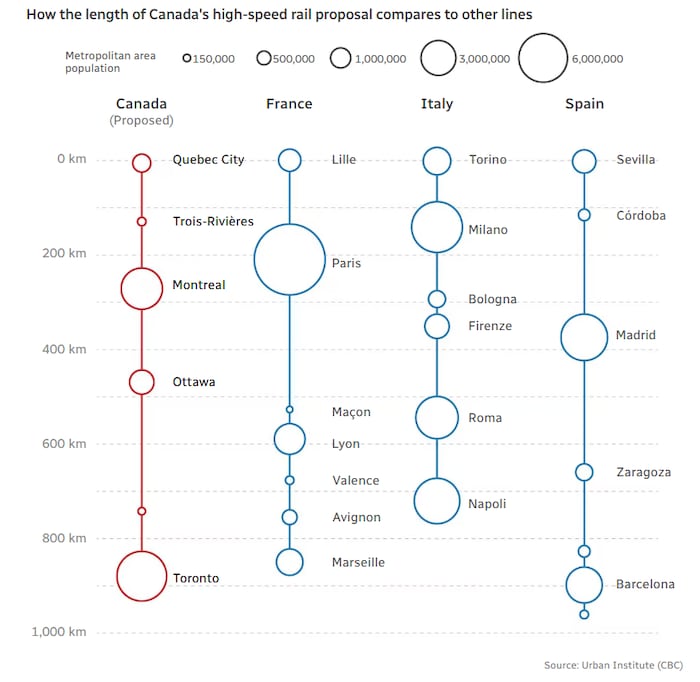
How the length of Canada’s high-speed rail proposal compares to other lines.
Photo: Urban Institute (CBC)
What about the cost?
Transport Canada has estimated that the cost of the high-speed rail link could be as high as $80 billion, though some experts have estimated that figure could climb up to $120 billion.
A proposed rail line between Los Angeles and San Francisco is often cited as a cautionary tale.
It was approved in 2008 to be completed by 2020 at a cost of $33 billion. Still nowhere near done, the line has been dubbed the “bullet train to nowhere (new window).” The estimated total cost is now estimated at $180 billion.
As it stands, Canada lags far behind (new window) other developed countries when it comes to funding rail service.
How fast would it go? And how fast can it get done?
With a federal election looming, the proposed high-speed line could soon become the responsibility of a new government.
It’s expected to take four to five years to design. The money for the project would be allotted once that’s done, so it’s possible a future government could modify or cancel the project.
If it does happen, a high-speed rail line could mean a trip between Montreal and Toronto would take less than three hours, far shorter than the current trip on Via Rail or by car — and in some cases quicker than a flight, after taking into account the trip to the airport and passing through security.
WATCH | High-speed rail also possible between Edmonton and Calgary:
High-speed transport could connect Edmonton and Calgary
Edmonton to Calgary in 45 minutes? Transpod’s high speed rail could reach speeds up to 1000 km/h, and construction is slated to begin next year. CBC’s Min Dhariwal spoke to TransPod CEO Sebastien Gendron about the project.
Right now, Via Rail trains operate at speeds of 60 to 120 km/h, depending on the rail segment. And its trains share tracks with freight cars, which have the right of way.
It’s a no-brainer as far as I’m concerned,
John Gradek, a faculty lecturer at McGill University who has a background in aviation and rail service, said of the proposed project.
Currently, there are about 150 flights a day between the cities along the proposed line, he said.
He said the increase in short-haul domestic flights has made airports like Montreal’s more congested, and they now require improvements to reduce car traffic nearby. He suggested that money should go toward rail instead.
The infrastructure that we’re going to have to invest in, whether it’s roads or whether it’s airports, is going to be unsustainable when it compares to the service that we could be offering with high-speed rail,
he said.
with files from Rowan Kennedy
This article is republished from RCI.




















