

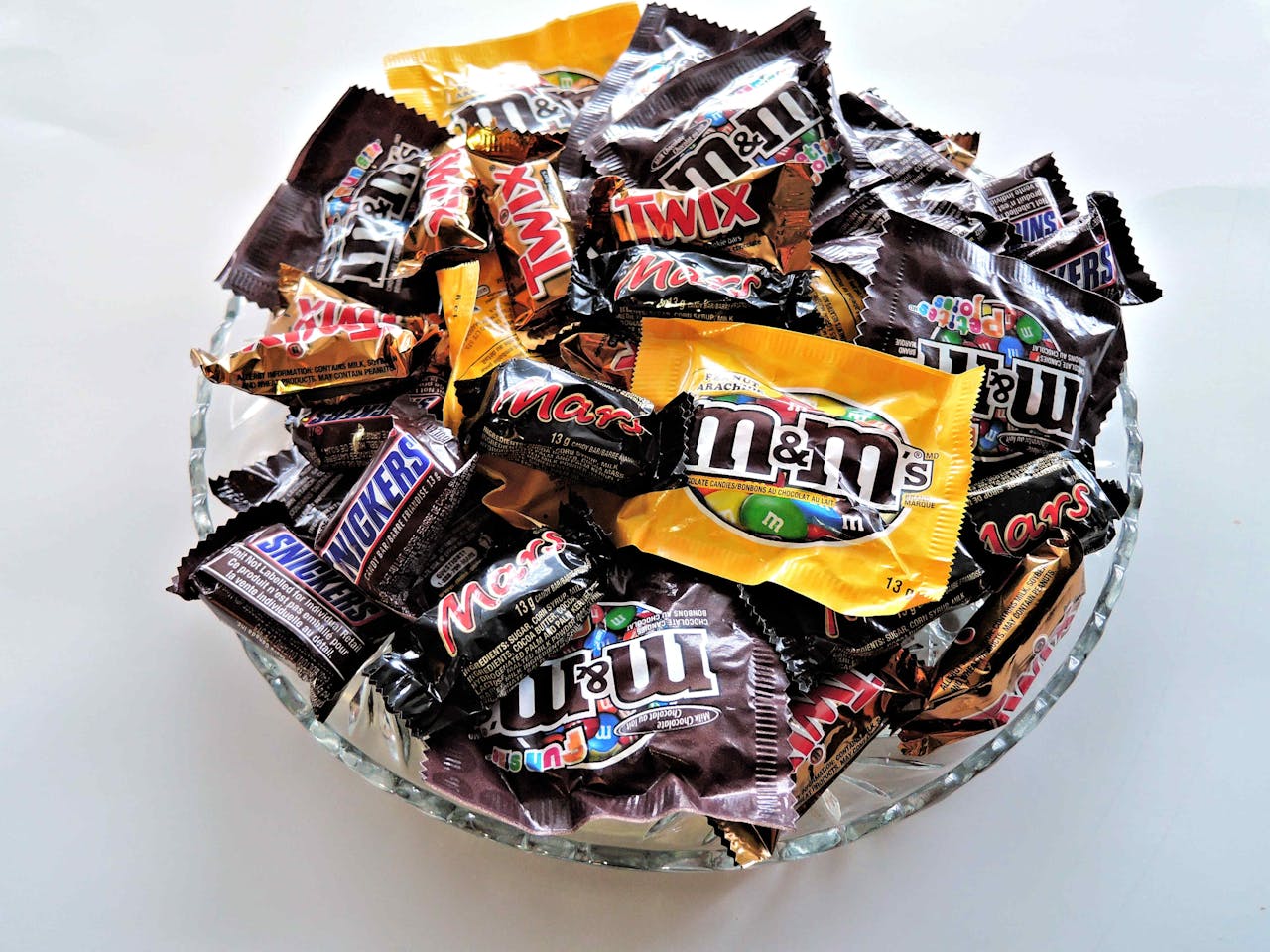
When done right, the result is a delicious Snickers bar, a popular Halloween – or anytime – candy. (Pexels Photo)
By Richard Hartel, University of Wisconsin-Madison, The Conversation
It’s Halloween. You’ve just finished trick-or-treating and it’s time to assess the haul. You likely have a favorite, whether it’s chocolate bars, peanut butter cups, those gummy clusters with Nerds on them or something else.
For some people, including me, one piece stands out – the Snickers bar, especially if it’s full-size. The combination of nougat, caramel and peanuts coated in milk chocolate makes Snickers a popular candy treat.
As a food engineer studying candy and ice cream at the University of Wisconsin-Madison, I now look at candy in a whole different way than I did as a kid. Back then, it was all about shoveling it in as fast as I could.
Now, as a scientist who has made a career studying and writing books about confections, I have a very different take on candy. I have no trouble sacrificing a piece for the microscope or the texture analyzer to better understand how all the components add up. I don’t work for, own stock in, or receive funding from Mars Wrigley, the company that makes Snickers bars. But in my work, I do study the different components that make up lots of popular candy bars. Snickers has many of the most common elements you’ll find in your Halloween candy.
Let’s look at the elements of a Snickers bar as an example of candy science. As with almost everything, once you get into it, each component is more complex than you might think.
Airy nougat
Let’s start with the nougat. The nougat in a Snickers bar is a slightly aerated candy with small sugar crystals distributed throughout.
One of the ingredients in the nougat is egg white, a protein that helps stabilize the air bubbles that provide a light texture. Often, nougats like this are made by whipping sugar and egg whites together. The egg whites coat the air bubbles created during whipping, which gives the nougat its aerated texture.
A boiled sugar syrup is then slowly mixed into the egg white sugar mixture, after which a melted fat is added. Since fat can cause air bubbles to collapse, this step has to be done last and very carefully.
The final ingredient added before cooling is powdered sugar to provide seeds for the sugar crystallization in the batch. The presence of small sugar crystals makes the nougat “short” – pull it apart between your fingers and it breaks cleanly with no stretch.
Chewy caramel
On top of the nougat layer is a band of chewy caramel. The chewiness of the caramel contrasts the nougat’s light, airy texture, which provides contrast to each bite.
Caramel stands out from other candies as it contains a dairy ingredient, such as cream or evaporated milk. During cooking, the milk proteins react with some of the sugars in a complex series of reactions called Maillard browning, which imparts the brown color and caramelly flavor.
Maillard browning starts with proteins and certain sugars. The end products of these reactions include melanoidins, which are brown coloring compounds, and a variety of flavors. The specific flavor molecules depend on the starting materials and the conditions, such as temperature and water content.
Commercial caramel, like that in the Snickers bar, is cooked up to about 240-245 degrees Fahrenheit (115-118 degrees Celsius), to control the water content. Cook to too high a temperature and the caramel gets too hard, but if the cook temperature is too low, the caramel will flow right off the nougat. In a Snickers bar, the caramel needs to be slightly chewy so the peanuts stick to it.
Chocolate coating
To make chocolate, raw cocoa beans are harvested from cacao pods and then fermented for several days. After the fermented beans are dried, they are roasted to develop the chocolate flavor. As in caramel, the Maillard browning reaction is an important contributor to the flavor of chocolate.
The milk chocolate coating on the Snickers bar happens through a process called enrobing. The naked bar, arranged on a wire mesh conveyor, passes through a curtain of tempered liquid chocolate, covering all sides with a thin layer. Tempering the chocolate coating makes it glossy and gives it a well-defined snap.
The flow of the tempered chocolate needs to be controlled precisely to give a coating of the desired thickness without leading to tails at the bottom of the candy bar.
The Snickers bar
When done right, the result is a delicious Snickers bar, a popular Halloween – or anytime – candy.
With about 15 million bars made each day, getting every detail just right requires a lot of scientific understanding and engineering precision.
Richard Hartel, Professor of Food Science, University of Wisconsin-Madison
This article is republished from The Conversation under a Creative Commons license. Read the original article.




















