Headline
De Lima: Duterte drug war modeled after Davao Death Squad

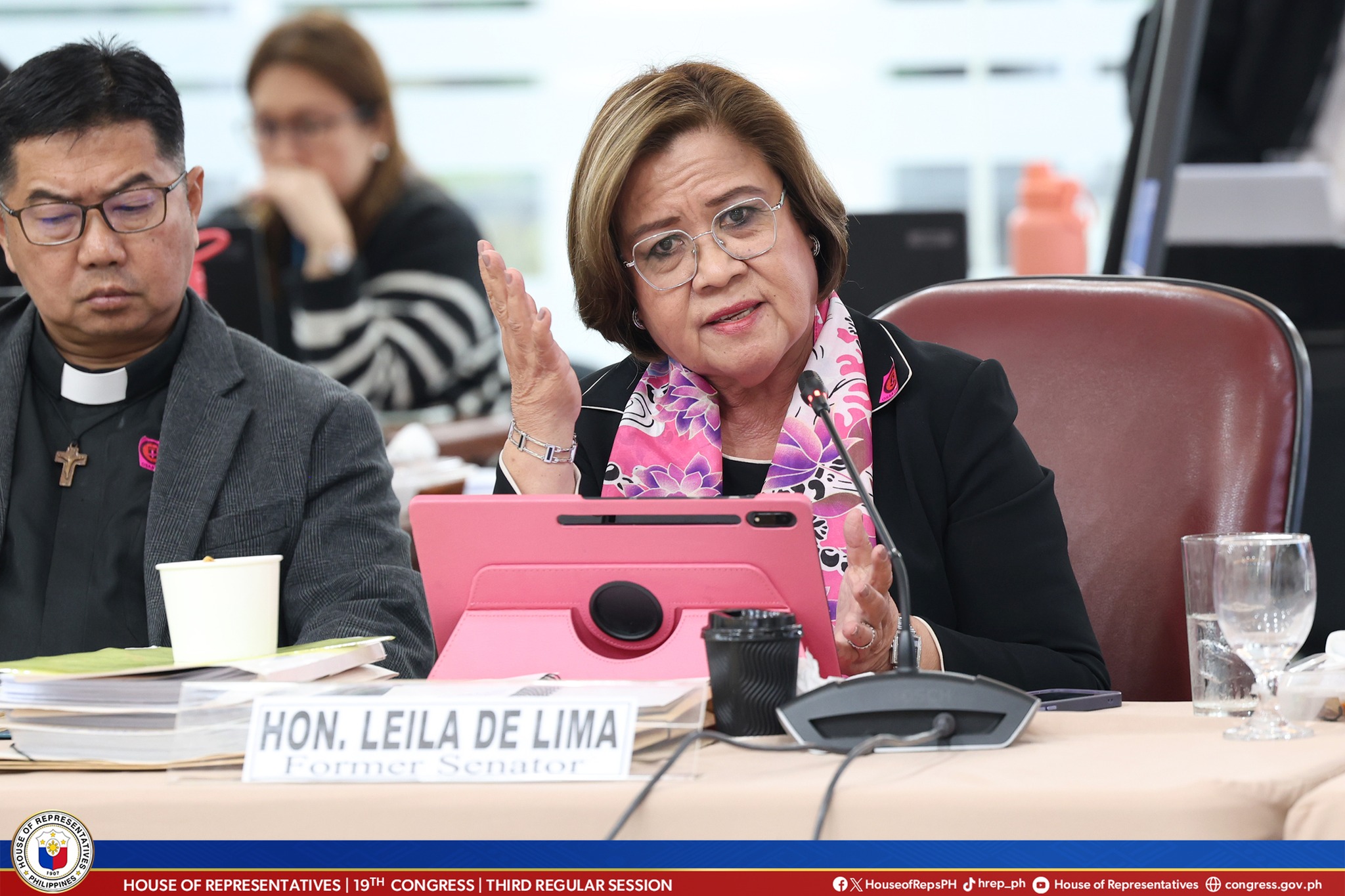
DAVAO MODEL. Former senator Leila De Lima testifies before the House of Representatives quad committee hearing on Tuesday (Oct. 22, 2024). De Lima reaffirmed former Philippine Charity Sweepstakes Office general manager Royina Garma’s claim that the drug war of former president Rodrigo R. Duterte was modeled after the so-called Davao Death Squad. (Photo: House of Representatives of the Philippines/Facebook)
By Zaldy De Layola, Philippine News Agency
MANILA – Former senator and Justice secretary Leila De Lima on Tuesday echoed former Philippine Charity Sweepstakes Office general manager Royina Garma’s claim that the drug war of ex-president Rodrigo R. Duterte was patterned after the so-called Davao Death Squad (DDS).
During the House quad committee (quadcom) investigation on extrajudicial killings (EJKs) linked to Duterte’s bloody campaign against illegal drugs, de Lima said the reward system used to incentivize killings in Davao City was expanded nationwide during Duterte’s presidency, leading to devastating consequences.
She called it the Davao Model, allegedly used by Duterte to fight illegal drugs during his term as Davao City mayor.
The party-list candidate said the DDS operated in two distinct periods — from 1988 to 1998 when Duterte first served as Davao mayor and 2001 to 2016 when the DDS transformed into the official Heinous Crimes Investigation Section under the Davao City Police Office.
Rewards system
During the first period, assassins composed of rebel returnees and Philippine National Police (PNP) officers were paid approximately PHP15,000 for each killing.
Of this, PHP5,000 went to police handlers and PHP10,000 was split among the assassins.
“Their safehouse was located inside the Napolcom (National Police Commission) compound in Barangay San Pedro,” de Lima recounted. “After the summary execution of targeted victims, the DDS members regrouped at their safehouse and divided the reward.”
De Lima further detailed how Duterte himself played a hands-on role.
“Duterte sometimes personally gave out the kill orders and the reward money directly to the assassins themselves,” she alleged.
During the second period, rewards ranged between PHP13,000 and PHP15,000 per killing.
The payment was divided, with PHP3,000 to PHP5,000 going to police handlers and the rest split among the civilian “abanteros” or hitmen, who were typically rebel returnees.
“A team of one PNP handler and three civilian abanteros was given an average of three targets every month,” de Lima claimed.
De Lima said the structure of the DDS was not confined to Davao City as Duterte replicated the Davao Model nationwide during his presidency.
Operators
She claimed that Duterte’s trusted police officers from Davao, including then-PNP chief Senator Ronald Dela Rosa, were appointed to key positions in major urban cities to lead the campaign of killings under the pretext of anti-drug operations.
“Duterte used the Davao system of barangay-based lists of victims,” de Lima said. “Barangay officials were required to identify drug offenders in their communities, who were then targeted in riding-in-tandem operations by death squads and official nanlaban (fought back) operations conducted by the PNP.”
De Lima stressed that the Commission on Human Rights (CHR) investigation into the DDS, conducted in 2009, was crucial in understanding how Duterte’s death squads operated.
“The CHR investigation provides crucial insight into how Duterte organizes his death squads using active police officials as their leaders,” de Lima, then the CHR chair when the constitutional body conducted its probe into the DDS, said.
The CHR investigation also shed light on the incentive system for the death squads, revealing how intelligence funds were used to finance logistics and rewards for the killings.
The DDS was not a loosely connected group of killers but a highly structured and state-backed death squad, according to the former senator.
“Most of our unofficial findings in the CHR investigation were eventually confirmed by Edgar Matobato and Arturo Lascañas,” De Lima said, referring to the former DDS insiders who testified about the group’s inner workings.
Matobato is a self-confessed hitman who publicly exposed the operations of the DDS in 2016.
His revelations were supported by Lascañas, a former senior police officer who later came forward to corroborate the existence of the DDS and its operational methods.
Lascañas, in particular, submitted a detailed 186-page affidavit to the International Criminal Court, which de Lima described as “the most comprehensive account on the DDS from its founding in 1988 up to 2016.”
In the affidavit, Lascañas identified Duterte, codenamed Superman, as the leader and mastermind of the DDS.
“MRRD (Mayor Rodrigo Roa Duterte) alias Superman was the highest leader and mastermind of the DDS,” de Lima quoted from the affidavit.
The affidavit also named SPO4 Sanson Buenaventura as the logistics and finance officer who handled the clearance for death squad operations, and SPO3 Lascañas as the overall team leader for operations and planning.
Lascañas said the death squad’s finances came from the Peace and Order or intelligence fund of Duterte’s office.
The fund provided weekly gas allowances, monthly cash stipends, and other incentives for the hitmen, who were tasked with eliminating both petty criminals and high-value targets.
“In so-called special project killings, they were rewarded anywhere from PHP100,000 to PHP1 million, depending on the status of the target,” de Lima revealed, quoting Lascañas’ affidavit.
Lascañas confirmed that the DDS maintained mass graves, including the Laud Quarry and the Mandug site, where the remains of the victims were disposed of, a detail corroborated by other testimonies.
Evidence
In her testimony, de Lima also referenced Garma’s affidavit, presented during a previous hearing, which described a similar reward system.
Garma worked closely with the DDS even before 2016, according to De Lima.
This link between the Davao Model and Duterte’s national drug war was critical to understanding how extrajudicial killings were incentivized and executed on a larger scale.
De Lima urged legislators to consider the CHR’s findings and the testimonies of Matobato and Lascañas as crucial evidence.
She emphasized that accountability must be sought for the thousands of victims killed during Duterte’s drug war.