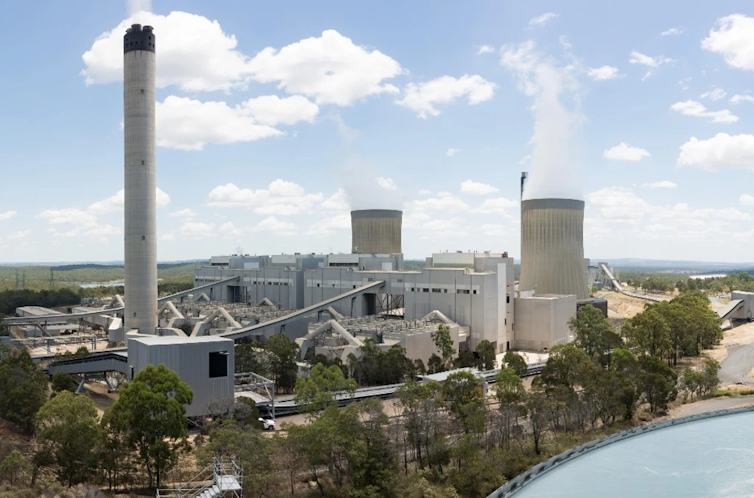
Stanwell
By Anne Twomey, University of Sydney, The Conversation
Queensland Premier Steven Miles this week declared his party would hold a plebiscite on nuclear power if it returns to office at the forthcoming state election.
The move is in response to plans by the federal Coalition to build and operate seven nuclear plants around Australia if elected to government. Opposition Leader Peter Dutton says the facilities would be built at sites of coal power stations scheduled for closure. Two are slated for Queensland, at the Callide and Tarong power stations.
Queensland has state laws banning the construction or operation of a nuclear facility and requiring the state government to hold a plebiscite if there are Commonwealth plans to build a nuclear plant in the state. A plebiscite is a referendum-style vote to gauge voters’ views on an issue.
Unlike a referendum, the results are not binding. There’s also very little chance a plebiscite could be held on or before the date of the next federal election, as Miles has suggested, as the laws do not allow for a plebiscite on an opposition policy.
Who has the constitutional power over nuclear facilities?
While the Commonwealth Constitution does not refer to nuclear energy, the federal parliament has passed laws to regulate nuclear matters. To do so, it relies on a web of constitutional powers, including the trade and commerce power, the corporations power, the external affairs power and the territories power.
The Commonwealth can also compulsorily acquire land for public purposes. This makes the land a “Commonwealth place” over which it can exercise full and exclusive legislative power.
The federal government has previously engaged in commercial matters by establishing trading corporations, such as NBN Co and Snowy Hydro Ltd, to deal with nation-building infrastructure.
It seems likely, therefore, that the federal parliament could pass laws to authorise and regulate the operation of nuclear power plants in Australia.
In doing so, its laws would override inconsistent state laws, such as those that prohibit nuclear facilities, under section 109 of the Constitution.
But state governments could still make it difficult for the Commonwealth to give effect to its nuclear policies. You only have to look at how state governments have successfully opposed Commonwealth efforts to create a nuclear waste facility to see the problems.
Plebiscite as booby trap
The development of a nuclear power industry in Australia has been debated before – most recently in 2006 when the Howard Coalition government commissioned the Switkowski report on the use of nuclear energy in Australia.
This report suggested the Commonwealth could act to establish 25 nuclear power stations across Australia. In response, Queensland’s parliament, under a Labor government, enacted the Nuclear Facilities Prohibition Act 2007. It banned the construction or operation of certain types of nuclear facilities in Queensland. New South Wales and Victoria had also previously done the same.
The Queensland government recognised the Commonwealth probably had the power to override such a ban. So it included a political booby trap in section 21 of the law.
It says that if the relevant Queensland minister is satisfied the Commonwealth government has taken, or is likely to take, any step supporting or allowing the construction of a prohibited nuclear facility in Queensland, the minister:
must take steps for the conduct of a plebiscite in Queensland to obtain the views of the people of Queensland about the construction of a prohibited nuclear facility in Queensland.
Unlike a referendum, which changes the Constitution, a plebiscite operates as an opinion poll.
It would not prevent a nuclear power plant being built, or stop the federal parliament overriding the state ban. But it could create a political impediment.
During the debate over the state law in 2007, then-Premier Peter Beattie made this point clearly:
If the Howard government wants to use its powers to override the strong position of Queenslanders […] this government will make certain that Queenslanders have a chance to have their say.
This was important, he claimed, because it would “put political pressure on the federal government to not go down this road”. In other words, the law can be used to apply political pressure.
Of plebiscites and federal elections
Miles suggested the plebiscite could be held the same day as the next federal election “to save people going to the polls twice”.
This could affect voting in the federal election by highlighting the impact of nuclear policies on Queensland. But if this is the tactic, Miles faces two problems.
First, Queensland law only triggers the plebiscite requirement when the relevant state minister is “satisfied the government of the Commonwealth” is likely to take a step in supporting or allowing the construction of a prohibited nuclear facility in Queensland.
But the minister could not legally be satisfied of this before the election outcome is known, as a policy of an opposition party does not amount to a proposed action of the “government of the Commonwealth”.
Second, section 394 of the Commonwealth Electoral Act 1918 says no state or territory election, referendum or vote can be held on the day of a Commonwealth election without the authority of the governor-general.
This ban was introduced in 1922, after holding state votes at the same time as federal elections resulted in a high informal vote due to different voting instructions.
The governor-general has given this permission only once, when the Northern Territory held a plebiscite on becoming a state on the same day as the 1998 federal election.
It’s doubtful the federal government would advise the governor-general to permit a partisan state plebiscite to be held on the same day as a federal election.

Queensland State Archives
Where does this leave us?
It’s unlikely Queensland could hold such a plebiscite at or before the next federal election.
But if the Coalition wins the next federal election and proceeds with its nuclear policy, Queensland would be obliged to hold a plebiscite – regardless of who wins the state election, unless its law was changed.
This would make clear how much support there was for nuclear power. A clear rejection wouldn’t have any legal effect, but could well achieve the same outcome through political pressure. We might also see other states follow suit to hold plebiscites on nuclear power, although none currently are legally obliged to do so.
Anne Twomey, Professor Emerita in Constitutional Law, University of Sydney
This article is republished from The Conversation under a Creative Commons license. Read the original article.