

By Philip Howell, University of Cambridge, The Conversation
General elections in Britain throw up some predictable news stories. For those, like myself, with an interest in animal history, some of the best are the familiar photo features of pets at polling stations. This is a recent tradition, now firmly established, that has proven handy for news outlets that have to wait until the polls have closed for serious reporting.
Party affiliation is sometimes apparent in the form of colours and rosettes and viewers can imagine that the appearance of a pack of foxhounds outside a polling station in rural Hampshire signifies the countryside Conservative vote. But these political animals largely provide light relief in times of political and social strife. There is a reassuring sense of political continuity, of business as usual, as well as a pleasingly British eccentricity. It’s hard not to smile.
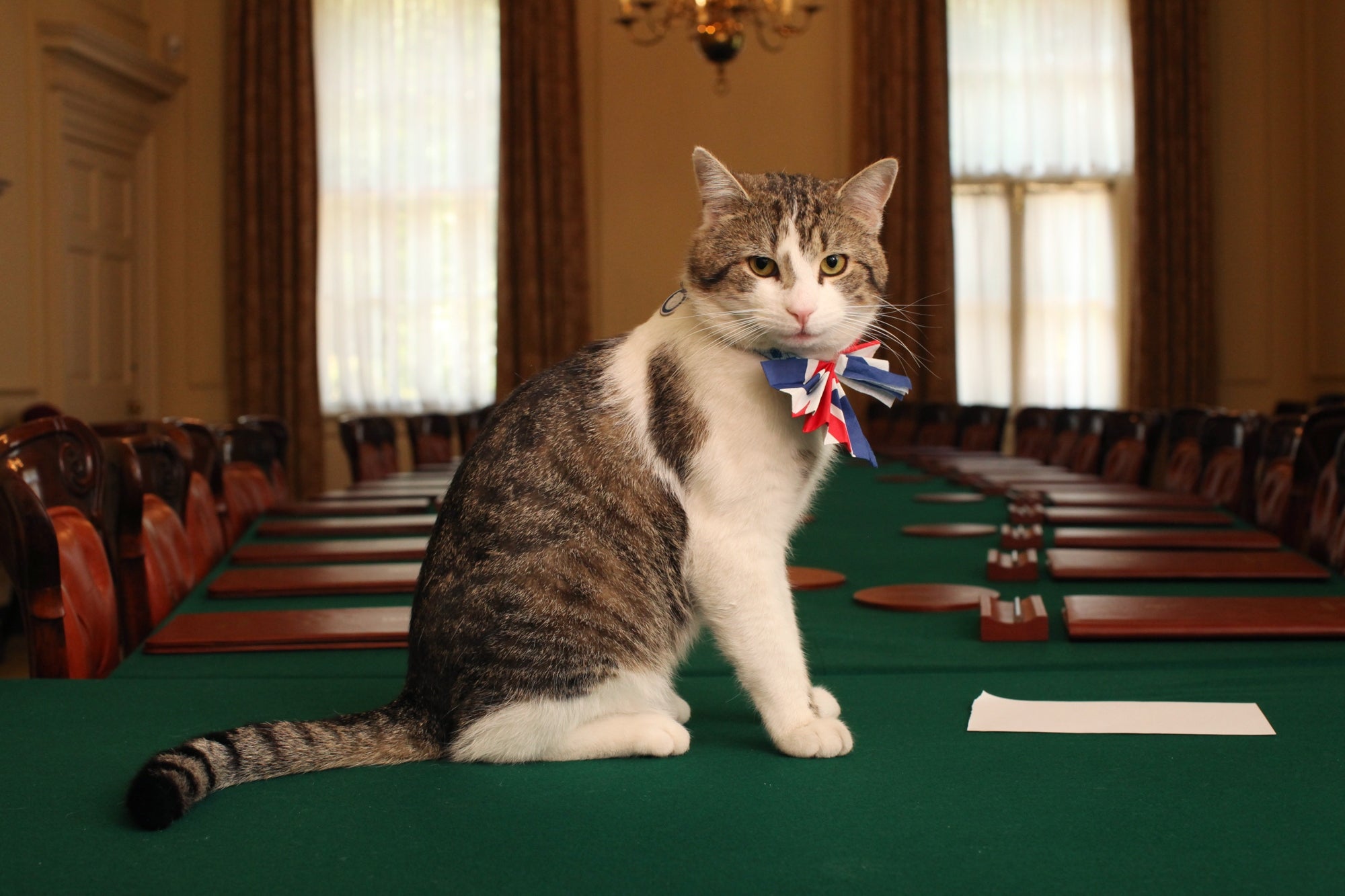
The same can be said of the political icon that is Larry the Cat, the rescued moggy that has been a resident at No 10 Downing Street for just over a decade. Larry was adopted in 2011 as a pet for then prime minister David Cameron’s children. But he has become something much more than that. Not just because he has official duties and the title of “chief mouser to the cabinet office”, but also because he stays at No 10 while prime ministers come and go.
Cameron left office in 2016 after the Brexit debacle, but Larry voted to remain. No longer personal property but a civil servant, Larry resumed his responsibilities under the premiership of Theresa May – even if she was more of a dog person.
In 2016, the Guardian imagined that Larry’s anxieties were about the possibility of Jeremy Corbyn becoming top dog: “My real worry is what happens if May calls an early election and Jezza wins. I hear he has a feline called El Gato and I really don’t fancy sharing this gaff. I didn’t vote to leave the EU only to end up with a Spanish housemate.” But, of course, the firebrand lefty lost out to Boris de Pfeffel Johnson.

Library of Congress
Other countries have more overtly partisan pets. US president Warren Harding’s airedale terrier Laddie Boy (1919-29) was described by historian Helen Pycior as the first of the “First Dogs of the land”.
Laddie Boy was an icon of loyalty and family even – or especially – for the Hardings, who didn’t have children. And the tradition of the “first dog” has survived. It was interrupted only by the dog-averse Donald Trump, but resumed with Joe Biden’s German shepherds – first Major and then the replacement puppy Commander, admittedly not without problems as both have proved to be serial biters.
Despite such incidents, and they have a long history, White House dogs are handy public relations assets. Sometimes, as with Franklin D. Roosevelt’s Fala or Richard Nixon’s Checkers, they may even have rescued political careers. Disliking dogs is demonstrably survivable, for sure, but mistreatment of dogs will probably stymie a political career, as potential Trump running mate Kristi Noem has recently discovered.
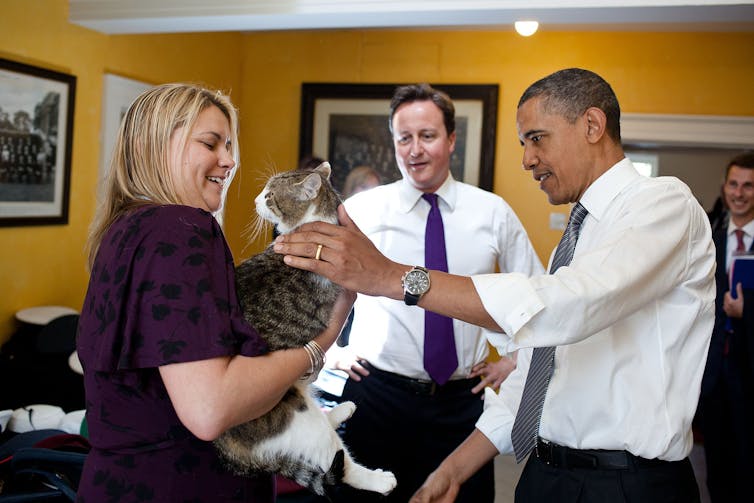
For the most part, Larry the chief mouser seems to rise above this kind of political exploitation. Tracing the history of what we might call the first cat in the land is fraught with difficulty and the lists of cats in the corridors of power tend to run together with the various offices of state. But Larry’s chief mouser predecessors go back at least to 1924 with a cat called Rufus of England – also known as Treasury Bill.
Pete Souza/White House
Chris Day of the British National Archives notes the promotion of celebrity government cats and the idea that as feline government employees they deserved to be officially recognised and rewarded. More recent chief mousers include the No 10 residents Wilberforce, who takes us from the premiership of Edward Heath to that of Margaret Thatcher, and his successor Humphrey, from Thatcher to the Tony Blair years. These cats were already part of a political culture that promoted celebrity cats at the heart of British politics.
Astonishingly, Larry has now seen in his sixth prime minister, and compared to the 50 days of Liz Truss, he feels like a genuine political heavyweight. Indeed, The Standard called him the “one figure of stability in the last 14 years of political turmoil”.
It’s clear that he isn’t just a civil servant: there is something distinctly presidential about Larry. For all the Guardian’s snark, Larry is seemingly above politics, flying the flag and cosying up to foreign dignitaries when required, but mostly staying above the fray.
The street-fighting former stray occasionally scraps with rivals like Palmerston of the foreign office, or on one famous occasion seeing off a trespassing fox. But – like the royal family – Larry mainly provides the pliant media with the more heartwarming kinds of digital content.
Partisanship is not wholly absent: the sociologist Robert Ford published a study that demonstrated that Conservative voters liked former chief mousers more if they were told that they belonged to Thatcher, while Labour voters preferred cats assigned to Blair. So even celebrity cats are not immune to the halo and horn effects.
But the current incarnation of the chief mouser surely signifies stability in an age of political upheaval. Larry’s unofficial social media feed once reminded the world that he had been in office longer than any of the political party leaders. It seems his run as the political world’s favourite feline won’t be ending any time soon.

Looking for something good? Cut through the noise with a carefully curated selection of the latest releases, live events and exhibitions, straight to your inbox every fortnight, on Fridays. Sign up here.
Philip Howell, Professor of Geography, University of Cambridge
This article is republished from The Conversation under a Creative Commons license. Read the original article.






















