

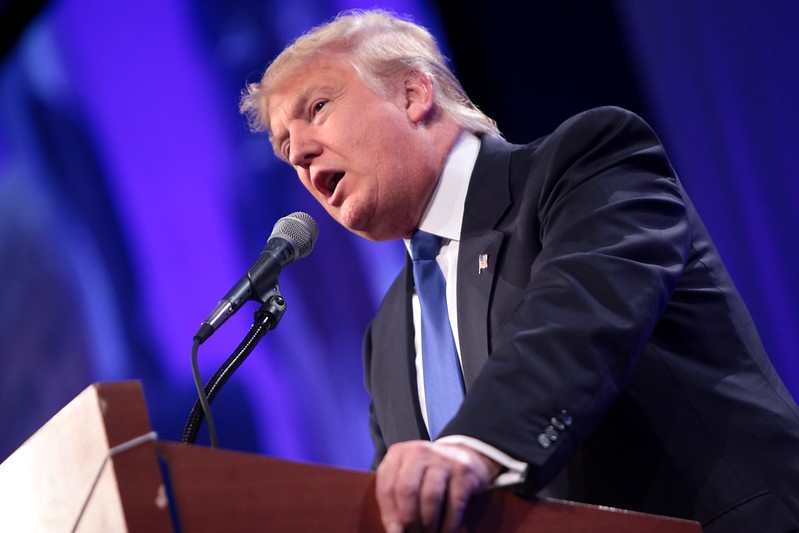
FILE: Donald Trump speaking at the Iowa Republican Party’s 2015 Lincoln Dinner at the Iowa Events Center in Des Moines, Iowa. (Photo by Gage Skidmore/Flickr, CC BY-SA 2.0)
Though Hollywood movies about courtroom dramas often glamorize the closing arguments given by lawyers, in reality the opening statement is likely the most important single event of a trial.
Such was the case in the hush money trial involving former President Donald Trump and alleged payments to porn star Stormy Daniels when lawyers for both sides presented their opening statements on April 22, 2024, in New York.
In this case, Manhattan District Attorney Alvin Bragg charged the former president with 34 felony counts of falsifying business records as part of an effort to influence voters’ knowledge about him before the 2016 presidential election. Trump entered a plea of not guilty.
During his opening argument, prosecutor Matthew Colangelo told the jury that Trump was part of a conspiracy to conceal negative information about him in order to help get him elected. “Then he covered up that conspiracy by lying in his New York business records, over and over and over again,” Colangelo said.
For Trump’s defense, lawyer Todd Blanche was direct. “President Trump did not commit any crimes.”
Blanche explained that Trump was “not involved and unaware” about the specifics of the hush-money payments because he left it all to Michael Cohen, his former lawyer and fixer who is expected to testify for the prosecution. Blanche described Cohen as being a “criminal” who was “obsessed” with Trump and looking to take personal revenge.
How will these contrasting opening arguments play on the jury?
Academic psychologists tell us that between 65% and 75% of jurors make up their minds about a case after the opening statement. What’s even more incredible is that 85% of those jurors maintain the position they formed after the opening statement once all evidence is received and the trial is closed.
More often than not, it is too late by closing arguments to win over the jury.
This phenomenon comes as no surprise to veteran trial lawyers. They are aware of two theories that define how jurors – indeed, people generally – process information: the concepts of primacy and recency.
These ideas suggest that jurors best remember what they hear first and what they hear last. It is vitally important, then, for lawyers on both sides to start their opening arguments with a bang.
The psychology of jurors
I have taught a course on trial advocacy for the past two decades at Harvard Law School. Part of my curriculum is to teach budding lawyers how to deliver effective opening statements.
If the idea is to win over the jury by the end of the lawyer’s opening statement, how, in practice, is that done?
Trial lawyers steeped in the research know that juries respond to a well-considered theory of the case, punctuated by a pithy theme.
A theory of the case is a brief, three- to five-sentence statement akin to what is known as an “elevator pitch.” The theme is a short, pithy summary of the theory of the case that is easy for a juror to remember. Often the theme is the first sentence out of the lawyer’s mouth, followed by a fuller description of the theory.
Indeed, in my class at Harvard, the very first skill I teach is how to develop theories and themes. In order to effectively convey a theory in a case, many lawyers start their opening statements with “This is a case about…” and then fill in the specific details.
So it went on the first day of Trump’s trial.
“This case is about a criminal conspiracy and fraud,” Colangelo, the prosecutor, told the jury. “The defendant, Donald Trump, orchestrated a criminal scheme to corrupt the 2016 presidential election.”
In stark contrast, Trump’s defense lawyers said: “There’s nothing wrong with trying to influence an election. It’s called democracy.”
Though prosecutors have tried to put a “sinister” spin on this, Blanche said jurors will learn it’s not a crime.
In each example, the jury is given enough information to frame the evidence they will hear throughout the trial.
After both sides have finished their openings, data shows that more than two-thirds of the jury will have come to a decision that will persist through the remainder of the trial.
Why do juries tend to behave this way?
Research also has taught trial lawyers that if you connect the jury with your theory of a case at the beginning of the trial, jurors will process all the rest of the evidence – whether potentially helpful to the prosecution or to the defense – through the prism of that theory.
The importance of opening statements cannot be overstated. They set the tone and offer the jury a framework to understand the upcoming months of testimony they are about to hear.
Material used in this story was originally published on April 22, 2024.
Ronald S. Sullivan Jr., Professor of Law, Harvard University
This article is republished from The Conversation under a Creative Commons license. Read the original article.




















