

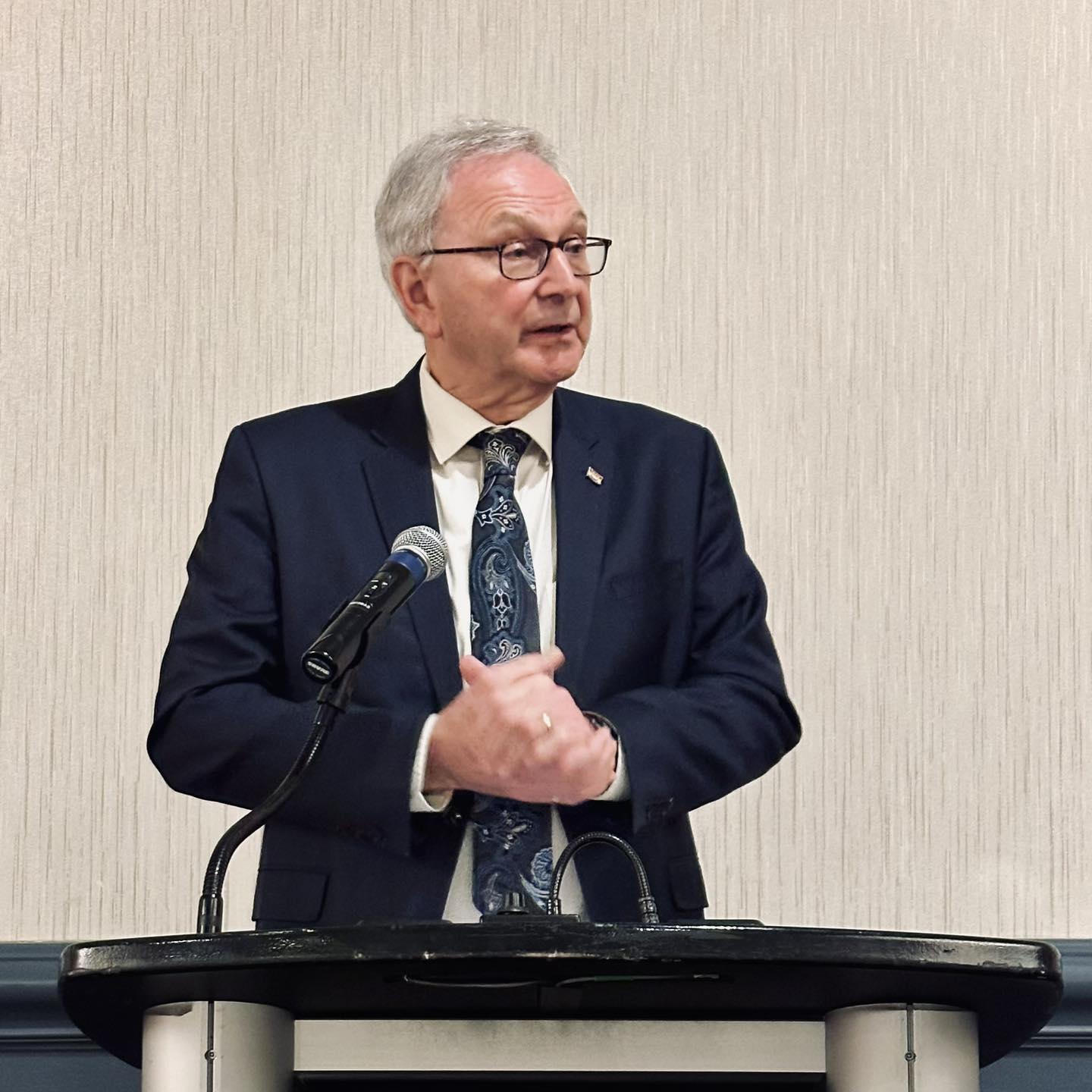
The Higgs government has not even attempted to rationalize the proposed legislation as rights-enhancing. (File Photo: Blaine Higgs/Facebook)
New Brunswick Premier Blaine Higgs recently mused about invoking the notwithstanding clause — Section 33 of the Charter of Rights and Freedoms — when his government introduces what it calls the Compassionate Intervention Act in May.
While the government has provided scant details, the new law would permit people with addictions to be detained involuntarily for forced treatment.
If Higgs follows through on his veiled threat, it would represent the most blatant attempt yet by a provincial government to distort the purpose of the notwithstanding clause. It may also motivate the Supreme Court of Canada to rethink its hands-off approach to Section 33, outlined in its 1988 Ford v Québec decision.
In that ruling, the court said judges can only assess whether laws validly invoke the notwithstanding clause; they must state explicitly that they are operating “notwithstanding” some or all of the rights covered by Section 33, including fundamental freedoms, legal rights and equality. Judges cannot look behind these laws and assess whether legislatures had good enough reasons to override rights.
The court also ruled that the pre-emptive invocation of the clause — made before a judge rules on a law’s Charter compliance — is entirely permissible.
Constitutionality fears
The New Brunswick government is right to be concerned about the Compassionate Intervention Act’s constitutionality.
Writing for the Canadian Bar Association (New Brunswick), I argue it will be difficult to craft a piece of legislation that doesn’t violate multiple Charter rights — the right to liberty and security of the person under Section 7, protection against discrimination under Section 15 and protection against arbitrary detention under Section 9.
Government supporters defend the bill in the language of care, but there is little evidence involuntary treatment works over the long term.
In fact, one study shows people released from involuntary treatment have a heightened risk of overdosing and dying, while many experts consider internal motivation critical to maintaining sobriety.
After a period of abstention, an individual’s lowered tolerance to the drugs they use can also prove lethal, as the death of Glee star Cory Monteith illustrates.
Mental health care shortage
There is a months-long wait list for voluntary addictions treatment in New Brunswick and a chronic shortage of both housing and mental health care.
A new addiction treatment centre has opened in the province, but Addictions and Mental Health Minister Sherry Wilson has said those who face being detained for treatment will not be housed there.
New Brunswick is a striking example of the vicious circle of residents experiencing income inequality, with the lowest social assistance payments in the country, increasing harms from addiction and lack of government supports — particularly for housing — to allow them to live with dignity.
If the province is serious about eliminating deaths from addiction, the answer, according to a recent study, lies instead in battling income inequality.
Tough on crime?
What is the point of the propose New Brunswick law, then?
Comments by Public Safety Minister Kris Austin provide a clue. In speaking about the proposed law, he pointed to a link between crime and addiction.
But drug-related offences are declining in New Brunswick, and they currently account for less than three per cent of crimes committed in the province.
In the absence of any evidence that the law will propel those with addictions into long-term recovery, it seems the new law is simply performance art. It allows the government to provide a vivid — if harsh and ineffectual — example of how it is “tough on crime.”
In the more distant past, most governments that invoked the notwithstanding clause have at least paid lip service to the Charter, arguing their use of Section 33 was to protect rights-enhancing legislation, to reconcile competing rights or to course-correct a court ruling that the legislature believed misinterpreted the Charter.
This aligns with the purpose of the clause, which constitutional law professor Eric Adams and lawyer Erin Bower say is aimed at reducing rights violations by mandating transparency and democratic accountability. The historical record shows that the Charter’s authors did not want the notwithstanding clause to be used for legislative free-for-alls that trample the rights of vulnerable groups.
Heeding Charter rights
The Higgs government has not even attempted to rationalize the proposed legislation as rights-enhancing. While it may be completely disingenous, proponents of Québec’s religious symbols ban, Bill 21, have at least resorted to justification based on the province’s collective cultural rights. That’s why I consider the proposed use of the clause by the Higgs’ government as something novel and particularly concerning.
The Compassion Intervention Act could signify the beginning of the end of any meaningful attempt by governments to heed Charter rights. Or, ironically, it could be what spurs the Supreme Court to save the Charter by establishing guardrails on the notwithstanding clause’s use.
The court could, for instance, insist governments adopt robust processes of consultation with the public before invoking Section 33, forbid its pre-emptive use or preclude calculated attempts to disregard core constitutional guarantees.
Its first chance to change course could happen if and when it hears the challenge to Québec’s Bill 21. The court should use that opportunity to reconsider the notion that lawmakers have the power to invoke Section 33 and override the rights of any Canadian at any time, for any reason, simply because they can.
Kerri Anne Froc, Associate Law Professor, University of New Brunswick
This article is republished from The Conversation under a Creative Commons license. Read the original article.




















